Köpf Marius, Nasehi Ramin, Kreimendahl Franziska, Jockenhoevel Stefan, Fischer Horst
Department of Dental Materials and Biomaterials Research (ZWBF), RWTH Aachen University Hospital, Aachen, Germany.
Department of Biohybrid and Medical Textiles (BioTex), Institute of Applied Medical Engineering, Helmholtz Institute Aachen, RWTH Aachen University, Aachen, Germany.
Int J Bioprint. 2022 Aug 18;8(4):606. doi: 10.18063/ijb.v8i4.606. eCollection 2022.
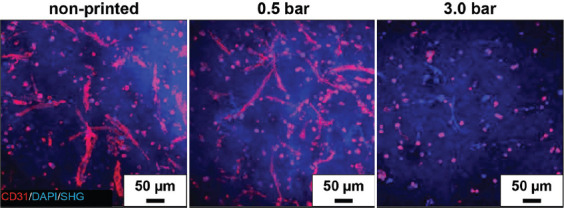
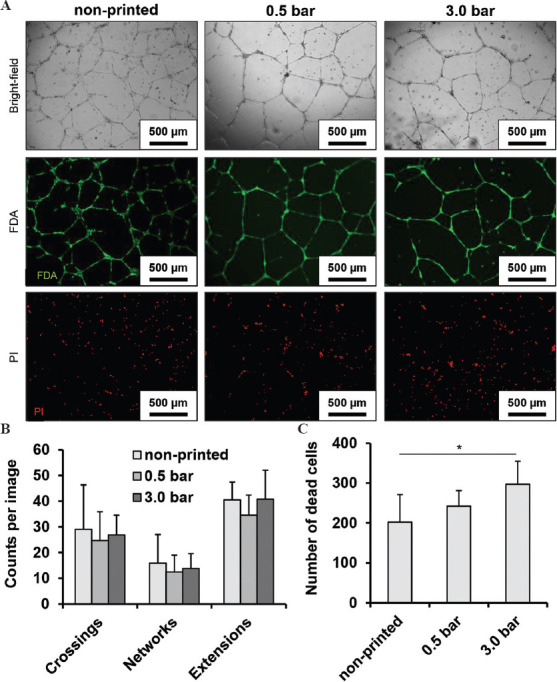
Bioprinting-associated shear stress and hydrostatic pressure can negatively affect the functionality of dispensed cells. We hypothesized that these mechanical stimuli can potentially affect the angiogenic potential of human umbilical vein endothelial cells (HUVECs). A numerical simulation model was used to calculate the shear stress during microvalve-based droplet ejection. The impact of different levels of applied pressure and the resulting shear stress levels on the angiogenic potential of HUVECs was investigated after up to 14 days of cultivation. results showed that bioprinting-associated stress not only has short-term but also long-term effects. The short-term viability results indicate a 20% loss in post-printing cell viability in samples printed under the harshest conditions compared to those with the lowest shear stress level. Further, it was revealed that even in two-dimensional culture, HUVECs were able to form a capillary-like network organization regardless of bioprinting pressure. In three-dimensional culture experiments; however, the HUVECs printed at 3 bar were not able to form tubular structures due to their exposure to high shear stress levels. In conclusion, this study provides new insights into how the bioprinting process should be conducted to control printing-associated shear stress and hydrostatic pressure to preserve the functionality and angiogenetic potential of HUVEC.
生物打印相关的剪切应力和静水压力会对所分配细胞的功能产生负面影响。我们假设这些机械刺激可能会影响人脐静脉内皮细胞(HUVECs)的血管生成潜力。使用数值模拟模型来计算基于微阀的液滴喷射过程中的剪切应力。在培养长达14天后,研究了不同施加压力水平和由此产生的剪切应力水平对HUVECs血管生成潜力的影响。结果表明,生物打印相关应力不仅具有短期影响,还具有长期影响。短期活力结果表明,与剪切应力水平最低的样品相比,在最苛刻条件下打印的样品在打印后细胞活力损失20%。此外,研究发现即使在二维培养中,HUVECs也能够形成类似毛细血管的网络组织,而与生物打印压力无关。然而,在三维培养实验中,在3巴压力下打印的HUVECs由于暴露于高剪切应力水平而无法形成管状结构。总之,本研究为如何进行生物打印过程以控制与打印相关的剪切应力和静水压力,从而保持HUVECs的功能和血管生成潜力提供了新的见解。