Bulka Catherine M, Eaves Lauren A, Gardner Amaree J, Parsons Patrick J, Galusha Aubrey L, Roell Kyle R, Smeester Lisa, O'Shea T Michael, Fry Rebecca C
Department of Environmental Sciences and Engineering, Gillings School of Global Public Health, University of North Carolina at Chapel Hill, Chapel Hill, NC, United States.
Division of Environmental Health Sciences, Wadsworth Center, New York State Department of Health, Albany, NY, United States.
Front Epidemiol. 2022;2. doi: 10.3389/fepid.2022.958389. Epub 2022 Sep 7.
Prenatal exposures to metallic and metalloid trace elements have been linked to altered immune function in animal studies, but few epidemiologic studies have investigated immunological effects in humans. We evaluated the risk of bacterial sepsis (an extreme immune response to bacterial infection) in relation to prenatal metal/metalloid exposures, individually and jointly, within a US-based cohort of infants born extremely preterm.
We analyzed data from 269 participants in the US-based ELGAN cohort, which enrolled infants delivered at <28 weeks' gestation (2002-2004). Concentrations of 8 trace elements-including 4 non-essential and 4 essential-were measured using inductively coupled plasma tandem mass spectrometry in umbilical cord tissue, reflecting fetal exposures. The infants were followed from birth to postnatal day 28 with bacterial blood culture results reported weekly to detect sepsis. Discrete-time hazard and quantile g-computation models were fit to estimate associations for individual trace elements and their mixtures with sepsis incidence.
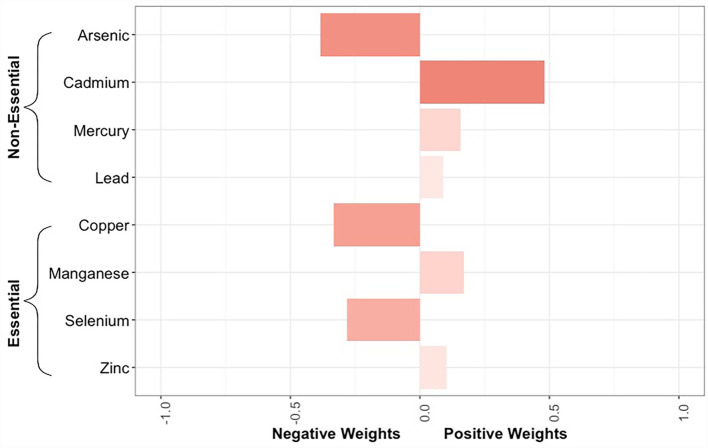
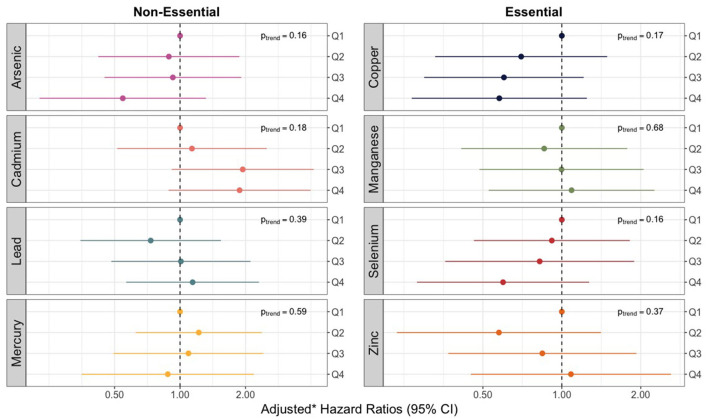
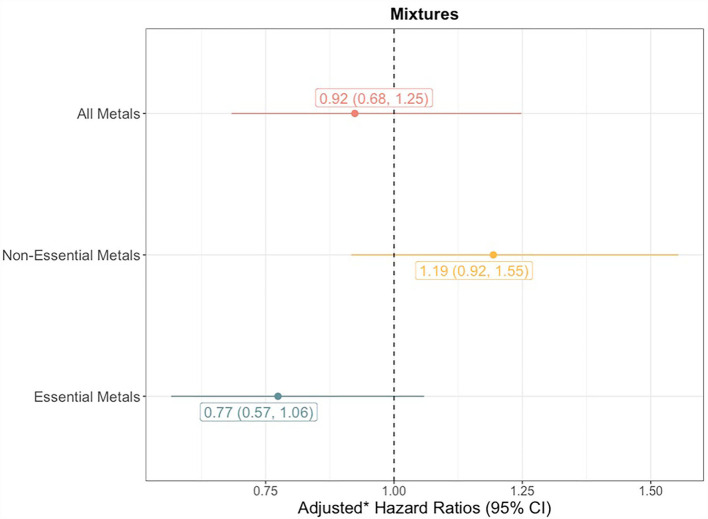
Approximately 30% of the extremely preterm infants developed sepsis during the follow-up period (median follow-up: 2 weeks). After adjustment for potential confounders, no trace element was individually associated with sepsis risk. However, there was some evidence of a non-monotonic relationship for cadmium, with hazard ratios (HRs) for the second, third, and fourth (highest) quartiles being 1.13 (95% CI: 0.51-2.54), 1.94 (95% CI: 0.87-4.32), and 1.88 (95% CI: 0.90-3.93), respectively. The HRs for a quartile increase in concentrations of all 8 elements, all 4 non-essential elements, and all 4 essential elements were 0.92 (95% CI: 0.68-1.25), 1.19 (95% CI: 0.92-1.55), and 0.77 (95% CI: 0.57-1.06). Cadmium had the greatest positive contribution whereas arsenic, copper, and selenium had the greatest negative contributions to the mixture associations.
We found some evidence that greater prenatal exposure to cadmium was associated with an increased the risk of bacterial sepsis in extremely preterm infants. However, this risk was counteracted by a combination of arsenic, copper, and selenium. Future studies are needed to confirm these findings and to evaluate the potential for nutritional interventions to prevent sepsis in high-risk infants.
在动物研究中,产前接触金属和类金属微量元素与免疫功能改变有关,但很少有流行病学研究调查其对人类的免疫影响。我们在美国一个极早产婴儿队列中,评估了产前金属/类金属暴露单独及联合与细菌性败血症(对细菌感染的极端免疫反应)风险的关系。
我们分析了美国ELGAN队列中269名参与者的数据,该队列纳入了妊娠<28周分娩的婴儿(2002 - 2004年)。使用电感耦合等离子体质谱法测量脐带组织中8种微量元素的浓度,包括4种非必需元素和4种必需元素,以反映胎儿暴露情况。对婴儿从出生到出生后第28天进行随访,每周报告细菌血培养结果以检测败血症。采用离散时间风险和分位数g计算模型来估计个体微量元素及其混合物与败血症发生率的关联。
在随访期间,约30%的极早产婴儿发生了败血症(中位随访时间:2周)。在调整潜在混杂因素后,没有单个微量元素与败血症风险相关。然而,有一些证据表明镉存在非单调关系,第二、第三和第四(最高)四分位数的风险比(HRs)分别为1.13(95%CI:0.51 - 2.54)、1.94(95%CI:0.87 - 4.32)和1.88(95%CI: