Endale Getu, Melis Tamirat, Dendir Andamlak, Lentiro Kifle, Sahle Tadesse
Department of Public Health, College of Medicine and Health Science, Wolkite University, Wolkite, Ethiopia.
Department of Nursing, Wolkite University, Wolkite, Ethiopia.
SAGE Open Med. 2022 Nov 14;10:20503121221133936. doi: 10.1177/20503121221133936. eCollection 2022.
United Nations International Children's Emergency Fund recommends a 100% growth monitoring and promotion coverage, but the prevalence of growth monitoring and promotion service utilization rate in Ethiopia is only 16.9%. Even though Ethiopia is attempting different strategies to cope up with this low rate, the problem is still unresolved.
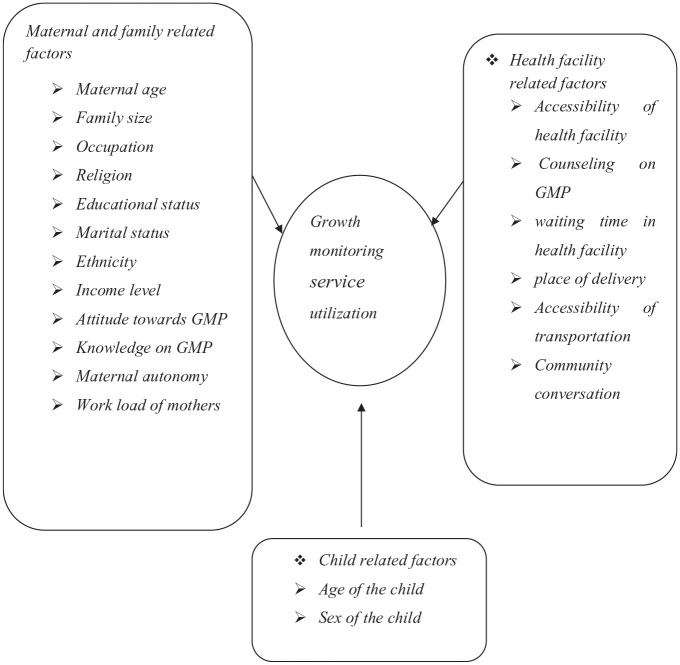
The aim of this study is to assess the prevalence of growth monitoring service utilization and its associated factors among mothers of children less than 2 years in Muhir Aklil district.
A community-based cross-sectional study was conducted on 443 study participants from 10 February to 8 March 2020. The study participants in the study were selected using simple random sampling technique. The collected data were entered in to EpiData3.1 and exported to SPSS version 23. Bivariate and multi-variable logistic regression analysis was used to identify factors associated with growth monitoring service utilization. Statistically significance was declared at p value < 0.05% and 95% confidence interval.
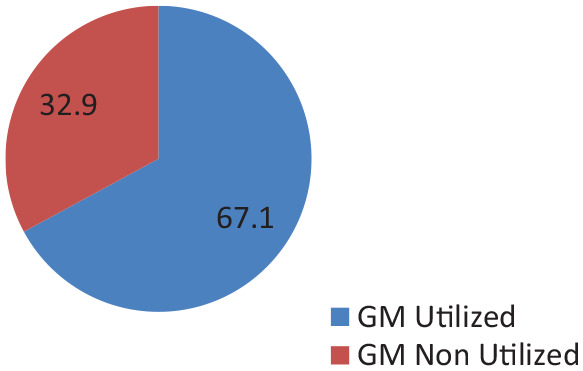
In this study, the overall growth monitoring and service utilization was 32.9%. Fully empowered mothers adjusted odds ratio: 2.7, 95% confidence interval: 1.5-4.3), receiving counseling (adjusted odds ratio: 2.8; 95% confidence interval: 2.0-4.7) and regularly participating on community conversation (adjusted odds ratio: 2.8, 95% confidence interval: 1.8-7.6) were significantly associated with growth monitoring service utilization.
Growth monitoring services utilization was 32.9%. Maternal empowerment on decision-making, engaging women on financial control, knowledge of mothers receiving counseling and regularly participating on community conversation were the independent factors for growth monitoring service utilization. The health extension workers should strengthen maternal empowerment and community conversation through increasing maternal awareness.
联合国国际儿童紧急基金会建议实现100%的生长监测与促进覆盖率,但埃塞俄比亚生长监测与促进服务的利用率仅为16.9%。尽管埃塞俄比亚正在尝试不同策略来应对这一低比率问题,但该问题仍未得到解决。
本研究旨在评估穆希尔·阿克利尔地区2岁以下儿童母亲的生长监测服务利用率及其相关因素。
2020年2月10日至3月8日,对443名研究参与者开展了一项基于社区的横断面研究。研究参与者采用简单随机抽样技术选取。收集的数据录入EpiData3.1并导出至SPSS 23版。采用双变量和多变量逻辑回归分析来确定与生长监测服务利用率相关的因素。p值<0.05%且置信区间为95%时具有统计学意义。
在本研究中,生长监测与服务的总体利用率为32.9%。完全赋权的母亲调整比值比:2.7,95%置信区间:1.5 - 4.3),接受咨询(调整比值比:2.8;95%置信区间:2.0 - 4.7)以及定期参与社区对话(调整比值比:2.8,95%置信区间:1.8 - 7.6)与生长监测服务利用率显著相关。
生长监测服务利用率为32.9%。母亲在决策方面的赋权、女性在财务控制方面的参与、母亲接受咨询的知识以及定期参与社区对话是生长监测服务利用率的独立因素。卫生推广工作者应通过提高母亲的意识来加强母亲赋权和社区对话。