Paramba Tanisha, Zilate Sarju
Pharmacology, Jawaharlal Nehru Medical College, Datta Meghe Institute of Medical Sciences, Wardha, IND.
Cureus. 2022 Oct 16;14(10):e30361. doi: 10.7759/cureus.30361. eCollection 2022 Oct.
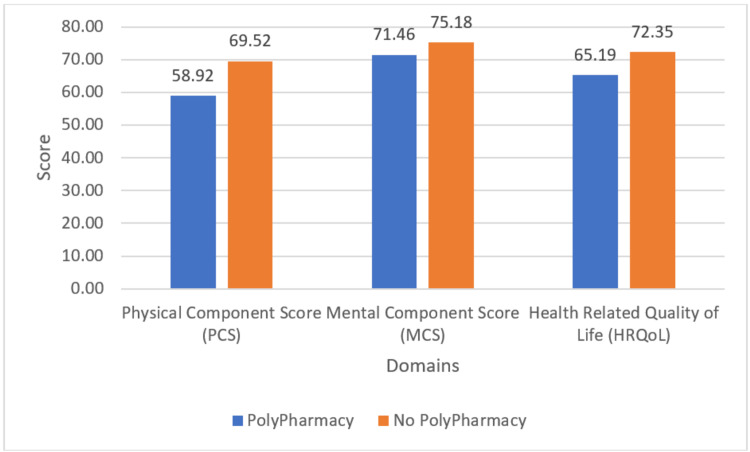
Introduction Hypertension is one of the major co-morbidities affecting older Indians, though current trends show that it is increasingly being diagnosed in younger adults as well. In elderly members of the population, it has been shown to be associated with other co-morbidities, making its management difficult. Among the issues that have arisen with its treatment is the increased prevalence of polypharmacy. Thus, there is a need to identify the issues arising from this increase in medications. In particular, the patient's health-related quality of life (HRQoL) can be assessed and interpreted to ensure only appropriate polypharmacy is practiced. Methods The adjusted Research and Development (RAND) 36-Item Health Survey 1.0 for health-related quality of life was sent to a consecutive sampling of 100 hypertensive patients at a rural tertiary care hospital in Wardha District. They were all clinically diagnosed with hypertension and had been prescribed allopathic medication for the same. They were instructed to answer all the questions to the best of their abilities, and each question was then scored from 0 to 100. In addition, they were given questions regarding their age, sociodemographic details, number of medications and frequency of dosage, and additional co-morbidities. The independent variable, i.e., the number of medications (polypharmacy), was then compared to the physical and mental scores they received on the 36-Item Short Form survey (SF-36) to see if there was an association between the two. Result The patients with hypertension that satisfied the criteria for polypharmacy scored lower in the Physical Component Score (PCS) of the HRQoL with a mean difference of 10.4 points. This is a significant value, and when studied in a multivariate linear regression model, controlling for the covariates mentioned above, indicated a statistically significant and negative association between the number of medications and adjusted PCS scores (β = -5.437, p<0.05, 95% CI -8.392 to -2.482). In regards to the Mental Component Score (MCS) of the HRQoL, a difference of 3.72 points was observed unadjusted and, upon controlling for covariates, it was found to be statistically significant (β = -2.825, p<0.05, 95% CI -5.300 to -0.351). Conclusion There is a negative correlation between HRQoL and polypharmacy in hypertensive patients. This is especially evident in the physical aspect, as can be inferred from the Physical Component Scores attained in the study. A smaller but still significant negative correlation is seen in the mental component as well. Hence, a change of policy is indicated to idealize prescriptions and physicians must be vigilant about inappropriate polypharmacy.
引言
高血压是影响印度老年人的主要合并症之一,不过目前的趋势表明,它在年轻成年人中也越来越多地被诊断出来。在老年人群体中,高血压已被证明与其他合并症有关,这使得其管理变得困难。在其治疗过程中出现的问题之一是多重用药的患病率增加。因此,有必要确定药物增加所引发的问题。特别是,可以评估和解读患者的健康相关生活质量(HRQoL),以确保仅实施适当的多重用药。
方法
将经过调整的用于健康相关生活质量的研发(RAND)36项健康调查1.0版发送给位于瓦尔达区一家农村三级护理医院的100名高血压患者的连续样本。他们均经临床诊断患有高血压,并已为此开具了对抗疗法药物。他们被要求尽最大能力回答所有问题,然后对每个问题从0到100进行评分。此外,还询问了他们的年龄、社会人口学细节、药物数量和用药频率以及其他合并症。然后将自变量,即药物数量(多重用药)与他们在36项简短问卷(SF - 36)中获得的身体和心理得分进行比较,以查看两者之间是否存在关联。
结果
符合多重用药标准的高血压患者在健康相关生活质量的身体成分得分(PCS)上较低,平均差异为10.4分。这是一个显著值,在多变量线性回归模型中进行研究时,控制上述协变量后,表明药物数量与调整后的PCS得分之间存在统计学上显著的负相关(β = -5.437,p<0.05,95%置信区间 -8.392至 -2.482)。关于健康相关生活质量的心理成分得分(MCS),未调整时观察到差异为3.72分,在控制协变量后,发现该差异具有统计学意义(β = -2.825,p<0.05,95%置信区间 -5.300至 -0.351)。
结论
高血压患者的健康相关生活质量与多重用药之间存在负相关。从研究中获得的身体成分得分可以推断,这在身体方面尤为明显。在心理成分方面也存在较小但仍显著的负相关。因此,需要改变政策以优化处方,医生必须警惕不适当的多重用药情况。