School of Public Health, Shanghai Jiao Tong University, School of Medicine, Shanghai, China.
Department of Occupational and Environmental Health Sciences, Peking University School of Public Health, Beijing, China.
Front Public Health. 2022 Nov 7;10:942307. doi: 10.3389/fpubh.2022.942307. eCollection 2022.
Childhood overweight and obesity are increasing public concerns. However, little is known about the transition patterns of childhood weight status, especially in developing countries. In this study, we aimed to evaluate patterns of change in weight status and the risk factors among Chinese school-age children.
This retrospective cohort study included 2,334 children aged 6 years with complete 5-year (2012-2017) physical examination data in Minhang District, Shanghai. A time-homogeneous three-state Markov model was fit to the longitudinal data with dynamic outcomes (normal weight, overweight, and obesity).
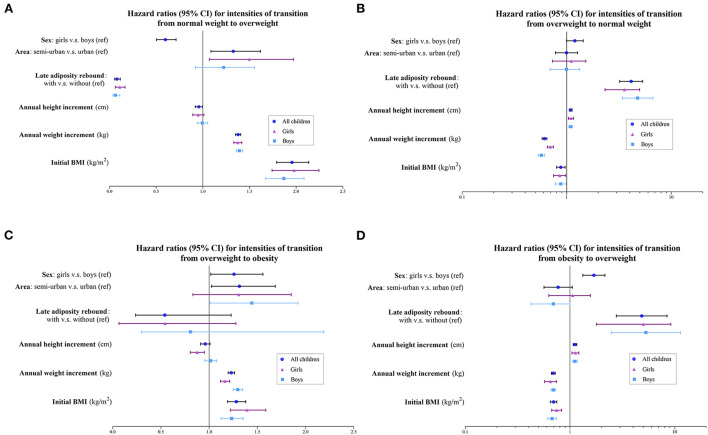
According to the Markov model, 42.3% of school-age children who were initially overweight transitioned to another weight status within 1 year, with 24.8% (95% confidence interval [CI]: 23.1, 27.0) transitioning to normal weight and 17.5% (95% CI: 15.9, 19.3) becoming obese. In contrast, children who were initially normal weight (92.9% [95% CI: 92.3, 93.5]) or obese (83.1% [95% CI: 81.1, 84.8]) tended to maintain their initial weight status. Male sex, semi-urban area, absence of late adiposity rebound, lower annual height increments, higher annual weight increments, and higher initial body mass index were significantly associated with a higher risk of developing or maintaining overweight and obesity ( < 0.05).
The weight status of Chinese school-age children is more likely to change among those who are initially overweight than in those who are initially obese. Interventions to promote healthy weight status may be more effective if key groups are targeted, such as overweight and pre-school-age children.
儿童超重和肥胖问题日益受到公众关注。然而,对于儿童体重状况的转变模式,尤其是在发展中国家,人们知之甚少。本研究旨在评估中国学龄儿童体重状况的变化模式及其危险因素。
本回顾性队列研究纳入了 2334 名 6 岁儿童,他们在上海闵行区完成了 5 年(2012-2017 年)的完整体格检查。使用动态结果(正常体重、超重和肥胖)的同质三状态马尔可夫模型对纵向数据进行拟合。
根据马尔可夫模型,最初超重的学龄儿童中有 42.3%在 1 年内转变为另一种体重状态,其中 24.8%(95%置信区间 [CI]:23.1,27.0)转变为正常体重,17.5%(95% CI:15.9,19.3)成为肥胖。相比之下,最初体重正常(92.9%[95% CI:92.3,93.5])或肥胖(83.1%[95% CI:81.1,84.8])的儿童往往保持初始体重状态。男性、半城市地区、缺乏晚脂肪反弹、年身高增长较低、年体重增长较高和初始体重指数较高与超重和肥胖的发生或维持风险增加显著相关(<0.05)。
与初始肥胖相比,初始超重的中国学龄儿童体重状况更有可能发生变化。如果针对超重和学龄前儿童等关键群体开展促进健康体重状况的干预措施,可能会更有效。