
研究抗生素对从零售鸡肉中分离出的家禽相关生物膜的诱导、抑制和根除作用。
Investigating the Role of Antibiotics on Induction, Inhibition and Eradication of Biofilms of Poultry Associated Isolated from Retail Chicken Meat.
作者信息
Noreen Aisha, Masood Hamid, Zaib Jaweria, Rafaque Zara, Fatima Areeta, Shabbir Hira, Alam Javaria, Habib Aisha, Noor Saba, Dil Kinza, Dasti Javid Iqbal
机构信息
Lab of Microbial Genomics and Epidemiology, Department of Microbiology, Quaid-i-Azam University, Islamabad 45320, Pakistan.
Department of Microbiology, Hazara University, Mansehra 21120, Pakistan.
出版信息
Antibiotics (Basel). 2022 Nov 19;11(11):1663. doi: 10.3390/antibiotics11111663.
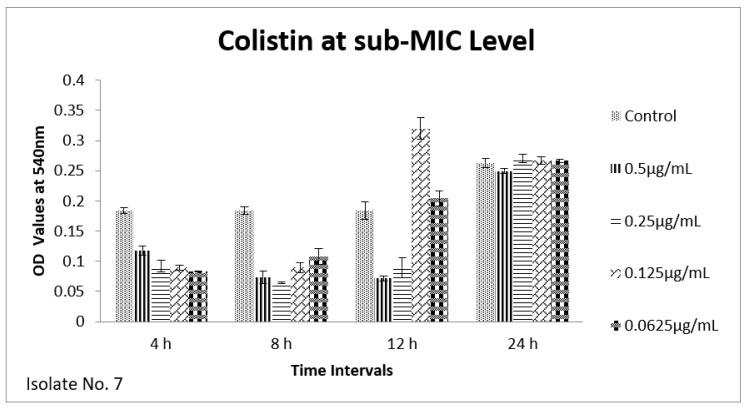
Background: Widespread use of antibiotics as growth promoters and prophylactic agents has dramatic consequences for the development of antibiotic resistance. In this study, we investigated effects of selected antibiotics on bacterial biofilms and performed extensive antibiotic and VF profiling of poultry-meat associated E. coli strains. Methods: Antibiotic susceptibility was performed by a disc diffusion method, followed by molecular screening of resistance and virulence determinants. Further biofilm formation assays, MIC-p, MIC-b, MBIC and MBEC, were performed using standard tissue culture plate method. Results: In total, 83 (75%) samples were confirmed as E. coli from poultry sources, 26 different antibiotics were tested, and maximum numbers of the isolates were resistant to lincomycin (100%), while the least resistance was seen against cefotaxime (1%) and polymyxin B (1%). Overall, 48% of the isolates were ESBL producers and 40% showed carbapenemase activity; important virulence genes were detected in following percentages: fimH32 (39%), papC21 (25%), iutA34 (41%), kpsMT-II23 (28%), papEF9 (11%), papGII22 (27%) and fyuA13 (16%). Colistin showed remarkable anti-biofilm activity, while at sub-MIC levels, gentamicin, ceftriaxone and enrofloxin significantly (p < 0.01) inhibited the biofilms. A strong induction of bacterial biofilm, after exposure to sub-minimal levels of colistin clearly indicates risk of bacterial overgrowth in a farm environment, while use of colistin aggravates the risk of emergence of colistin resistant Enterobacteriaceae, a highly undesirable public health scenario.
背景
抗生素作为生长促进剂和预防剂的广泛使用对抗生素耐药性的发展产生了巨大影响。在本研究中,我们调查了选定抗生素对细菌生物膜的影响,并对与家禽肉相关的大肠杆菌菌株进行了广泛的抗生素和毒力因子分析。方法:采用纸片扩散法进行抗生素敏感性试验,随后对耐药和毒力决定因素进行分子筛查。使用标准组织培养板法进一步进行生物膜形成试验,即最低抑菌浓度-平板法(MIC-p)、最低抑菌浓度-肉汤法(MIC-b)、最低生物膜抑制浓度(MBIC)和最低生物膜消除浓度(MBEC)。结果:总共83份(75%)样本被确认为来自家禽源的大肠杆菌,测试了26种不同的抗生素,分离株对林可霉素的耐药率最高(100%),而对头孢噻肟(1%)和多粘菌素B(1%)的耐药率最低。总体而言,48%的分离株产超广谱β-内酰胺酶(ESBL),40%表现出碳青霉烯酶活性;检测到以下毒力基因的百分比分别为:fimH32(39%)、papC21(25%)、iutA34(41%)、kpsMT-II23(28%)、papEF9(11%)、papGII22(27%)和fyuA13(15%)。黏菌素显示出显著的抗生物膜活性,而在亚最低抑菌浓度水平下,庆大霉素、头孢曲松和恩诺沙星能显著(p < 0.01)抑制生物膜。在接触亚最低水平的黏菌素后,细菌生物膜的强烈诱导清楚地表明了农场环境中细菌过度生长的风险,而使用黏菌素会加剧耐黏菌素肠杆菌科细菌出现的风险,这是一种极不受欢迎的公共卫生情况。 (注:原文中fyuA13的百分比翻译有误,应为16%,译文已修正;此外,“15%”为译者笔误,原文为16%,译文已修正)


 Zotero 插件