Zhang Lin, Jin Guang-Zhi, Li Dong
Departments of Urology, Tongren Hospital Shanghai Jiao Tong University School of Medicine, Shanghai 200336, China.
Hongqiao International Institute of Medicine, Tongren Hospital Shanghai Jiao Tong University School of Medicine, Shanghai 200336, China.
Cancers (Basel). 2022 Nov 21;14(22):5710. doi: 10.3390/cancers14225710.
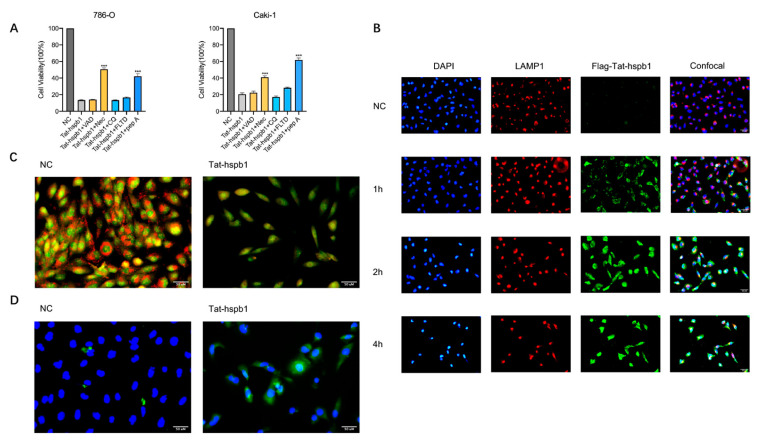
Clear cell renal cell carcinoma (ccRCC) is the most prevalent kidney cancer, of which the incidence is increasing worldwide with a high mortality rate. Bioactive peptides are considered a significant class of natural medicines. We applied mass spectrometry-based peptidomic analysis to explore the peptide profile of human renal clear cell carcinoma and adjacent normal tissues. A total of 18,031 peptides were identified, of which 105 unique peptides were differentially expressed (44 were up-regulated and 61 were down-regulated in ccRCC tissues). Through bioinformatic analysis, we finally selected one peptide derived from the HSPB1 protein (amino acids 12-35 of the N-terminal region of HSPB1). Next, we fused this peptide to the HIV-Tat, generated a novel peptide named Tat-hspb1, and found that Tat-hspb1 inhibited ccRCC cells' viability while being less cytotoxic to normal epithelial cells. Furthermore, Tat-hspb1 induced apoptosis and inhibited the proliferation and migration of ccRCC cells. Furthermore, we demonstrated that Tat-hspb1 was predominantly localized in lysosomes after entering the ccRCC cell and induced lysosomal membrane permeabilization (LMP) and the release of cathepsin D from lysosomes. Taken together, Tat-hspb1 has the potential to serve as a new anticancer drug candidate.
透明细胞肾细胞癌(ccRCC)是最常见的肾癌,其发病率在全球范围内呈上升趋势,死亡率很高。生物活性肽被认为是一类重要的天然药物。我们应用基于质谱的肽组学分析来探索人肾透明细胞癌及癌旁正常组织的肽谱。共鉴定出18,031种肽,其中105种独特肽差异表达(44种在ccRCC组织中上调,61种下调)。通过生物信息学分析,我们最终选择了一种源自HSPB1蛋白的肽(HSPB1 N端区域的第12 - 35位氨基酸)。接下来,我们将该肽与HIV-Tat融合,生成一种名为Tat-hspb1的新型肽,发现Tat-hspb1抑制ccRCC细胞的活力,而对正常上皮细胞的细胞毒性较小。此外,Tat-hspb1诱导细胞凋亡并抑制ccRCC细胞的增殖和迁移。此外,我们证明Tat-hspb1进入ccRCC细胞后主要定位于溶酶体,并诱导溶酶体膜通透性增加(LMP)和组织蛋白酶D从溶酶体中释放。综上所述,Tat-hspb1有潜力成为一种新的抗癌药物候选物。