Department of Epidemiology, School of Public Health, Qilu Hospital, Cheeloo College of Medicine, Shandong University, Jinan, China.
Department of Nutrition and Food Hygiene, School of Public Health, Cheeloo College of Medicine, Shandong University, Jinan, China.
BMC Med. 2022 Nov 25;20(1):460. doi: 10.1186/s12916-022-02662-0.
Smokeless tobacco use is popular in some regions worldwide, but it receives less attention compared to cigarette smoking. We aimed to estimate the recent prevalence of, and trends in, smokeless tobacco use and to examine its associated factors among adolescents aged 12-16 years in 138 countries/territories (hereafter "countries") from 1999 to 2019.
Data from the Global Youth Tobacco Survey conducted in 138 countries in 2010-2019 and the National Youth Tobacco Survey conducted in the United States in 2019 were used to calculate the prevalence of current smokeless tobacco use and investigate its associated factors among adolescents aged 12-16 years. We also assessed the trend in the prevalence of smokeless tobacco use in 100 countries that had conducted more than one survey from 1999 to 2019.
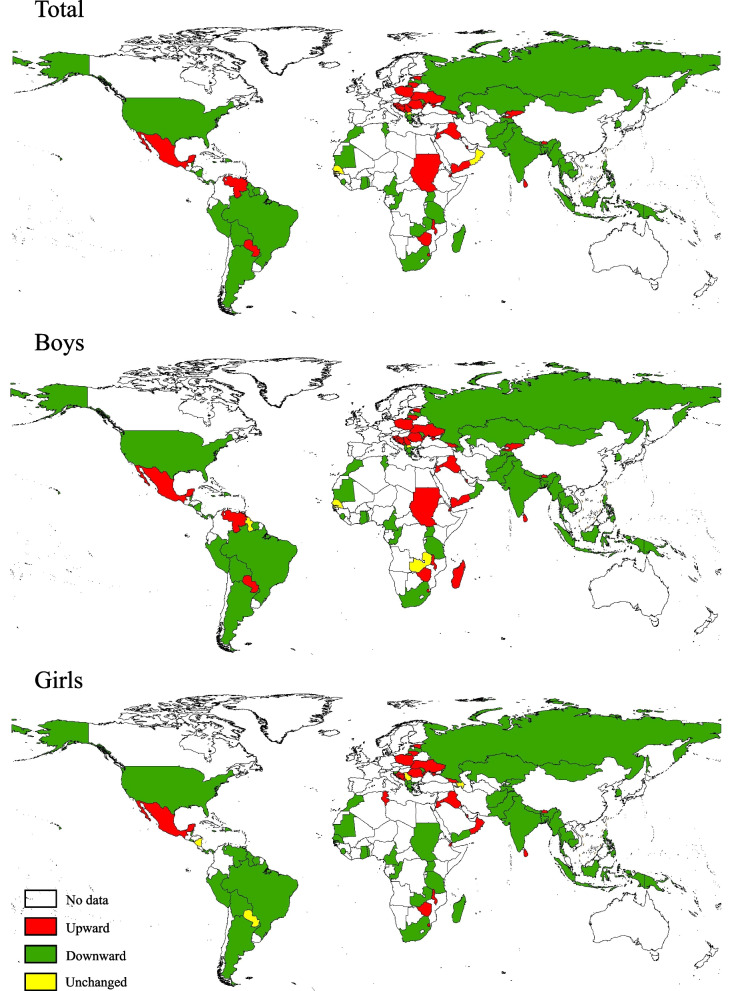
The overall prevalence of current smokeless tobacco use was 4.4% (95% confidence interval [CI] 4.0-4.9), with 5.7% (5.1-6.3) for boys, 3.1% (2.6-3.5) for girls, 3.9% (3.5-4.4) for adolescents aged 12-14 years and 5.4% (4.8-5.9) for those aged 15-16 years. The prevalence was highest in the South-East Asian region (6.1%, 4.4-7.7) and lowest in the Western Pacific region (2.0%, 1.7-2.4). The prevalence of smokeless tobacco use decreased in 57 of 100 countries, increased in 32 countries, and remained unchanged in 11 countries. Current cigarette smoking (odds ratio [OR]=2.00, 95% CI=1.68-2.39), other tobacco product use (OR=6.03, 95% CI=4.92-7.40), tobacco advertisement exposure (OR=1.44, 95% CI=1.19-1.74), being offered free tobacco products (OR=2.01, 95% CI=1.66-2.42), and not being taught about dangers of smoking (OR=1.28, 95% CI=1.09-1.50) were all positively associated with current smokeless tobacco use.
Smokeless tobacco use among adolescents remains a public health concern worldwide. Although the prevalence among adolescents decreased in most countries, it remains high especially in the South-East Asian region. More strict and effective strategies and measures are needed to further curb the smokeless tobacco use among adolescents.
无烟烟草制品在世界上一些地区很流行,但相比吸烟,它受到的关注较少。我们旨在评估全球 138 个国家/地区(以下简称“国家”)12-16 岁青少年近期使用无烟烟草制品的流行情况和趋势,并分析其相关因素。
使用了全球青年烟草调查(2010-2019 年在 138 个国家进行)和美国国家青年烟草调查(2019 年进行)的数据,计算了 12-16 岁青少年中当前使用无烟烟草制品的流行率,并调查了其相关因素。我们还评估了 1999 年至 2019 年期间进行了一次以上调查的 100 个国家中无烟烟草制品使用流行率的趋势。
当前使用无烟烟草制品的总体流行率为 4.4%(95%置信区间[CI]为 4.0-4.9),男孩为 5.7%(5.1-6.3),女孩为 3.1%(2.6-3.5),12-14 岁青少年为 3.9%(3.5-4.4),15-16 岁青少年为 5.4%(4.8-5.9)。流行率最高的是东南亚地区(6.1%,4.4-7.7),最低的是西太平洋地区(2.0%,1.7-2.4)。在 100 个国家中,有 57 个国家的无烟烟草制品使用流行率下降,32 个国家上升,11 个国家不变。当前吸烟(比值比[OR]=2.00,95%CI=1.68-2.39)、使用其他烟草制品(OR=6.03,95%CI=4.92-7.40)、接触烟草广告(OR=1.44,95%CI=1.19-1.74)、免费提供烟草制品(OR=2.01,95%CI=1.66-2.42)和未接受吸烟危害教育(OR=1.28,95%CI=1.09-1.50)均与当前使用无烟烟草制品呈正相关。
青少年使用无烟烟草制品仍然是全球公共卫生关注的问题。尽管大多数国家青少年使用无烟烟草制品的流行率有所下降,但在东南亚地区仍然很高。需要采取更严格和有效的战略和措施,进一步遏制青少年使用无烟烟草制品。