Department of Trauma, Hand and Reconstructive Surgery, University Hospital Münster, Albert-Schweitzer-Campus 1, Building W1, 48149, Münster, Germany.
BMC Musculoskelet Disord. 2022 Dec 1;23(1):1037. doi: 10.1186/s12891-022-05983-6.
Wire cerclages play a fundamental role in fracture fixation. With an increasing variety of designs being commercially available the question arises which cerclage should be used. This study investigates the biomechanical properties of metallic and non-metallic cerclages and their different application-types. Furthermore, potential influence of muscular interposition between bone and cerclage constructs was tested.
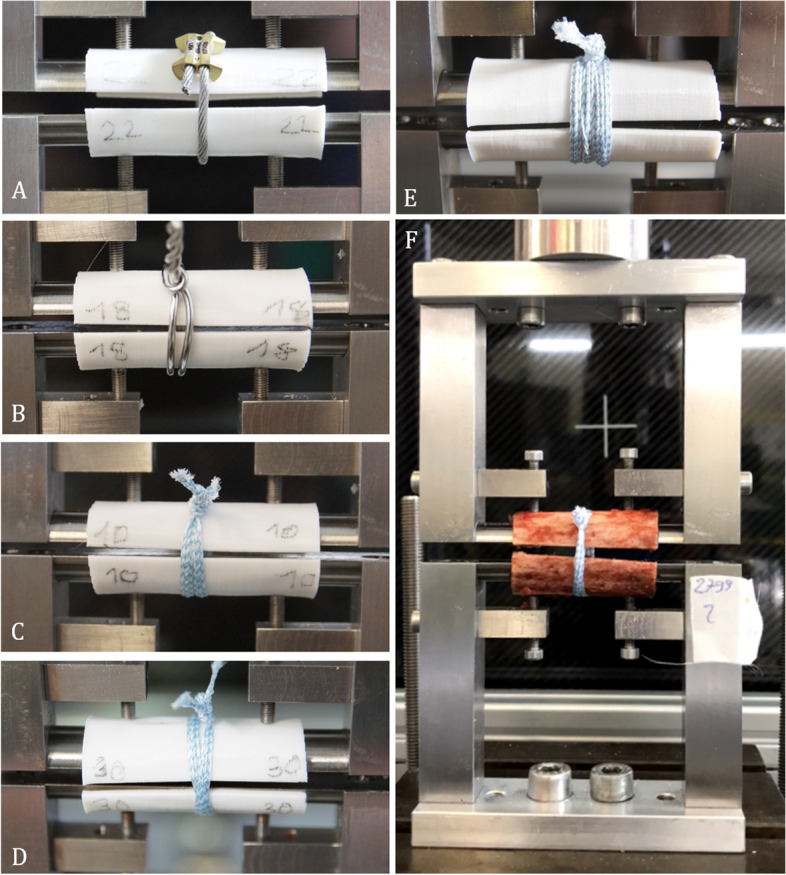
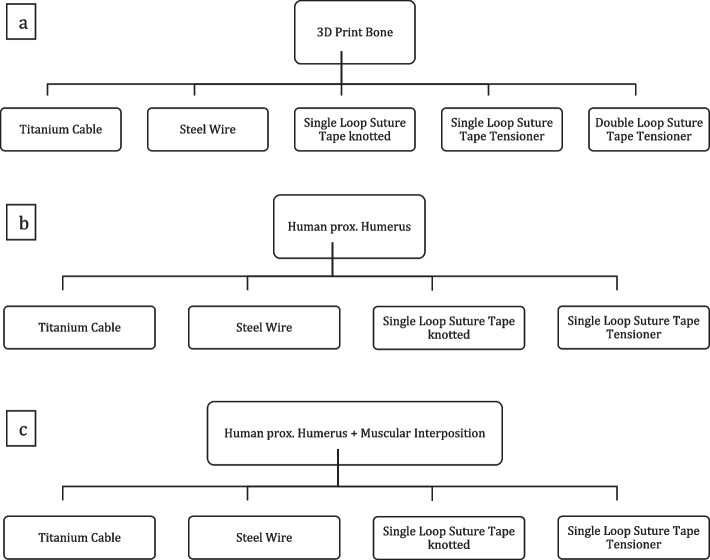
Samples of the following four different cerclage types were tested on 3D printed models of human humeri as well as on human cadaveric humeri with and without muscular interposition: Titanium Cable Cerclage (CC), Steel Wire Cerclage (SWC), Suture Tape (ST), Suture Tape Cerclage (STC) with both single- (sSTC) and double-loop application (dSTC). A preinstalled self-locking mechanism secured by the provided tensioner in the STCs being the main difference to the STs. Cyclic loading was performed to 1 kN and then linearly to a maximum load of 3 kN. Statistical analysis was performed using either one-way ANOVA and post-hoc Tukey or Kruskal-Wallis and post-hoc Dunn test depending on normalization of data (p < 0.05).
Whilst all cerclage options could withstand high loads during failure testing, only within the CC and dSTC group, all samples reached the maximal testing load of 3000 N without any failure. The SWC reached 2977.5 ± 63.6 N, the ST 1970.8 ± 145.9 N, and the sSTC 1617.0 ± 341.6 N on average. Neither muscular interposition nor bone quality showed to have a negative influence on the biomechanical properties of the cerclage constructs, presenting no significant differences.
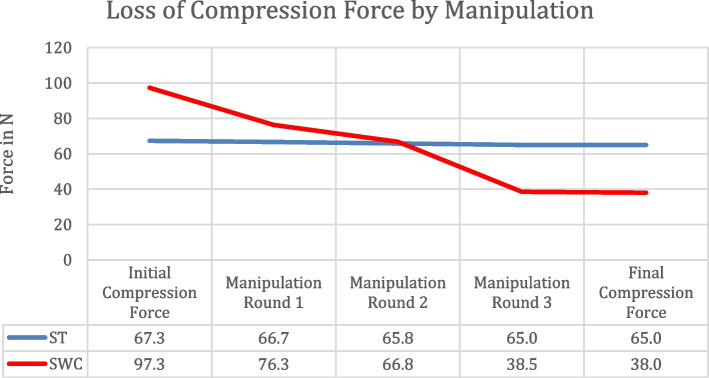
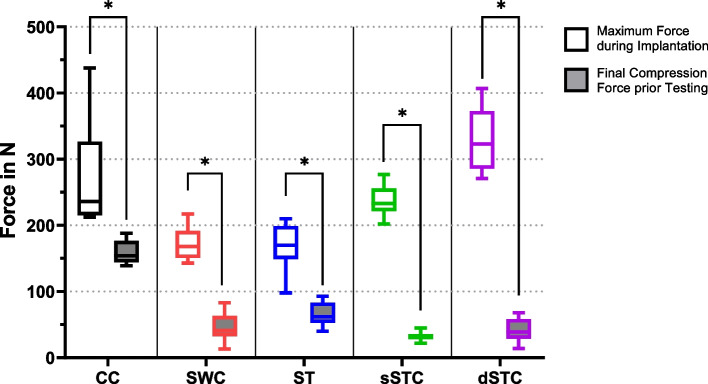
All tested cerclage constructs produce reliable stability but differ in their resulting compression forces, in a simplified fracture model. Therefore, non-metallic cerclage alternatives can provide similar stability with less compression and stiffness to metallic cable constructs, but they may offer several advantages and could possibly provide future benefits. Especially, by offering more elasticity without losing overall stability, may offer a biologic benefit. Installing any cerclage constructs should be performed carefully, especially if poor bone quality is present, as the tightening process leads to high forces on the construct.
钢丝环扎在骨折固定中起着至关重要的作用。随着商业上可用的设计种类越来越多,出现了一个问题,即应该使用哪种环扎。本研究调查了金属和非金属环扎及其不同应用类型的生物力学特性。此外,还测试了骨骼和环扎结构之间肌肉介入的潜在影响。
在 3D 打印的人肱骨模型以及有和没有肌肉介入的人体肱骨标本上测试了以下四种不同环扎类型的样本:钛缆环扎(CC)、钢丝环扎(SWC)、缝线带(ST)、缝线带环扎(STC),包括单环(sSTC)和双环(dSTC)应用。STCs 中的预安装自锁机构由提供的张力器固定,这是与 STs 的主要区别。进行循环加载至 1 kN,然后线性加载至最大负载 3 kN。根据数据的归一化情况(p<0.05),使用单向方差分析和事后 Tukey 检验或 Kruskal-Wallis 和事后 Dunn 检验进行统计分析。
虽然在失效测试中所有的环扎选择都能承受高负荷,但只有在 CC 和 dSTC 组中,所有样本都在没有任何失效的情况下达到了 3000 N 的最大测试负载。SWC 的平均峰值负载为 2977.5±63.6 N,ST 为 1970.8±145.9 N,sSTC 为 1617.0±341.6 N。肌肉介入或骨骼质量均未对环扎结构的生物力学性能产生负面影响,没有显著差异。
在简化的骨折模型中,所有测试的环扎结构都能提供可靠的稳定性,但在产生的压缩力方面有所不同。因此,非金属环扎替代品可以提供类似的稳定性,同时对金属电缆结构的压缩和刚度更小,但它们可能具有许多优势,并可能带来未来的益处。特别是,通过提供更多的弹性而不失去整体稳定性,可能具有生物学益处。如果存在较差的骨骼质量,安装任何环扎结构都应小心进行,因为紧固过程会导致结构上产生高的力。