Cai Yuanqing, Huang Changyu, Chen Xiaoqing, Chen Yang, Huang Zida, Zhang Chaofan, Zhang Wenming, Fang Xinyu
Department of Orthopaedics, National Regional Medical Center, Binhai Campus of the First Affiliated Hospital, Fujian Medical University, Fuzhou, China.
Department of Orthopaedics, The Second Affiliated Hospital of Xi'an Jiaotong University, Xi'an, China.
Bone Joint Res. 2022 Dec;11(12):843-853. doi: 10.1302/2046-3758.1112.BJR-2021-0590.R1.
This study aimed to explore the role of small colony variants (SCVs) of in intraosseous invasion and colonization in patients with periprosthetic joint infection (PJI).
A PJI diagnosis was made according to the MusculoSkeletal Infection Society (MSIS) for PJI. Bone and tissue samples were collected intraoperatively and the intracellular invasion and intraosseous colonization were detected. Transcriptomics of PJI samples were analyzed and verified by polymerase chain reaction (PCR).
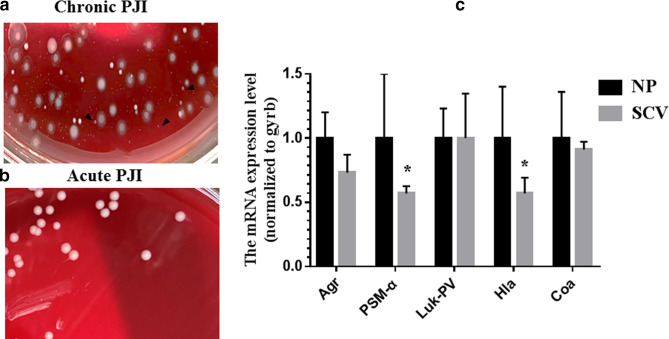
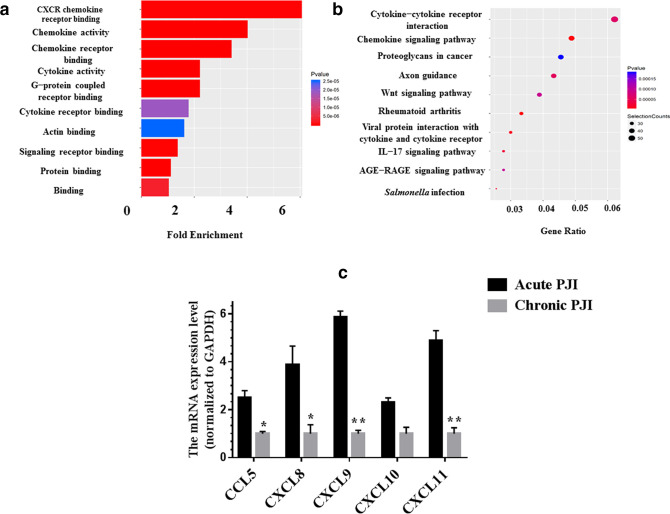
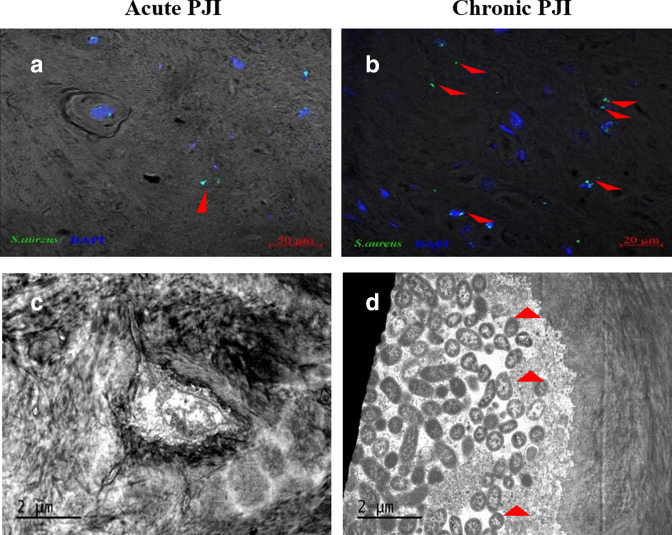
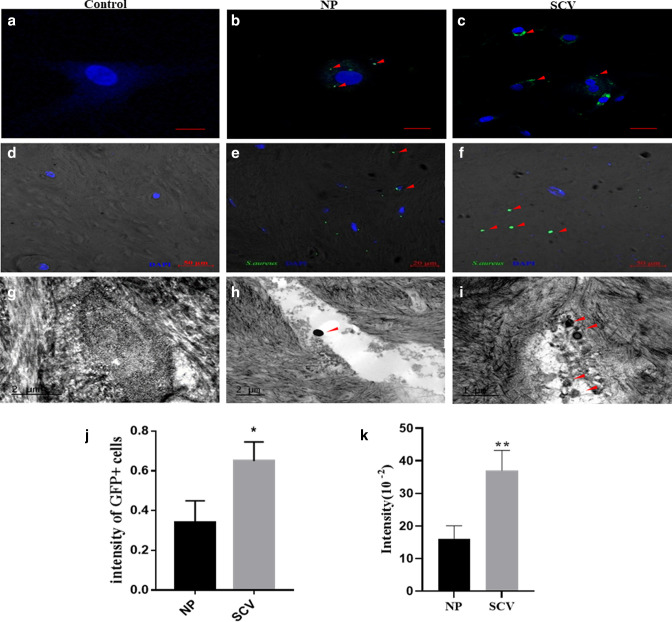
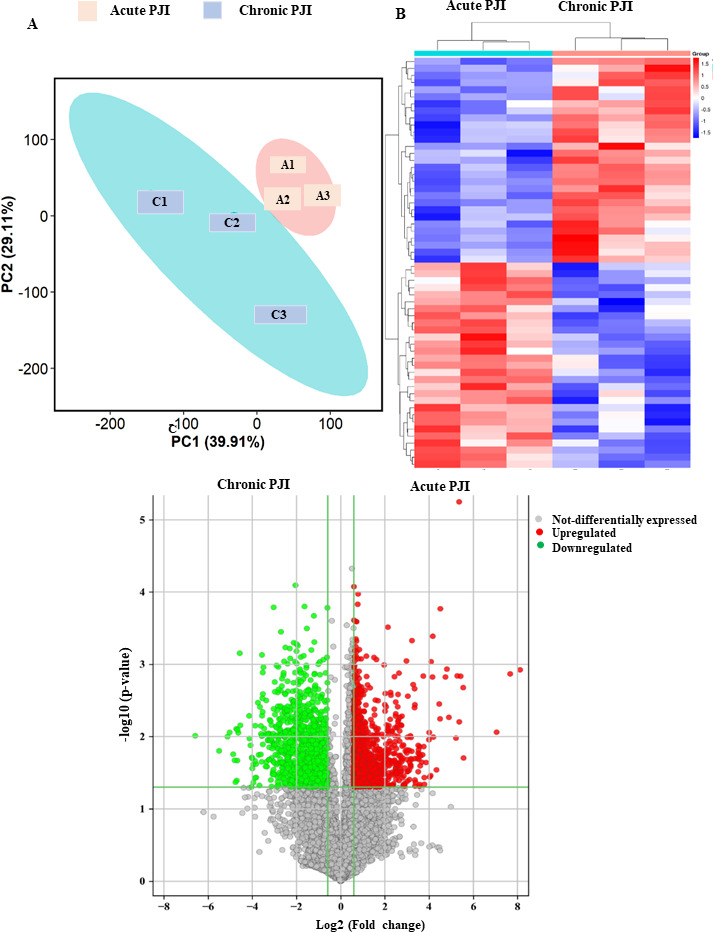
SCVs can be isolated from samples collected from chronic PJIs intraoperatively. Transmission electron microscopy (TEM) and immunofluorescence (IF) showed that there was more in bone samples collected from chronic PJIs, but much less in bone samples from acute PJIs, providing a potential mechanism of PJI. Immunofluorescence results showed that SCVs of were more likely to invade osteoblasts in vitro. Furthermore, TEM and IF also demonstrated that SCVs of were more likely to invade and colonize in vivo Cluster analysis and principal component analysis (PCA) showed that there were substantial differences in gene expression profiles between chronic and acute PJI. Gene Ontology (GO) and Kyoto Encyclopedia of Genes and Genomes (KEGG) analysis showed that these differentially expressed genes were enriched to chemokine-related signal pathways. PCR also verified these results.
Our study has shown that the SCVs have a greater ability to invade and colonize in bone, resulting in remaining in bone tissues long-term, thus explaining the pathogenesis of chronic PJI.Cite this article: 2022;11(12):843-853.
本研究旨在探讨小菌落变异株(SCVs)在人工关节感染(PJI)患者骨内侵袭和定植中的作用。
根据肌肉骨骼感染学会(MSIS)的标准对PJI进行诊断。术中采集骨和组织样本,检测细胞内侵袭和骨内定植情况。对PJI样本进行转录组学分析,并通过聚合酶链反应(PCR)进行验证。
术中可从慢性PJI采集样本中分离出SCVs。透射电子显微镜(TEM)和免疫荧光(IF)显示,慢性PJI采集的骨样本中存在更多的[具体细菌名称未给出],而急性PJI骨样本中则少得多,这为PJI提供了一种潜在机制。免疫荧光结果显示,[具体细菌名称未给出]的SCVs在体外更易侵袭成骨细胞。此外,TEM和IF还表明,[具体细菌名称未给出]的SCVs在体内更易侵袭和定植。聚类分析和主成分分析(PCA)显示,慢性和急性PJI之间的基因表达谱存在显著差异。基因本体论(GO)和京都基因与基因组百科全书(KEGG)分析表明,这些差异表达基因富集于趋化因子相关信号通路。PCR也验证了这些结果。
我们的研究表明,[具体细菌名称未给出]的SCVs在骨内具有更强的侵袭和定植能力,导致[具体细菌名称未给出]长期留存于骨组织中,从而解释了慢性PJI的发病机制。引用本文:2022;11(12):843 - 853。