Division of Hematology-Oncology, Department of Medicine, Samsung Medical Center, Sungkyunkwan University School of Medicine, Seoul, Republic of Korea.
Department of Health Science and Technology, Samsung Advanced Institute of Health Science and Technology, Sungkyunkwan University, Seoul, Republic of Korea.
Cancer Med. 2023 Mar;12(6):7639-7650. doi: 10.1002/cam4.5460. Epub 2022 Dec 1.
The chemokine CXCL13 is known to influence local anti-tumor immunity by recruiting immune cells and forming tertiary lymphoid structures (TLS). It has been hypothesized that TLS, led by the expression of CXCL13, could be a predictive or prognostic biomarker for immunotherapy. We investigated the predictive value of CXCL13 to immune checkpoint inhibitors (ICI) in lung adenocarcinoma.
We constructed an exploratory dataset (n = 63) and a validation dataset (n = 57) in metastatic lung adenocarcinoma patients treated with ICI. Based on the clinical response, the difference in gene expression profile, including CXCL13, was evaluated.
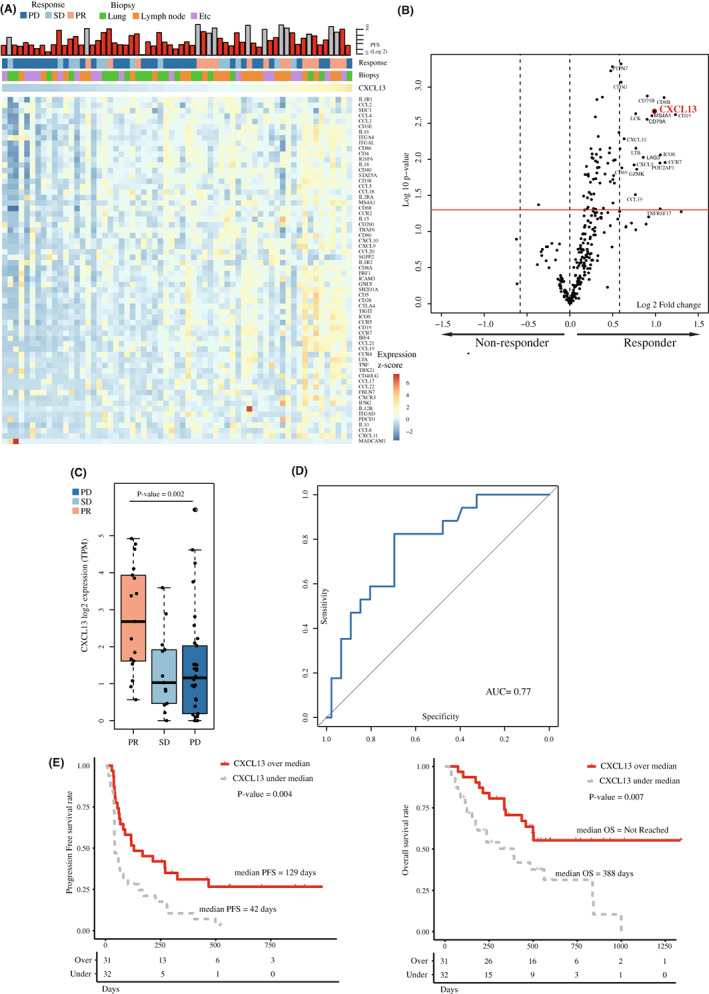
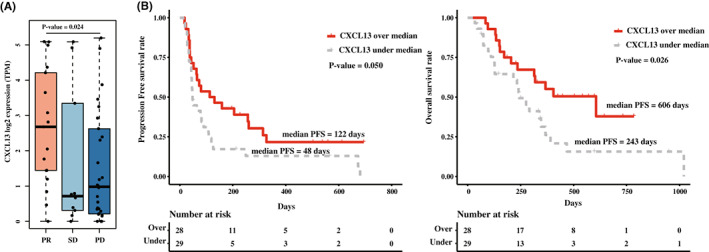
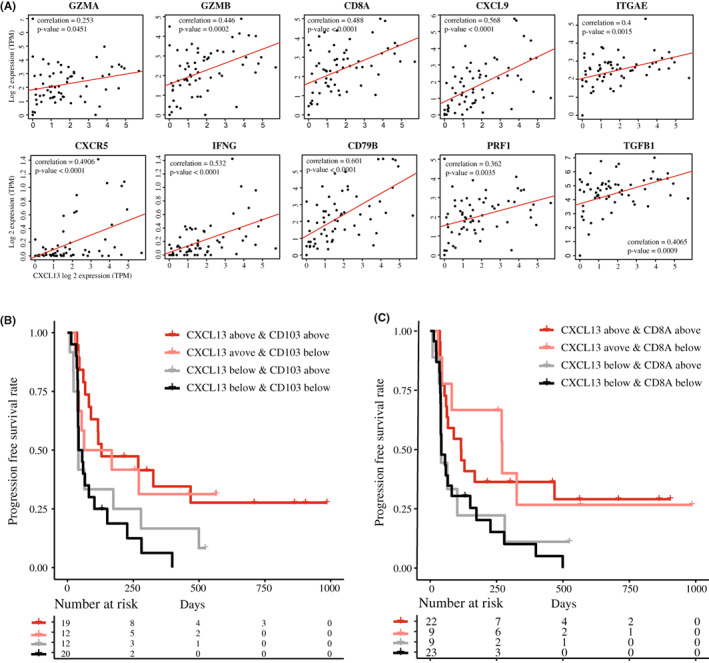
From the exploratory dataset, CXCL13 expression was significantly upregulated in the ICI responders (p = 0.002). Survival analysis using a cut-off value of the median expression value of CXCL13 showed prolonged progression-free survival (PFS) (p = 0.004) and overall survival (OS) (p = 0.007). CXCL13 expression was correlated with other immune response genes, such as GZMA, CD8A, IFNG, PRF1, TLS-related gene sets and its receptor, CXCR5. Notably, subgroup analyses based on CXCL13 expression and CD8A showed that CXCL13-upregulated patients demonstrated comparably prolonged survival regardless of CD8A expression. In the validation dataset, CXCL13 upregulation also demonstrated a significant prolongation of both PFS (p = 0.050) and OS (p = 0.026).
We observed that CXCL13 upregulation is correlated to better ICI response in lung adenocarcinoma. Our results support that CXCL13 could be an important chemokine in shaping the immunoactive tumor microenvironment which affects the anti-tumor effect of ICI.
趋化因子 CXCL13 通过招募免疫细胞并形成三级淋巴结构 (TLS) 来影响局部抗肿瘤免疫。据推测,以 CXCL13 表达为特征的 TLS 可能是免疫治疗的预测或预后生物标志物。我们研究了 CXCL13 在肺腺癌中对免疫检查点抑制剂 (ICI) 的预测价值。
我们构建了转移性肺腺癌患者接受 ICI 治疗的探索性数据集 (n=63) 和验证性数据集 (n=57)。根据临床反应,评估了包括 CXCL13 在内的基因表达谱的差异。
从探索性数据集来看,ICI 应答者的 CXCL13 表达明显上调 (p=0.002)。使用 CXCL13 中位表达值的截止值进行生存分析表明,无进展生存期 (PFS) (p=0.004) 和总生存期 (OS) (p=0.007) 延长。CXCL13 表达与其他免疫反应基因相关,如 GZMA、CD8A、IFNG、PRF1、TLS 相关基因集及其受体 CXCR5。值得注意的是,基于 CXCL13 表达和 CD8A 的亚组分析表明,无论 CD8A 表达如何,CXCL13 上调的患者表现出相当的生存延长。在验证性数据集,CXCL13 上调也显著延长了 PFS (p=0.050) 和 OS (p=0.026)。
我们观察到 CXCL13 的上调与肺腺癌中更好的 ICI 反应相关。我们的结果支持 CXCL13 可能是塑造影响 ICI 抗肿瘤作用的免疫活性肿瘤微环境的重要趋化因子。