Department of Environmental Engineering, Kumoh National Institute of Technology, Gumi 39177, Republic of Korea; Department of Energy Engineering Convergence, Kumoh National Institute of Technology, Gumi 39177, Republic of Korea.
Department of Environmental Engineering, Kumoh National Institute of Technology, Gumi 39177, Republic of Korea.
Ultrason Sonochem. 2023 Jan;92:106250. doi: 10.1016/j.ultsonch.2022.106250. Epub 2022 Nov 28.
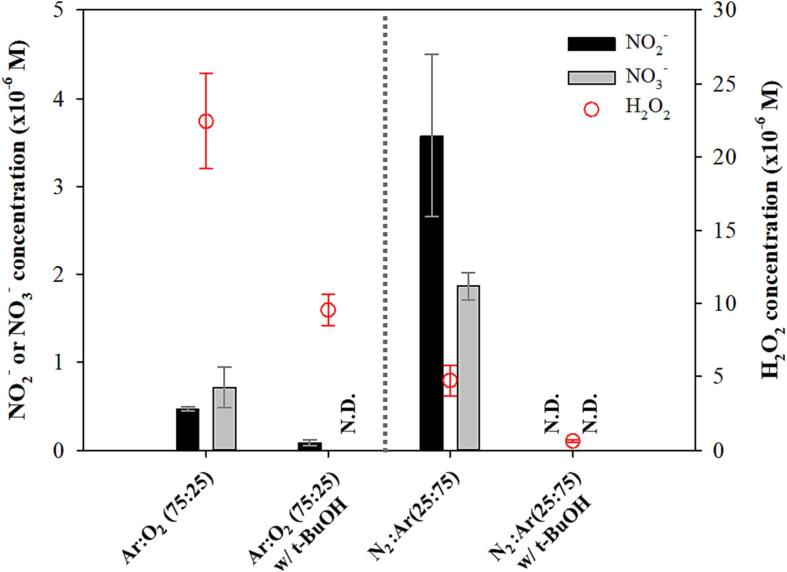
The sonochemical generation of NO and NO is considered to be one of the reasons for the low sonochemical oxidation activity in the presence of N in the liquid phase. In this study, the generation characteristics of NO and NO were investigated using the same 28 kHz sonoreactor and the 12 gas conditions used in Part I of this study. Three gas modes, saturation/closed, saturation/open, and sparging/closed, were applied. N:Ar (25:75), N:Ar (50:50), and O:N (25:75) in the saturation/closed mode generated the three highest values of NO and NO. Ar and O were vital for generating relatively large concentrations of NO and NO. The absorption of N from the air resulted in high generation of NO and NO for Ar 100 % and Ar/O mixtures under the saturation/open mode. In addition, gas sparging enhanced the generation of NO and NO for N:Ar (25:75), O:N (25:75), and N significantly because of the change in the sonochemically active zone and the increase in the mixing intensity in the liquid phase, as discussed in Part I. The ratio of NO to NO was calculated using their final concentrations, and a ratio higher than 1 was obtained for the condition of Ar 100 %, Ar/O mixtures, and O 100 %, wherein a relatively high oxidation activity was detected. From a summary of the results and findings of previous studies, it was revealed that the observations of NO + NO could be more appropriate for investigating the NO and NO generation characteristics. In addition, HO/NO/NO related activity rather than HO activity was suggested to quantify the OH radical activity more appropriately in the presence of N.
声化学产生的 NO 和 NO 被认为是液相中存在 N 时声化学氧化活性低的原因之一。在本研究中,使用相同的 28 kHz 声反应器和本研究第一部分中使用的 12 种气体条件,研究了 NO 和 NO 的产生特性。采用了三种气体模式:饱和/封闭、饱和/开放和通气/封闭。在饱和/封闭模式下,N:Ar(25:75)、N:Ar(50:50)和 O:N(25:75)产生了 NO 和 NO 的三个最高值。Ar 和 O 对于产生相对较高浓度的 NO 和 NO 至关重要。在饱和/开放模式下,空气中的 N 吸收导致 Ar 100%和 Ar/O 混合物中产生大量的 NO 和 NO。此外,由于声化学活性区的变化和液相混合强度的增加,通气增强了 N:Ar(25:75)、O:N(25:75)和 N 的 NO 和 NO 的产生,这在第一部分中进行了讨论。使用它们的最终浓度计算了 NO 与 NO 的比值,对于 Ar 100%、Ar/O 混合物和 O 100%的条件,获得了高于 1 的比值,其中检测到相对较高的氧化活性。从结果的总结和以前研究的发现来看,表明观察 NO + NO 可能更适合研究 NO 和 NO 的产生特性。此外,建议在存在 N 的情况下,用 HO/NO/NO 相关活性而不是 HO 活性来更恰当地量化 OH 自由基活性。