Gilbert William, Bureau Julien S, Poellhuber Bruno, Guay Frédéric
School of Psychology, Université Laval, Québec, QC Canada.
Department of Educational Fundamentals and Practices, Université Laval, 2320 Rue Des Bibliothèques, Quebec City, QC G1V 0A6 Canada.
Curr Psychol. 2022 Nov 22:1-21. doi: 10.1007/s12144-022-04019-5.
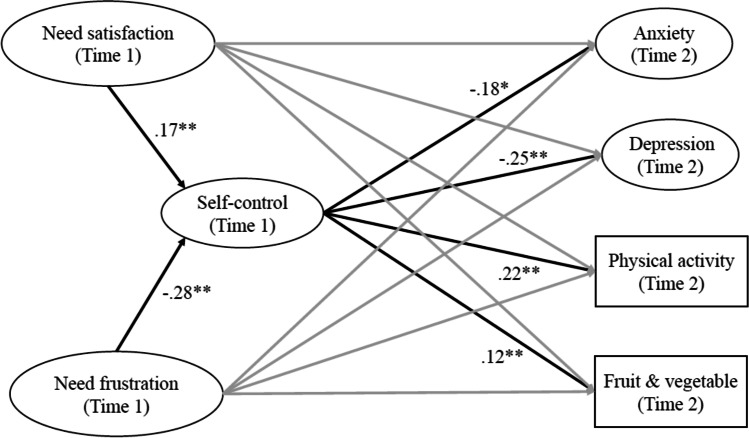
Psychological distress and unhealthy lifestyle behaviors are highly prevalent among undergraduate students. Importantly, numerous longitudinal studies show that these phenomena rise significantly during the first months of college and remain high thereafter. However, research identifying theory-driven mechanisms to explain these phenomena is lacking. Using two complementary statistical approaches (person- and variable-centered), this study assesses basic psychological needs (BPNs) and self-control as possible explanatory factors underlying the association between student's educational experience and multiple health-related outcomes. A total of 2450 Canadian undergraduates participated in this study study involving two time points (12 months apart; N = 1783; N = 1053), of which 386 participated at both measurement occasions. First, results from person-centered analyses (i.e., latent profile and transition analyses) revealed three profiles of need-satisfaction and frustration in students that were replicated at both time points. Need-supportive conditions within college generally predicted membership in the most adaptive profile. In turn, more adaptive profiles predicted higher self-control, lower levels of psychological distress (anxiety, depression), and healthier lifestyle behaviors (physical activity, fruit and vegetable consumption). Second, results from variable-centered analyses (i.e., structural equation modeling) showed that the association between students' BPNs and health-related outcomes was mediated by self-control. In other words, high need satisfaction and low need frustration were associated with higher self-regulatory performance at Time 1, which in turn predicted a more adaptive functioning at Time 2. Overall, these findings help clarify the mechanisms underlying the association between college educational climate and students' health-related functioning.
The online version contains supplementary material available at 10.1007/s12144-022-04019-5.
心理困扰和不健康的生活方式行为在本科生中非常普遍。重要的是,大量纵向研究表明,这些现象在大学的头几个月显著增加,并在之后一直保持在较高水平。然而,缺乏确定理论驱动机制来解释这些现象的研究。本研究使用两种互补的统计方法(以人为中心和以变量为中心),评估基本心理需求(BPNs)和自我控制,作为学生教育经历与多种健康相关结果之间关联的潜在解释因素。共有2450名加拿大本科生参与了这项涉及两个时间点(相隔12个月;N = 1783;N = 1053)的研究,其中386人在两个测量时点都参与了。首先,以人为中心分析(即潜在剖面和转换分析)的结果显示,学生中需求满足和需求受挫的三种剖面在两个时间点都得到了重复。大学中的需求支持条件通常预测了最具适应性剖面中的成员身份。反过来,更具适应性的剖面预测了更高的自我控制、更低水平的心理困扰(焦虑症、抑郁症)以及更健康的生活方式行为(体育活动、水果和蔬菜消费)。其次,以变量为中心分析(即结构方程模型)的结果表明,学生的基本心理需求与健康相关结果之间的关联是由自我控制介导的。换句话说,高需求满足和低需求受挫与时间1时更高的自我调节表现相关,这反过来又预测了时间2时更具适应性的功能。总体而言,这些发现有助于阐明大学教育氛围与学生健康相关功能之间关联的潜在机制。
在线版本包含可在10.1007/s12144-022-04019-5获取的补充材料。