Department of Trauma and Orthopaedic Surgery, University Medical Center Hamburg-Eppendorf, Martinistr. 52, 20246, Hamburg, Germany.
Department of Orthopedics, Bergman Clinics, Arnhem, The Netherlands.
Arch Orthop Trauma Surg. 2023 Jul;143(7):4181-4220. doi: 10.1007/s00402-022-04643-7. Epub 2022 Dec 5.
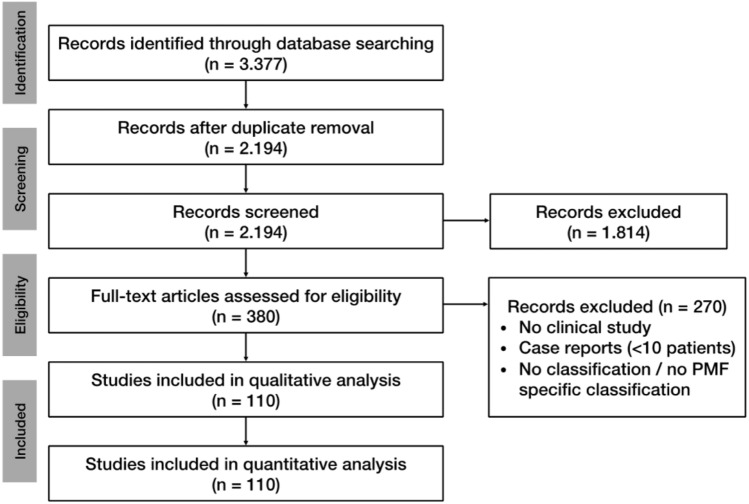
Complex ankle fractures frequently involve the posterior malleolus. Many classifications describing posterior malleolar fractures (PMF) exist. The aim of this study was to provide a systematic literature review to outline existing PMF classifications and estimate their accuracy.
The databases PubMed and Scopus were searched without time limits. Only specific PMF classifications were included; general ankle and/or pilon fracture classifications were excluded. Selection and data extraction was performed by three independent observers. The systematic literature search was performed according to the current criteria of Preferred Reporting Items for Systematic Review and Meta-Analyses (PRISMA). The methodological quality of the included studies was quantified using the modified Coleman score.
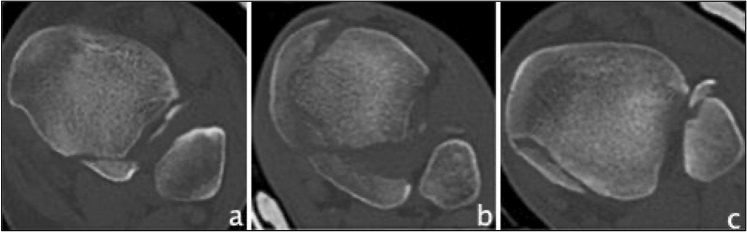
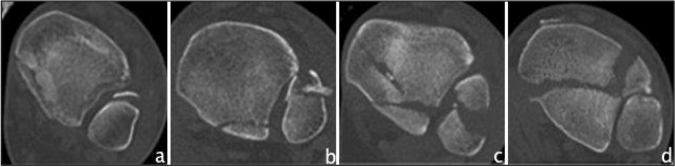
A total of 110 studies with a total of 12.614 patients were included. Four main classifications were identified: Those describing the size of the posterior malleolar fracture (n = 66), Haraguchi (n = 44), Bartoníček/Rammelt (n = 21) and Mason (n = 12). The quality of the studies was moderate to good with a median Coleman-score of 43.5 (14-79) and a weighted median Coleman-score of 42.5 points. All classifications achieved a substantial to perfect score regarding the inter- and intraobserver reliability, with Mason scoring the lowest in comparison.
None of the reviewed PMF classifications has been able to establish itself decisively in the literature. Most of the classifications are insufficient in terms of a derivable treatment algorithm or a prognosis with regard to outcome. However, as the Bartoníček/Rammelt classification has the greatest potential due to its treatment algorithm, its reliability in combination with consistent predictive values, its usage in clinical practice and research appears advisable.
复杂的踝关节骨折常涉及后踝。有许多描述后踝骨折(PMF)的分类。本研究旨在对现有的 PMF 分类进行系统综述,以概述其存在情况并评估其准确性。
无时间限制地在 PubMed 和 Scopus 数据库中进行检索。仅纳入特定的 PMF 分类;排除一般踝关节和/或 Pilon 骨折分类。由三位独立观察员进行选择和数据提取。系统文献检索符合当前系统评价和荟萃分析首选报告项目(PRISMA)的标准。使用改良的 Coleman 评分量化纳入研究的方法学质量。
共纳入 110 项研究,共 12614 例患者。确定了四种主要分类:描述后踝骨折大小的分类(n=66)、Haraguchi 分类(n=44)、Bartoníček/Rammelt 分类(n=21)和 Mason 分类(n=12)。研究质量为中等到良好,中位数 Coleman 得分为 43.5(14-79),加权中位数 Coleman 得分为 42.5 分。所有分类在观察者间和观察者内的可靠性方面均获得了实质性到完美的评分,Mason 分类的评分最低。
没有一种综述的 PMF 分类在文献中能够明确确立。大多数分类在可得出的治疗算法或预后方面存在不足。然而,由于 Bartoníček/Rammelt 分类具有最大的潜力,因为它具有治疗算法、可靠性以及一致性的预测价值,因此在临床实践和研究中使用是合理的。