
慢性便秘患者中,足三里经皮电声刺激的持续改善作用及自主神经机制。
Sustained ameliorating effects and autonomic mechanisms of transcutaneous electrical acustimulation at ST36 in patients with chronic constipation.
作者信息
Zhou Jie-Yi, Wang Jian, Ning Bei-Fang, Hu Ye-Dong, Zhao Qi, Tan Wei, Shi Pei-Mei, Yuan Zong-Li, Feng Xin-Wei, Chen Jiande D Z, Xie Wei-Fen
机构信息
Department of Gastroenterology, Changzheng Hospital, Naval Medical University, Shanghai, China.
Department of Gastroenterology, Shanghai East Hospital, Tongji University School of Medicine, Shanghai, China.
出版信息
Front Neurosci. 2022 Nov 21;16:1038922. doi: 10.3389/fnins.2022.1038922. eCollection 2022.
BACKGROUND AND AIMS
The treatment of chronic constipation is still a great challenge in clinical practice. This study aimed to determine the efficacy and sustained effects of transcutaneous electrical acustimulation (TEA) at acupoint ST36 on the treatment of chronic constipation and explore possible underlying mechanisms.
METHODS
Forty-four patients with chronic constipation were recruited and randomly assigned to a TEA group or sham-TEA group. A bowel diary was recorded by the patients. The Patient Assessment of Constipation Symptom (PAC-SYM) and the Patient Assessment of Constipation Quality of Life (PAC-QoL) questionnaires were administered during each visit. Anal and rectal functions were evaluated with anorectal manometry. Autonomic functions were assessed by the special analysis of heart rate variability derived from the ECG recording.
RESULTS
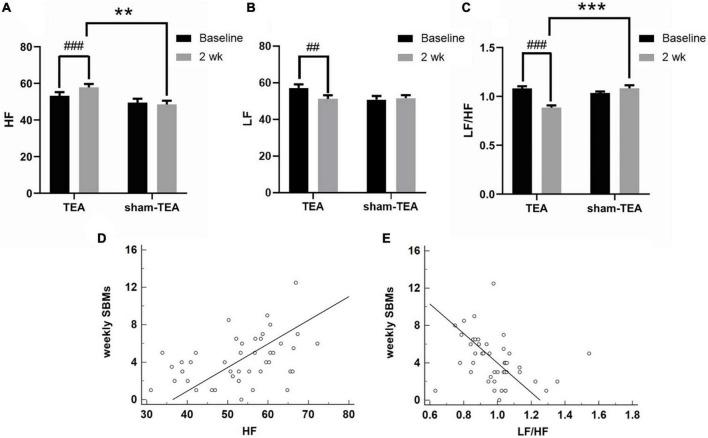
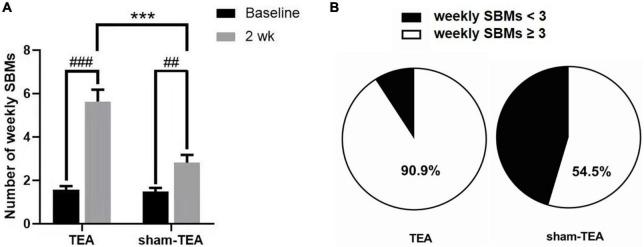
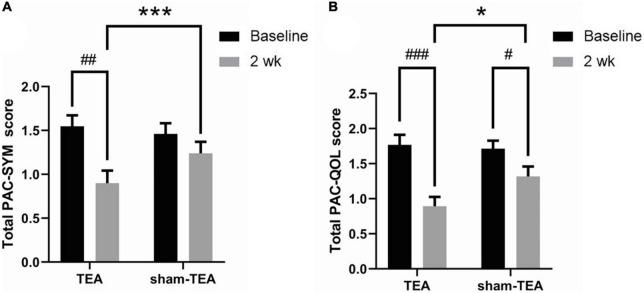
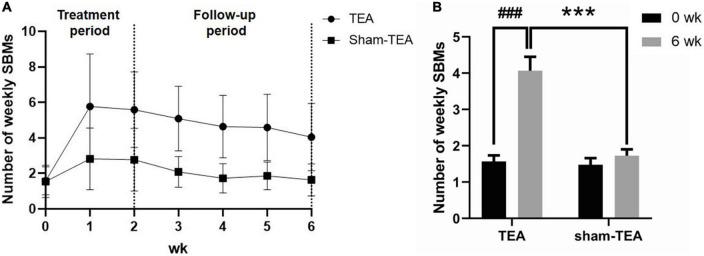
Compared with sham-TEA, 2-week TEA treatment significantly increased the number of spontaneous bowel movements (SBMs) (5.64 ± 0.54 vs. 2.82 ± 0.36, < 0.001) and lowered the total scores of PAC-SYM (0.90 ± 0.14 vs. 1.35 ± 0.13, < 0.001) and PAC-QoL (0.89 ± 0.13 vs. 1.32 ± 0.14, < 0.05). TEA improved symptoms, as reflected by a reduction in the straining ( < 0.001), the incomplete defecation ( < 0.05), the frequency of emergency drug use ( < 0.05), the days of abdominal distension ( < 0.01) and an increase in intestinal satisfaction ( < 0.01). Interestingly, the effects of TEA on the improvement of weekly SBMs sustained four weeks after the cessation of treatment ( < 0.001). Anorectal manometry indicated that 2-week treatment of TEA lowered the threshold of first sensation ( < 0.05), desire of defecation ( < 0.01) and maximum tolerable volume ( < 0.001) compared with sham-TEA group. TEA also significantly enhanced vagal activity, reflected by high-frequency band of heart rate variability, compared with sham-TEA (57.86 ± 1.83 vs. 48.51 ± 2.04, ).
CONCLUSION
TEA ameliorates constipation with sustained effects, which may be mediated via improvement of rectal sensitivity and enhancement of vagal activity.
CLINICAL TRIAL REGISTRATION
[https://clinicaltrials.gov/], identifier [ChiCTR210004267].
背景与目的
慢性便秘的治疗在临床实践中仍然是一项巨大挑战。本研究旨在确定经皮电刺激足三里穴位(TEA)治疗慢性便秘的疗效和持续效果,并探索可能的潜在机制。
方法
招募44例慢性便秘患者,随机分为TEA组或假TEA组。患者记录排便日记。每次就诊时进行便秘症状患者评估(PAC-SYM)和便秘生活质量患者评估(PAC-QoL)问卷调查。通过肛门直肠测压评估肛门和直肠功能。通过对心电图记录得出的心率变异性进行特殊分析来评估自主神经功能。
结果
与假TEA相比,2周的TEA治疗显著增加了自发排便次数(SBMs)(5.64±0.54对2.82±0.36,<0.001),并降低了PAC-SYM总分(0.90±0.14对1.35±0.13,<0.001)和PAC-QoL总分(0.89±0.13对1.32±0.14,<0.05)。TEA改善了症状,表现为用力排便减少(<0.001)、排便不尽减少(<0.05)、应急药物使用频率减少(<0.05)、腹胀天数减少(<0.01)以及肠道满意度增加(<0.01)。有趣的是,TEA对每周SBMs改善的效果在治疗停止后持续了四周(<0.001)。肛门直肠测压表明,与假TEA组相比,2周的TEA治疗降低了首次感觉阈值(<0.05)、排便欲望阈值(<0.01)和最大耐受量阈值(<
 Zotero 插件