Medical Oncology, Santa Chiara Hospital, Largo Medaglie d'Oro 1, 38122, Trento, Italy.
Pathological Anatomy, Santa Chiara Hospital, Trento, Italy.
Target Oncol. 2023 Jan;18(1):129-138. doi: 10.1007/s11523-022-00934-6. Epub 2022 Dec 8.
KRAS is the most frequently mutated gene in non-small cell lung cancer (NSCLC), however conflicting data are available on its role as a biomarker.
The aim of our work was to investigate the impact of KRAS mutations on response and survival outcomes in advanced non-squamous NSCLC patients treated with immune checkpoint inhibitors alone or in combination with chemotherapy.
We retrospectively identified 119 patients, most of whom (58%) were KRAS wild type. For each patient we evaluated overall survival (OS), progression-free survival (PFS), and disease control rate (DCR). An exploratory analysis was performed among KRAS mutated patients to investigate the impact of specific KRAS mutations on response and survival outcomes.
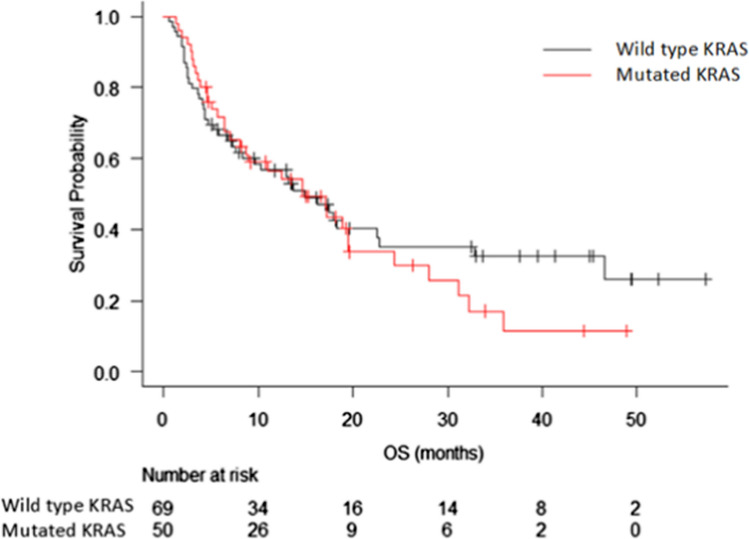
After a median follow-up of 10.3 months, the median OS was 14.9 months (95% confidence interval [CI] 7.6-22.7) in wild-type KRAS patients versus 14.7 months (95% CI 8.0-19.5) in mutated KRAS patients (p = 0.529). No differences were detected between the two groups in terms of PFS and DCR. Patients with a KRAS G12C mutation reported survival and response outcomes that were not statistically different from those of patients with other KRAS mutations.
Our data confirmed that KRAS mutational status is not associated with survival and response outcomes in advanced non-squamous NSCLC patients treated with immunotherapy alone or combined with chemotherapy.
KRAS 是最常发生突变的基因非小细胞肺癌(NSCLC),然而,关于其作为生物标志物的作用存在相互矛盾的数据。
我们的研究旨在探讨 KRAS 突变对单独或联合化疗的免疫检查点抑制剂治疗的晚期非鳞状 NSCLC 患者的反应和生存结局的影响。
我们回顾性地确定了 119 名患者,其中大多数(58%)为 KRAS 野生型。我们评估了每位患者的总生存期(OS)、无进展生存期(PFS)和疾病控制率(DCR)。对 KRAS 突变患者进行了探索性分析,以研究特定 KRAS 突变对反应和生存结局的影响。
在中位随访 10.3 个月后,KRAS 野生型患者的中位 OS 为 14.9 个月(95%置信区间 [CI] 7.6-22.7),而 KRAS 突变型患者为 14.7 个月(95% CI 8.0-19.5)(p=0.529)。两组在 PFS 和 DCR 方面没有差异。KRAS G12C 突变患者的生存和反应结局与其他 KRAS 突变患者没有统计学差异。
我们的数据证实,KRAS 突变状态与单独接受免疫治疗或联合化疗治疗的晚期非鳞状 NSCLC 患者的生存和反应结局无关。