
青春期有助于额-纹状体功能连接的发展,从而支持抑制控制。
Puberty contributes to adolescent development of fronto-striatal functional connectivity supporting inhibitory control.
机构信息
Center for Neuroscience, University of Pittsburgh, Pittsburgh, PA, USA; Center for the Neural Basis of Cognition, University of Pittsburgh, Pittsburgh, PA, USA.
Center for the Neural Basis of Cognition, University of Pittsburgh, Pittsburgh, PA, USA; Department of Psychiatry, University of Pittsburgh, Pittsburgh, PA, USA.
出版信息
Dev Cogn Neurosci. 2022 Dec;58:101183. doi: 10.1016/j.dcn.2022.101183. Epub 2022 Nov 29.
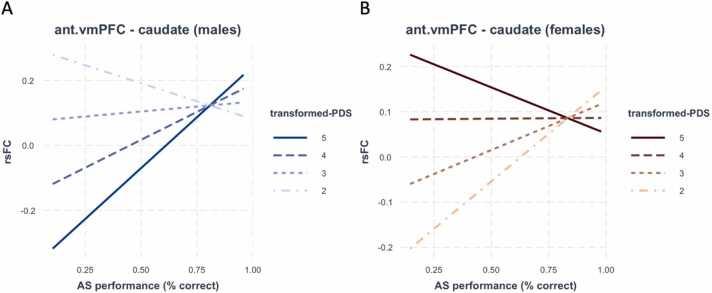
Adolescence is defined by puberty and represents a period characterized by neural circuitry maturation (e.g., fronto-striatal systems) facilitating cognitive improvements. Though studies have characterized age-related changes, the extent to which puberty influences maturation of fronto-striatal networks is less known. Here, we combine two longitudinal datasets to characterize the role of puberty in the development of fronto-striatal resting-state functional connectivity (rsFC) and its relationship to inhibitory control in 106 10-18-year-olds. Beyond age effects, we found that puberty was related to decreases in rsFC between the caudate and the anterior vmPFC, rostral and ventral ACC, and v/dlPFC, as well as with rsFC increases between the dlPFC and nucleus accumbens (NAcc) across males and females. Stronger caudate rsFC with the dlPFC and vlPFC during early puberty was associated with worse inhibitory control and slower correct responses, respectively, whereas by late puberty, stronger vlPFC rsFC with the dorsal striatum was associated with faster correct responses. Taken together, our findings suggest that certain fronto-striatal connections are associated with pubertal maturation beyond age effects, which, in turn are related to inhibitory control. We discuss implications of puberty-related fronto-striatal maturation to further our understanding of pubertal effects related to adolescent cognitive and affective neurodevelopment.
青春期由青春期定义,代表一个以神经回路成熟为特征的时期(例如,额纹状体系统),促进认知的提高。尽管研究已经描述了与年龄相关的变化,但青春期对额纹状体网络成熟的影响程度知之甚少。在这里,我们结合了两个纵向数据集,以描述青春期在 106 名 10-18 岁青少年的额纹状体静息状态功能连接(rsFC)发育中的作用及其与抑制控制的关系。除了年龄的影响外,我们发现青春期与尾状核与前扣带回、额前皮质和腹侧 ACC 以及 dlPFC 和伏隔核(NAcc)之间的 rsFC 减少有关,以及 dlPFC 和 NAcc 之间的 rsFC 增加与男性和女性有关。青春期早期尾状核与 dlPFC 和 vlPFC 的 rsFC 越强,与抑制控制越差和正确反应越慢有关,而在青春期后期,vlPFC 与背侧纹状体的 rsFC 越强,与正确反应越快有关。总之,我们的研究结果表明,某些额纹状体连接与青春期成熟有关,与年龄有关,而青春期成熟又与抑制控制有关。我们讨论了与青春期相关的额纹状体成熟对进一步了解与青少年认知和情感神经发育相关的青春期影响的意义。


 Zotero 插件