Benesch Matthew G K, O'Brien Shalana B L
Department of Surgical Oncology, Roswell Park Comprehensive Cancer Center, Buffalo, NY 14263, USA.
Cancers (Basel). 2022 Nov 25;14(23):5819. doi: 10.3390/cancers14235819.
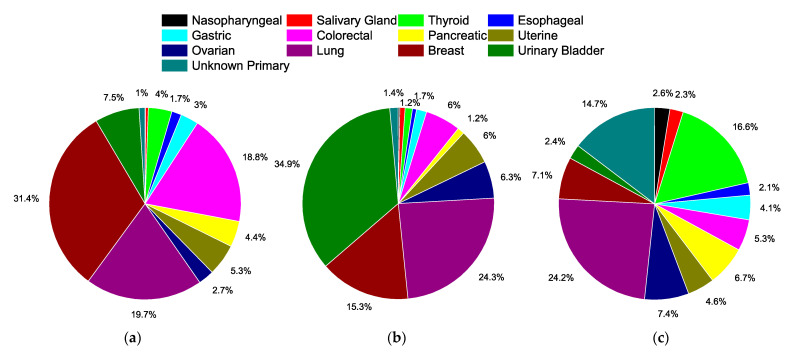
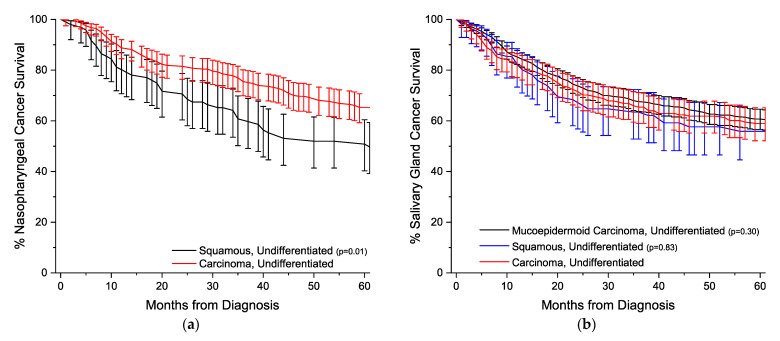
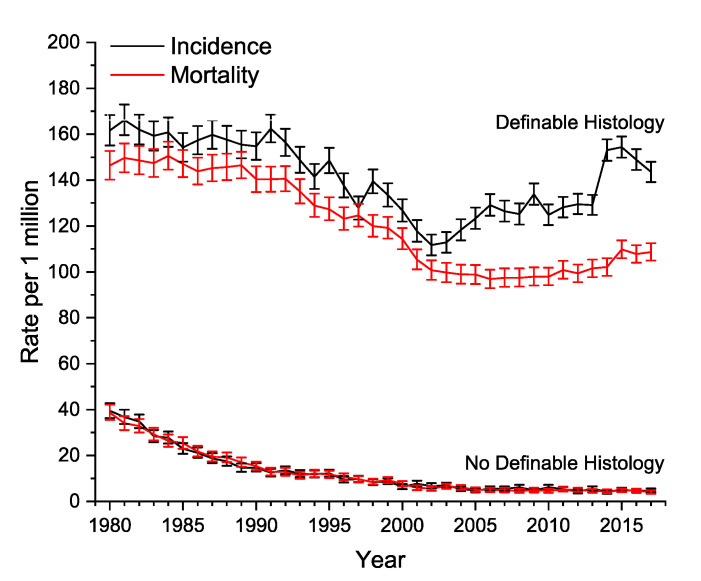
Undifferentiated carcinomas are rare cancers that lack differentiation, such that they cannot be classified into any conventional histological subtype. These cancers are uniquely codified and are contrasted to carcinomas with an ascertained histology that are grade classified as poorly differentiated, undifferentiated, or anaplastic. Given their rarity, there are no standardized overviews of undifferentiated carcinomas in the literature, and it is unknown if their classification indicates a unique prognosis profile. In this study, we summarize the clinicodemographic and mortality outcomes of undifferentiated carcinomas in twelve primary sites and for unknown primaries, comprising 92.8% of all undifferentiated carcinomas diagnosed from 1975-2017 in the Surveillance, Epidemiology, and End Results Program (SEER). Incidence has decreased to 4 per 1 million cancer diagnoses since 1980. Relative to the most common undifferentiated cancers with a defined histology, undifferentiated carcinomas have overall worse prognosis, except in nasopharyngeal and salivary gland cancers (hazard ratio (HR) 0.7-1.3). After correction for age, sex, race, detection stage, and treatment (surgery, chemotherapy, and radiotherapy), the mortality HR averages 1.3-1.4 for these cancers relative to histologically ascertainable undifferentiated cancers. However, there is a wide variance depending on site, signifying that survival outcomes for undifferentiated carcinomas depend on factors related to site tumor biology.
未分化癌是一种罕见的癌症,缺乏分化能力,因此无法归类为任何传统的组织学亚型。这些癌症有独特的编码方式,并与具有明确组织学诊断的癌进行对比,后者根据分级被归类为低分化、未分化或间变。鉴于其罕见性,文献中没有关于未分化癌的标准化综述,而且其分类是否表明独特的预后情况也尚不清楚。在本研究中,我们总结了12个原发部位及原发灶不明的未分化癌的临床人口统计学和死亡率结果,这些病例占监测、流行病学和最终结果计划(SEER)1975 - 2017年诊断的所有未分化癌的92.8%。自1980年以来,发病率已降至每100万例癌症诊断中4例。相对于具有明确组织学诊断的最常见未分化癌,未分化癌总体预后更差,但鼻咽癌和唾液腺癌除外(风险比(HR)为0.7 - 1.3)。在对年龄、性别、种族、检测阶段和治疗(手术、化疗和放疗)进行校正后,这些癌症相对于组织学上可确定的未分化癌的死亡率HR平均为1.3 - 1.4。然而,根据部位不同存在很大差异,这表明未分化癌的生存结果取决于与部位肿瘤生物学相关的因素。