Ueda Koki, Umemoto Yasunori, Kamijo Yoshi-Ichiro, Sakurai Yuta, Araki Shohei, Ise Masato, Yoshioka Izumi, Banno Motohiko, Mochida Satoshi, Iwahashi Takaya, Shimokawa Toshio, Nishimura Yukihide, Tajima Fumihiro
Department of Rehabilitation Medicine, School of Medicine, Wakayama Medical University, Wakayama 641-8509, Japan.
Department of Rehabilitation Medicine, Dokkyo Medical University Saitama Medical Center, Saitama 343-8555, Japan.
J Clin Med. 2022 Nov 23;11(23):6911. doi: 10.3390/jcm11236911.
Spastic hemiplegia causes slow and unstable walking in post-stroke patients. Dynamic tilt table with robotic leg movement (DTTRLM) is safe and effective in improving walking. Functional electric stimulation (FES) improves walking speed in post-stroke patients with spastic hemiplegia. The aim of this study was to determine the effects of combined DTTRLM + FES on walking speed compared with DTTRLM alone.
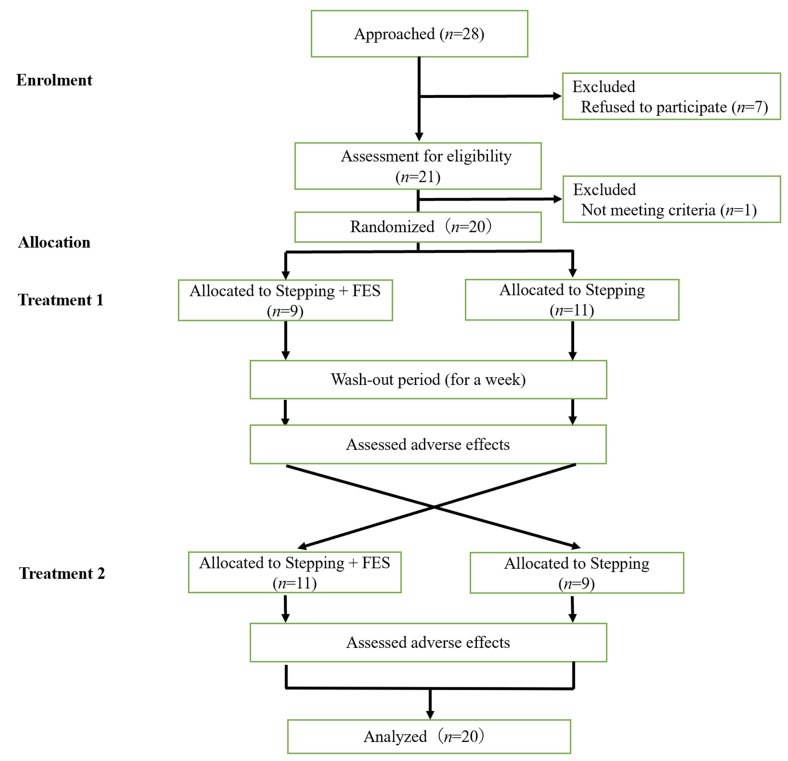
Twenty post-stroke patients were randomly assigned to receive either a single session of stepping + FES treatment or a single session of stepping alone treatment. After a one-week washout period, the same two groups underwent a single session of the other treatment, and the same measurements were taken. We measured walking speed, cadence, and the number of steps in a 10 m walking test (10MWT) and assessed Modified Ashworth Scale (MAS), Fugl-Meyer Assessment (FMA), and range of motion (ROM) before and after the intervention.
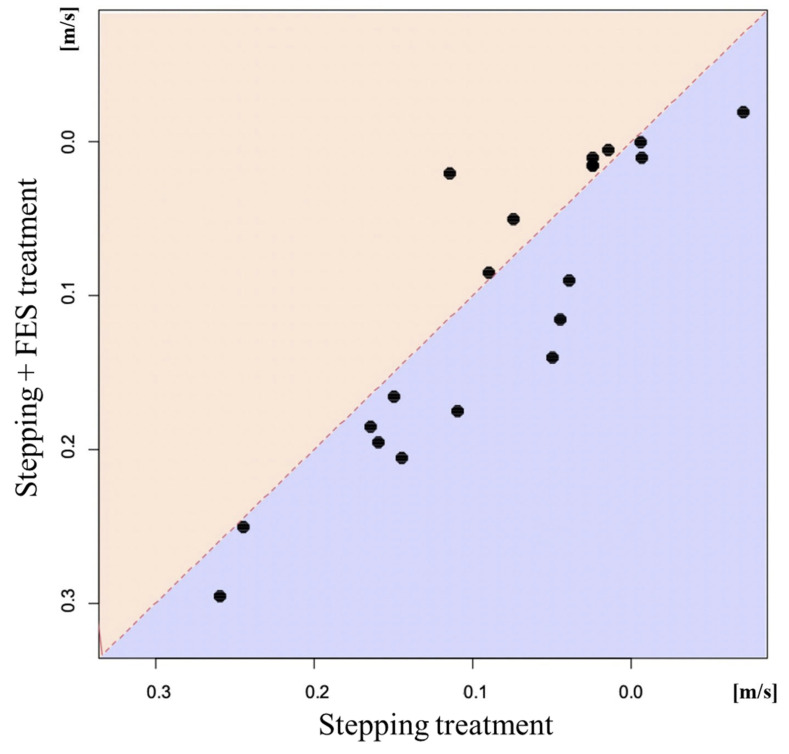
Stepping + FES significantly improved walking speed, number of steps, and ankle inversion ROM, compared with stepping alone. Adverse events were not observed in any subject.
Robotic stepping therapy combined with FES significantly improved 10 m walking speed (10MWS) compared with stepping only in patients with post-stroke and spastic hemiplegia. Further studies are needed to determine the long-term effects of the combination treatment.
痉挛性偏瘫导致中风后患者行走缓慢且不稳定。带有机器人腿部运动的动态倾斜台(DTTRLM)在改善行走方面安全有效。功能性电刺激(FES)可提高中风后痉挛性偏瘫患者的行走速度。本研究的目的是确定与单独使用DTTRLM相比,DTTRLM + FES联合治疗对行走速度的影响。
20名中风后患者被随机分配接受单次踏步 + FES治疗或单次单独踏步治疗。经过为期一周的洗脱期后,同一两组患者接受另一种治疗的单次治疗,并进行相同的测量。我们在10米步行测试(10MWT)中测量了行走速度、步频和步数,并在干预前后评估了改良Ashworth量表(MAS)、Fugl-Meyer评估(FMA)和关节活动范围(ROM)。
与单独踏步相比,踏步 + FES显著提高了行走速度、步数和踝关节内翻ROM。未在任何受试者中观察到不良事件。
与仅进行踏步相比,机器人踏步疗法联合FES在中风后痉挛性偏瘫患者中显著提高了10米行走速度(10MWS)。需要进一步研究来确定联合治疗的长期效果。