Laboratoray of Physics and Physiology, Université Libre de Bruxelles, 1050 Brussels, Belgium.
Laboratory of Image Synthesis and Analysis, Université Libre de Bruxelles, 1050 Brussels, Belgium.
Sensors (Basel). 2022 Dec 6;22(23):9565. doi: 10.3390/s22239565.
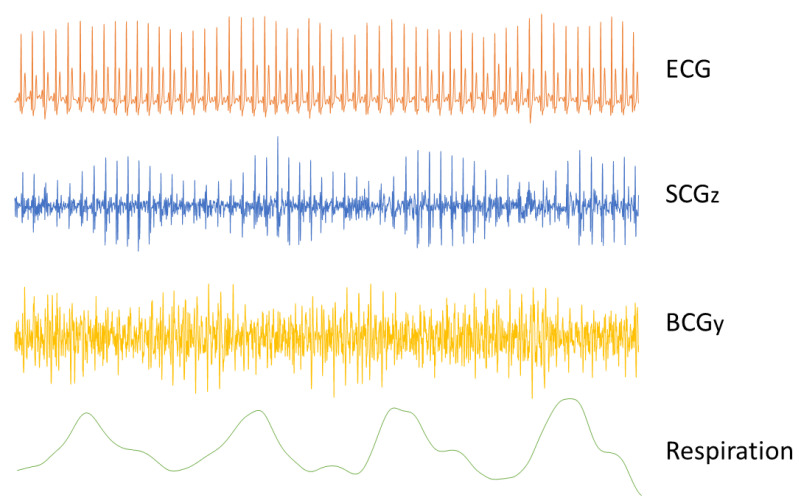
Ballistocardiography (BCG) and seismocardiography (SCG) are non-invasive techniques used to record the micromovements induced by cardiovascular activity at the body's center of mass and on the chest, respectively. Since their inception, their potential for evaluating cardiovascular health has been studied. However, both BCG and SCG are impacted by respiration, leading to a periodic modulation of these signals. As a result, data processing algorithms have been developed to exclude the respiratory signals, or recording protocols have been designed to limit the respiratory bias. Reviewing the present status of the literature reveals an increasing interest in applying these techniques to extract respiratory information, as well as cardiac information. The possibility of simultaneous monitoring of respiratory and cardiovascular signals via BCG or SCG enables the monitoring of vital signs during activities that require considerable mental concentration, in extreme environments, or during sleep, where data acquisition must occur without introducing recording bias due to irritating monitoring equipment. This work aims to provide a theoretical and practical overview of cardiopulmonary interaction based on BCG and SCG signals. It covers the recent improvements in extracting respiratory signals, computing markers of the cardiorespiratory interaction with practical applications, and investigating sleep breathing disorders, as well as a comparison of different sensors used for these applications. According to the results of this review, recent studies have mainly concentrated on a few domains, especially sleep studies and heart rate variability computation. Even in those instances, the study population is not always large or diversified. Furthermore, BCG and SCG are prone to movement artifacts and are relatively subject dependent. However, the growing tendency toward artificial intelligence may help achieve a more accurate and efficient diagnosis. These encouraging results bring hope that, in the near future, such compact, lightweight BCG and SCG devices will offer a good proxy for the gold standard methods for assessing cardiorespiratory function, with the added benefit of being able to perform measurements in real-world situations, outside of the clinic, and thus decrease costs and time.
心冲击图(BCG)和地震心动图(SCG)是两种非侵入性技术,分别用于记录心血管活动在身体质心和胸部引起的微运动。自诞生以来,它们在评估心血管健康方面的潜力一直受到研究。然而,BCG 和 SCG 都受到呼吸的影响,导致这些信号的周期性调制。因此,已经开发了数据处理算法来排除呼吸信号,或者设计了记录协议来限制呼吸偏差。回顾目前的文献状况表明,人们越来越有兴趣应用这些技术来提取呼吸信息和心脏信息。通过 BCG 或 SCG 同时监测呼吸和心血管信号的可能性使得可以在需要大量精神集中、在极端环境中或在睡眠期间监测生命体征,在睡眠期间,数据采集必须在不由于刺激监测设备而引入记录偏差的情况下进行。这项工作旨在提供基于 BCG 和 SCG 信号的心肺相互作用的理论和实践概述。它涵盖了提取呼吸信号的最新改进,计算与实际应用相关的心呼吸相互作用标记,以及研究睡眠呼吸障碍,以及比较用于这些应用的不同传感器。根据这项综述的结果,最近的研究主要集中在几个领域,特别是睡眠研究和心率变异性计算。即使在这些情况下,研究人群也不总是庞大或多样化。此外,BCG 和 SCG 容易受到运动伪影的影响,并且相对依赖于个体。然而,人工智能的增长趋势可能有助于实现更准确和高效的诊断。这些令人鼓舞的结果带来了希望,即在不久的将来,这种紧凑、轻便的 BCG 和 SCG 设备将为评估心呼吸功能的黄金标准方法提供良好的替代方法,并且还能够在实际情况下进行测量,在诊所之外,从而降低成本和时间。