Wageningen Environmental Research, Wageningen University and Research, Wageningen, The Netherlands.
Forest Ecology and Forest Management Group, Wageningen University and Research, Wageningen, The Netherlands.
Glob Chang Biol. 2023 Mar;29(5):1359-1376. doi: 10.1111/gcb.16531. Epub 2022 Dec 12.
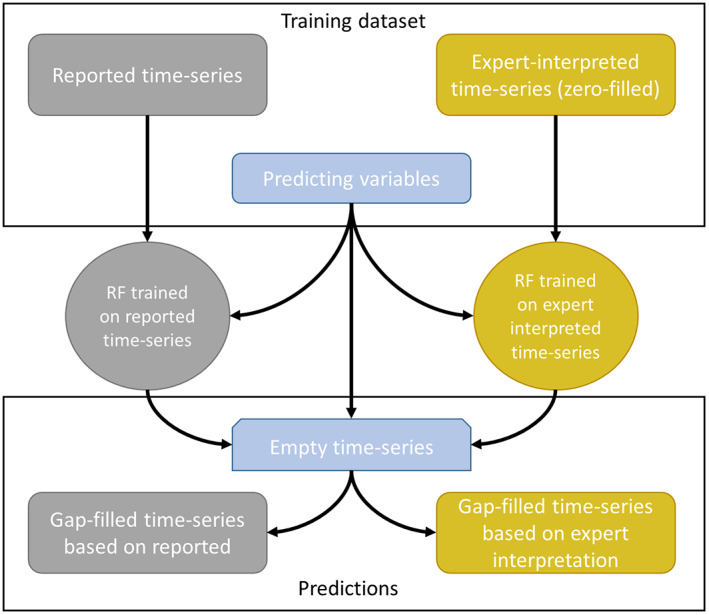
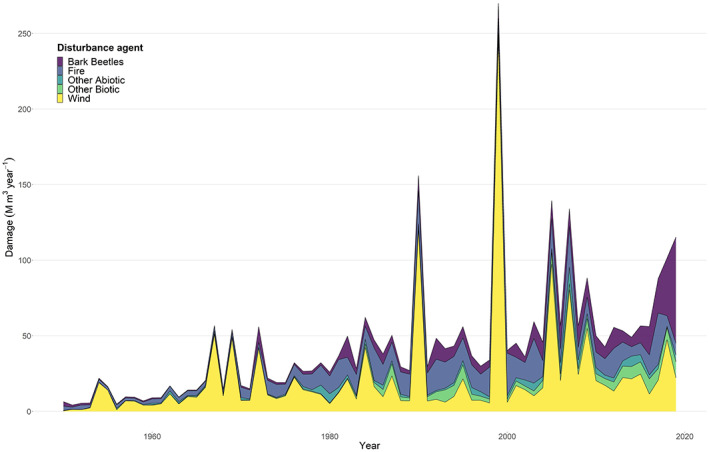
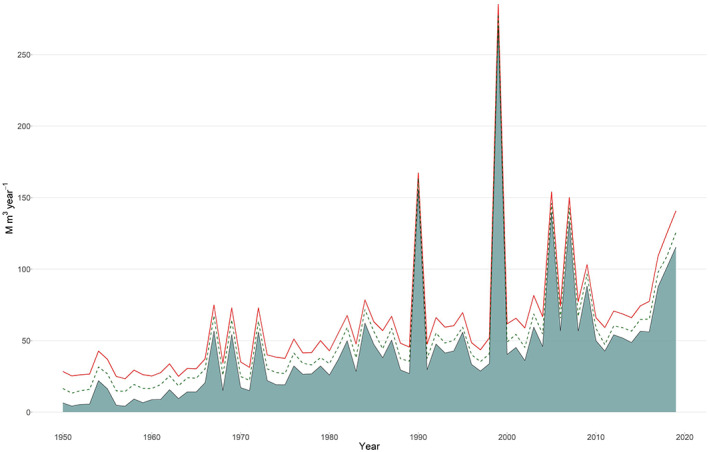
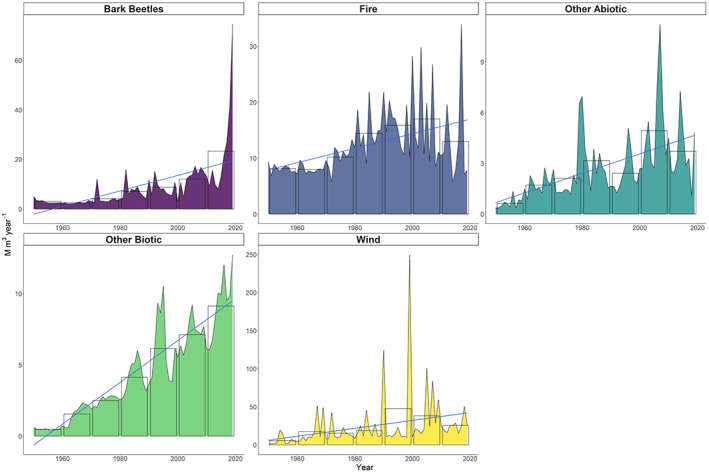
Over the last decades, the natural disturbance is increasingly putting pressure on European forests. Shifts in disturbance regimes may compromise forest functioning and the continuous provisioning of ecosystem services to society, including their climate change mitigation potential. Although forests are central to many European policies, we lack the long-term empirical data needed for thoroughly understanding disturbance dynamics, modeling them, and developing adaptive management strategies. Here, we present a unique database of >170,000 records of ground-based natural disturbance observations in European forests from 1950 to 2019. Reported data confirm a significant increase in forest disturbance in 34 European countries, causing on an average of 43.8 million m of disturbed timber volume per year over the 70-year study period. This value is likely a conservative estimate due to under-reporting, especially of small-scale disturbances. We used machine learning techniques for assessing the magnitude of unreported disturbances, which are estimated to be between 8.6 and 18.3 million m /year. In the last 20 years, disturbances on average accounted for 16% of the mean annual harvest in Europe. Wind was the most important disturbance agent over the study period (46% of total damage), followed by fire (24%) and bark beetles (17%). Bark beetle disturbance doubled its share of the total damage in the last 20 years. Forest disturbances can profoundly impact ecosystem services (e.g., climate change mitigation), affect regional forest resource provisioning and consequently disrupt long-term management planning objectives and timber markets. We conclude that adaptation to changing disturbance regimes must be placed at the core of the European forest management and policy debate. Furthermore, a coherent and homogeneous monitoring system of natural disturbances is urgently needed in Europe, to better observe and respond to the ongoing changes in forest disturbance regimes.
在过去的几十年里,自然干扰对欧洲森林的压力越来越大。干扰机制的转变可能会影响森林的功能和生态系统服务的持续供应,包括其减缓气候变化的潜力。尽管森林是许多欧洲政策的核心,但我们缺乏彻底了解干扰动态、对其进行建模以及制定适应性管理策略所需的长期经验数据。在这里,我们提出了一个独特的数据库,其中包含 1950 年至 2019 年欧洲森林中超过 17 万次基于地面的自然干扰观测记录。报告的数据证实,34 个欧洲国家的森林干扰显著增加,在 70 年的研究期间,每年平均造成 4380 万立方米受干扰木材。由于报告不足,特别是对小规模干扰的报告不足,这一数值可能是保守估计。我们使用机器学习技术评估未报告干扰的程度,估计每年未报告的干扰在 860 万至 1830 万立方米之间。在过去的 20 年里,干扰平均占欧洲年平均采伐量的 16%。在研究期间,风是最重要的干扰因素(占总损害的 46%),其次是火灾(24%)和树皮甲虫(17%)。在过去的 20 年里,树皮甲虫干扰的份额翻了一番。森林干扰会对生态系统服务(如减缓气候变化)产生深远影响,影响区域森林资源供应,并因此扰乱长期管理规划目标和木材市场。我们的结论是,必须将适应不断变化的干扰机制置于欧洲森林管理和政策辩论的核心。此外,欧洲迫切需要一个连贯和统一的自然干扰监测系统,以便更好地观察和应对森林干扰机制的持续变化。