Choi Ji Eun, Heo Seo-Hee, Chung Woo-Hyun
College of Pharmacy, Duksung Women's University, Seoul, South Korea.
Innovative Drug Center, Duksung Women's University, Seoul, South Korea.
Front Microbiol. 2022 Nov 23;13:1026780. doi: 10.3389/fmicb.2022.1026780. eCollection 2022.
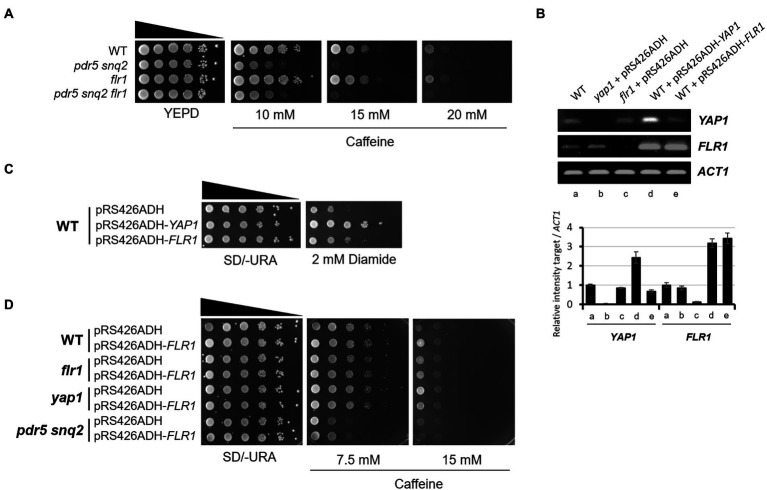
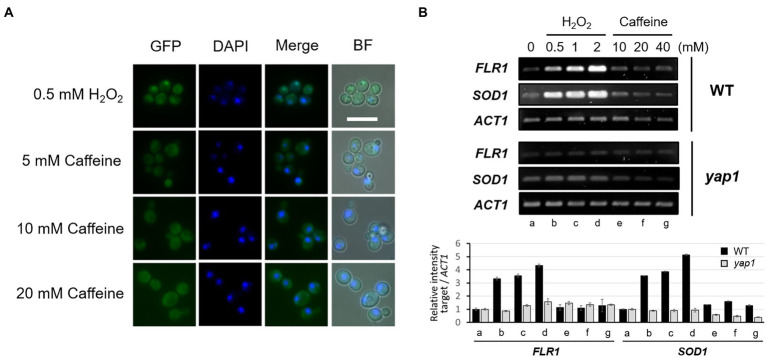
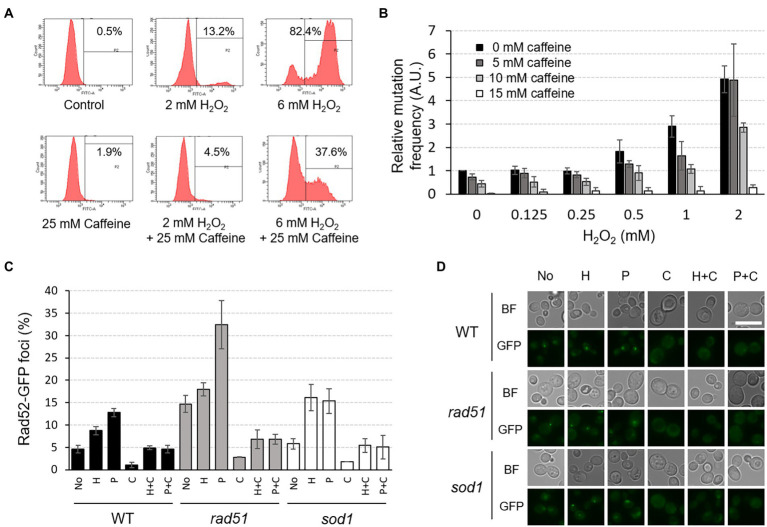
Caffeine, a methylxanthine derivative, affects various physiological conditions such as cell growth, proliferation, and energy metabolism. A genome-wide screening for genes required for caffeine resistance in revealed several candidates, including Pap1 and downstream target genes involved in caffeine efflux. We found that Yap1, a budding yeast AP-1 homolog required for oxidative stress response, has a caffeine tolerance function. Although the mutant is not sensitive to caffeine, overexpression of Yap1 renders cells resistant to high concentrations of caffeine. Caffeine sensitivity of mutants lacking two multidrug transporters, Pdr5 or Snq2, is completely recovered by Yap1 overexpression. Among Yap1-dependent target genes, , a fluconazole-resistant gene, is necessary but not sufficient for caffeine tolerance. Low concentrations of hydrogen peroxide induce Yap1 activation, which restores cell viability against caffeine toxicity. Intriguingly, oxidative stress-mediated cellular adaptation to caffeine toxicity requires Yap1, but not Flr1. Moreover, caffeine is involved in reduction of intracellular reactive oxygen species (ROS), as well as mutation rate and Rad52 foci formation. Altogether, we identified novel reciprocal crosstalk between ROS signaling and caffeine resistance.
咖啡因是一种甲基黄嘌呤衍生物,会影响多种生理状况,如细胞生长、增殖和能量代谢。一项针对咖啡因抗性所需基因的全基因组筛选揭示了几个候选基因,包括Pap1以及参与咖啡因外排的下游靶基因。我们发现,Yap1是一种参与氧化应激反应的芽殖酵母AP - 1同源物,具有咖啡因耐受功能。尽管 突变体对咖啡因不敏感,但Yap1的过表达使细胞对高浓度咖啡因具有抗性。缺乏两种多药转运蛋白Pdr5或Snq2的突变体的咖啡因敏感性可通过Yap1的过表达完全恢复。在Yap1依赖的靶基因中, 是一种氟康唑抗性基因,对咖啡因耐受是必要但不充分的。低浓度的过氧化氢会诱导Yap1激活,从而恢复细胞对咖啡因毒性的活力。有趣的是,氧化应激介导的细胞对咖啡因毒性的适应需要Yap1,而不是Flr1。此外,咖啡因还参与细胞内活性氧(ROS)的减少以及突变率和Rad52焦点形成。总之,我们确定了ROS信号与咖啡因抗性之间新的相互作用。 (注:原文中存在一些未明确的指代内容,如“ ”,翻译时保留原样)