Liu Huamin, Huang Zhiwei, Zhang Xiaochun, He Yong, Gu Shanyuan, Mo Dan, Wang Shaoli, Yuan Zelin, Huang Yining, Zhong Qi, Zhou Rui, Wu Keyi, Zou Fei, Wu Xianbo
Department of Epidemiology, Guangdong Provincial Key Laboratory of Tropical Disease Research, School of Public Health, Southern Medical University, Guangzhou, China.
Baiyun Jingkang Hospital, Guangzhou, China.
Front Psychiatry. 2022 Nov 24;13:1013698. doi: 10.3389/fpsyt.2022.1013698. eCollection 2022.
The association between blood lipids and cognitive function in schizophrenia is still controversial. Thus, the present study aimed to verify the association between various lipid parameters and cognitive impairment in schizophrenic patients and potential lipid pathways.
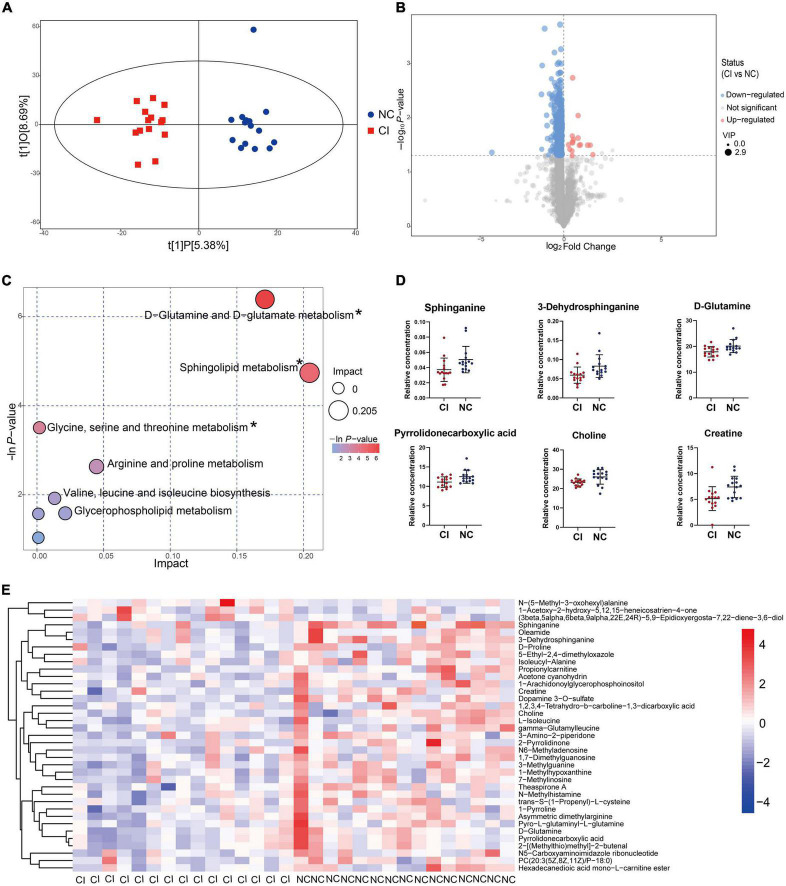
A total of 447 adult inpatients with schizophrenia were divided into cognitive normal and cognitive impairment groups based on the Mini-Mental State Examination with a cut-off of 26. The blood lipid parameters were defined as abnormal levels based on the guideline. The liquid chromatography-mass spectrometry method was used to preliminarily explore the potential lipid metabolism pathway associated with cognitive impairment.
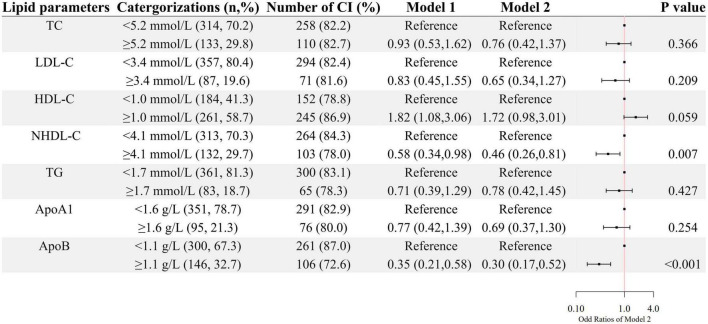
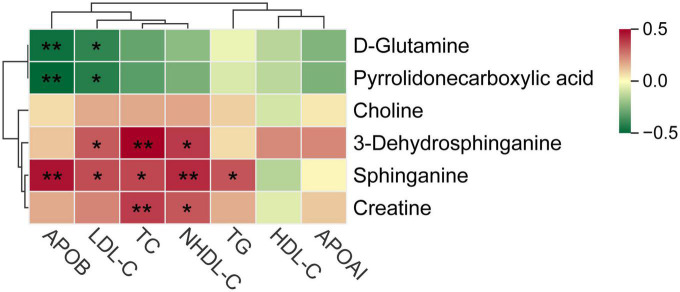
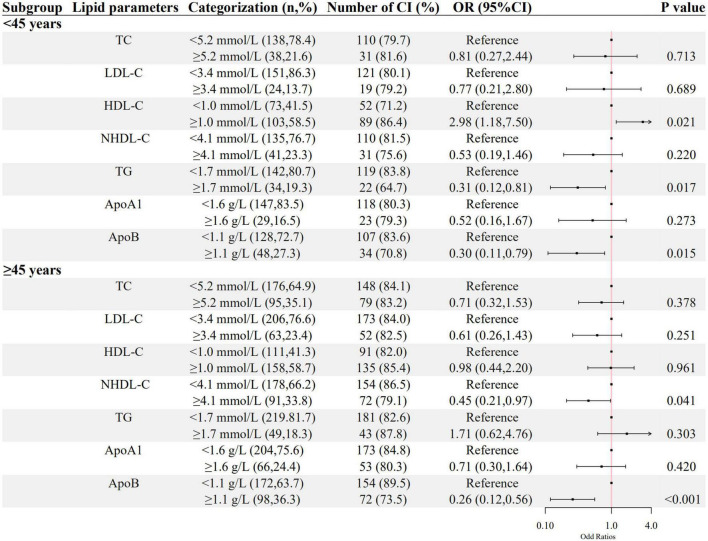
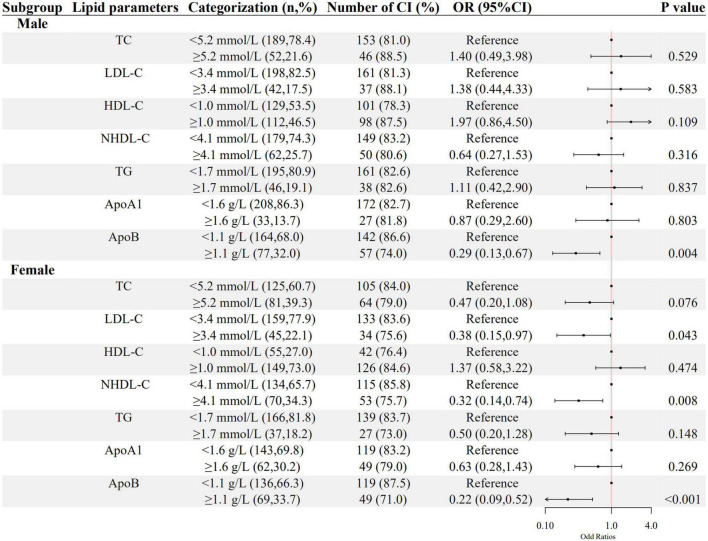
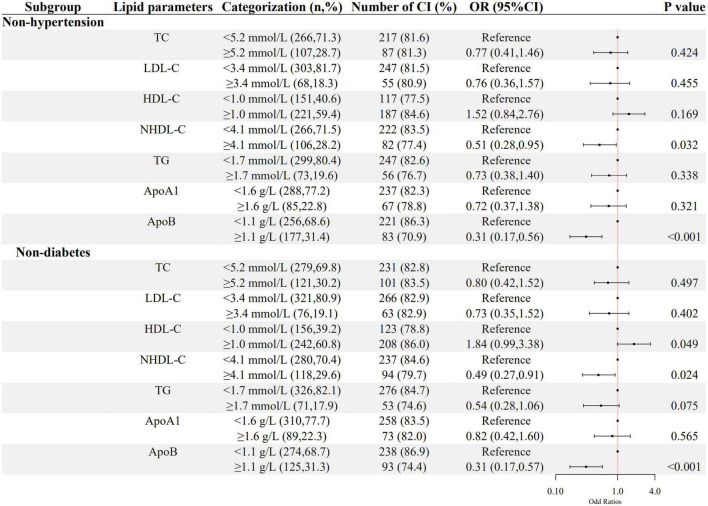
There were 368 (82.3%) patients who had cognitive impairment. Herein, apolipoprotein B was positively associated with cognitive function in overall patients and age (≥45 and <45 years) and sex subgroups. After excluding patients with hypertension and diabetes, ApoB was still significantly associated with cognitive function in all the patients. The associations between other lipid parameters, including non-high-density lipoprotein cholesterol, low-density lipoprotein cholesterol, high-density lipoprotein cholesterol and triglyceride, and cognitive impairment were heterogeneous in age and sex subgroups. In contrast, total cholesterol and apolipoprotein A1 were not significantly associated with cognitive impairment. Metabolomics analysis showed that metabolic pathway mainly involved sphingolipid metabolism. Meanwhile, sphinganine and 3-dehydrosphinganine were positively correlated with lipid parameters and decreased in patients with cognitive impairment as compared to those with normal cognition.
The present study suggests a positive association between lipids and cognitive function in schizophrenic patients and needs to be further verified by a prospective study.
精神分裂症患者血脂与认知功能之间的关联仍存在争议。因此,本研究旨在验证精神分裂症患者各种血脂参数与认知障碍之间的关联以及潜在的血脂通路。
基于简易精神状态检查表(临界值为26),将447例成年精神分裂症住院患者分为认知正常组和认知障碍组。根据指南将血脂参数定义为异常水平。采用液相色谱-质谱法初步探索与认知障碍相关的潜在脂质代谢途径。
有368例(82.3%)患者存在认知障碍。在此,载脂蛋白B在总体患者以及年龄(≥45岁和<45岁)和性别亚组中与认知功能呈正相关。排除高血压和糖尿病患者后,载脂蛋白B在所有患者中仍与认知功能显著相关。其他血脂参数,包括非高密度脂蛋白胆固醇、低密度脂蛋白胆固醇、高密度脂蛋白胆固醇和甘油三酯,与认知障碍之间的关联在年龄和性别亚组中存在异质性。相比之下,总胆固醇和载脂蛋白A1与认知障碍无显著关联。代谢组学分析表明,代谢途径主要涉及鞘脂代谢。同时,鞘氨醇和3-脱氢鞘氨醇与血脂参数呈正相关,与认知正常的患者相比,认知障碍患者的这些指标降低。
本研究表明精神分裂症患者血脂与认知功能之间存在正相关,需要通过前瞻性研究进一步验证。