Division of Pharmaceutics and Pharmacology, College of Pharmacy & Comprehensive Cancer Center, The Ohio State University, Columbus, OH 43210.
Division of Outcomes and Translational Sciences, College of Pharmacy & Comprehensive Cancer Center, The Ohio State University, Columbus, OH 43210.
Cancer Res Commun. 2022 Nov;2(11):1334-1343. doi: 10.1158/2767-9764.crc-22-0172. Epub 2022 Nov 3.
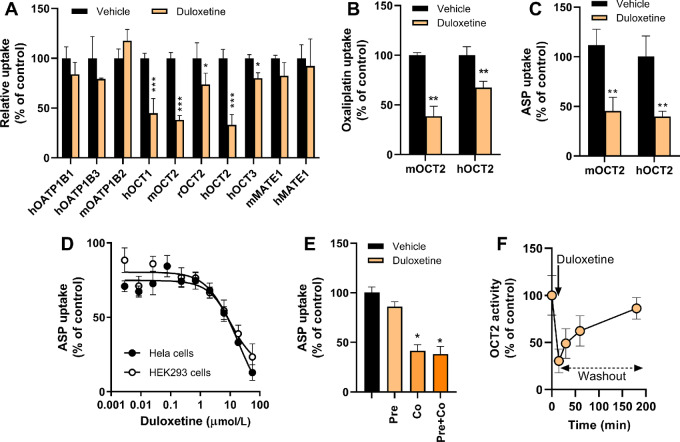
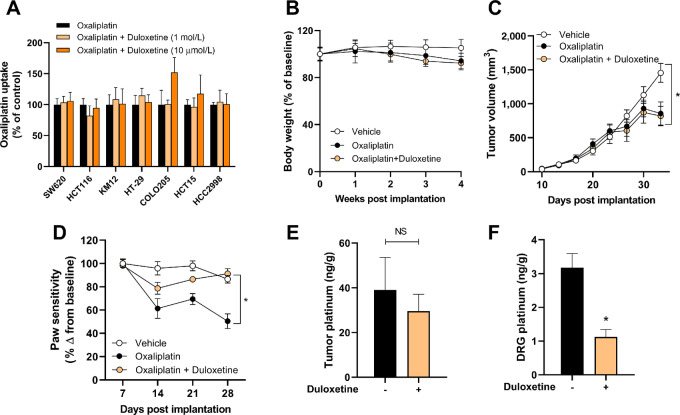
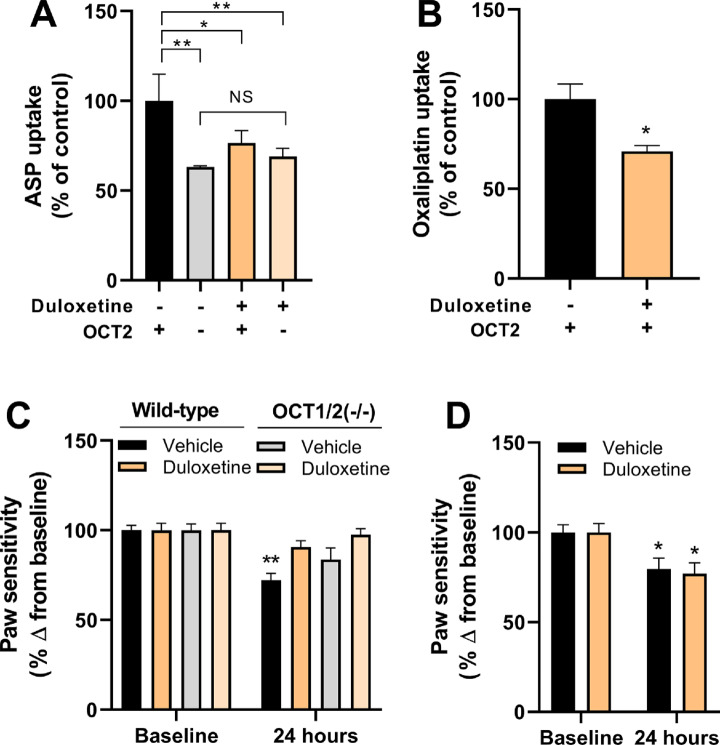
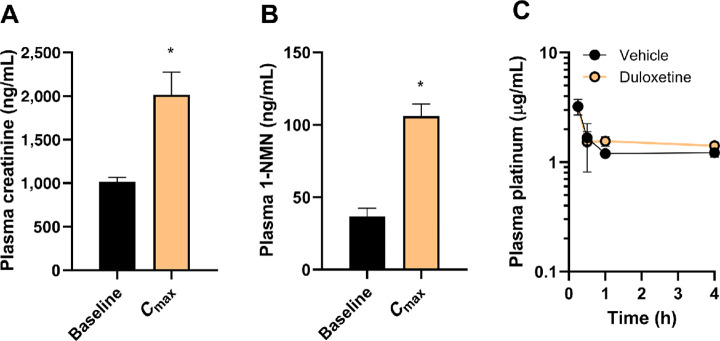
Oxaliplatin-induced peripheral neurotoxicity (OIPN) is a debilitating side effect that afflicts ~90% of patients that is initiated by OCT2-dependent uptake of oxaliplatin in DRG neurons. The antidepressant drug duloxetine has been used to treat OIPN, although its usefulness in preventing this side effect remains unclear. We hypothesized that duloxetine has OCT2-inhibitory properties and can be used as an adjunct to oxaliplatin-based regimens to prevent OIPN. Transport studies were performed in cells stably transfected with mouse or human OCT2 and in isolated mouse DRG neurons . Wild-type and OCT2-deficient mice were used to assess effects of duloxetine on hallmarks of OIPN, endogenous OCT2 biomarkers, and the pharmacokinetics of oxaliplatin, and the translational feasibility of a duloxetine-oxaliplatin combination was evaluated in various models of colorectal cancer. We found that duloxetine potently inhibited the OCT2-mediated transport of several xenobiotic substrates, including oxaliplatin, in a reversible, concentration-dependent manner, and independent of species and cell context. Furthermore, duloxetine restricted access of these substrates to DRG neurons and prevented OIPN in wild-type mice to a degree similar to the complete protection observed in OCT2-deficient mice, without affecting the plasma levels of oxaliplatin. Importantly, the uptake and cytotoxicity of oxaliplatin in tumor cell lines and were not negatively influenced by duloxetine. The observed OCT2-targeting properties of duloxetine, combined with the potential for clinical translation, provide support for its further exploration as a therapeutic candidate for studies aimed at preventing OIPN in cancer patients requiring treatment with oxaliplatin.
We found that duloxetine has potent OCT2-inhibitory properties and can diminish excessive accumulation of oxaliplatin into DRG neurons. In addition, pre-treatment of mice with duloxetine prevented OIPN without significantly altering the plasma pharmacokinetics and antitumor properties of oxaliplatin. These results suggest that intentional inhibition of OCT2-mediated transport by duloxetine can be employed as a prevention strategy to ameliorate OIPN without compromising the effectiveness of oxaliplatin-based treatment.
奥沙利铂引起的周围神经毒性(OIPN)是一种使人虚弱的副作用,影响约 90%的患者,其由 OCT2 依赖性摄取奥沙利铂在 DRG 神经元中引发。抗抑郁药度洛西汀已被用于治疗 OIPN,尽管其在预防这种副作用方面的有效性尚不清楚。我们假设度洛西汀具有 OCT2 抑制特性,可作为奥沙利铂治疗方案的辅助手段,以预防 OIPN。在稳定转染小鼠或人 OCT2 的细胞和分离的小鼠 DRG 神经元中进行转运研究。使用野生型和 OCT2 缺陷型小鼠来评估度洛西汀对 OIPN 特征、内源性 OCT2 生物标志物和奥沙利铂药代动力学的影响,并在各种结直肠癌模型中评估度洛西汀-奥沙利铂联合治疗的转化可行性。我们发现,度洛西汀以可逆、浓度依赖性的方式强烈抑制几种外源性底物(包括奥沙利铂)的 OCT2 介导的转运,并且与物种和细胞背景无关。此外,度洛西汀限制这些底物进入 DRG 神经元,并在野生型小鼠中预防 OIPN,其程度类似于在 OCT2 缺陷型小鼠中观察到的完全保护,而不影响奥沙利铂的血浆水平。重要的是,度洛西汀对肿瘤细胞系中的奥沙利铂摄取和细胞毒性没有负面影响。度洛西汀的观察到的 OCT2 靶向特性,加上临床转化的潜力,为进一步探索其作为治疗候选物以预防需要奥沙利铂治疗的癌症患者的 OIPN 提供了支持。
我们发现度洛西汀具有强大的 OCT2 抑制特性,可以减少奥沙利铂过度积聚到 DRG 神经元中。此外,在使用奥沙利铂治疗之前,用度洛西汀预处理小鼠可以预防 OIPN,而不会显著改变奥沙利铂的血浆药代动力学和抗肿瘤特性。这些结果表明,通过度洛西汀有意抑制 OCT2 介导的转运可以作为一种预防策略,以改善 OIPN,而不影响基于奥沙利铂的治疗效果。