Chuang Ling, Enders Anton, Offermann Sascha, Bahnemann Janina, Franke Jakob
Centre of Biomolecular Drug Research Leibniz University Hannover Hannover Germany.
Institute of Technical Chemistry Leibniz University Hannover Hannover Germany.
Eng Life Sci. 2022 Aug 15;22(12):803-810. doi: 10.1002/elsc.202200001. eCollection 2022 Dec.
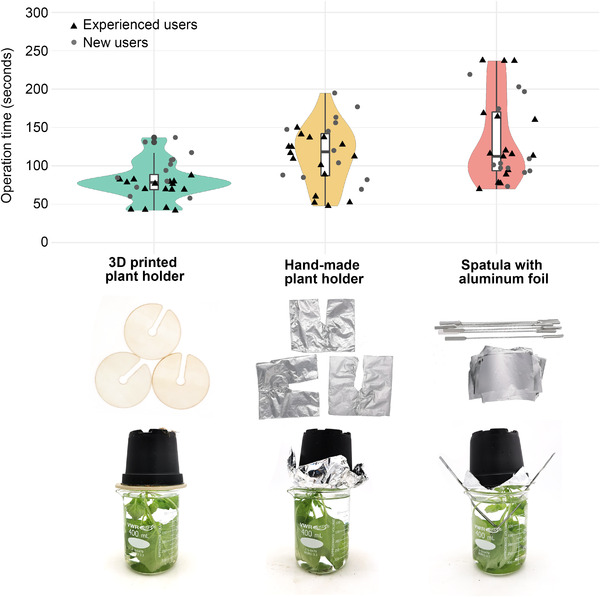
The Australian tobacco plant is becoming increasingly popular as a platform for protein production and metabolic engineering. In this system, gene expression is achieved transiently by infiltrating plants with suspensions of carrying vectors with the target genes. To infiltrate larger numbers of plants, vacuum infiltration is the most efficient approach known, which is already used on industrial scale. Current laboratory-scale solutions for vacuum infiltration, however, either require expensive custom-tailored equipment or produce large amounts of biologically contaminated waste. To overcome these problems and lower the burden to establish vacuum infiltration in new laboratories, we present here 3D-printed plant holders for vacuum infiltration. We demonstrate that our plant holders are simple to use and enable a throughput of around 40 plants per hour. In addition, our 3D-printed plant holders are made from autoclavable material, which tolerate at least 12 autoclave cycles, helping to limit the production of contaminated waste and thus contributing to increased sustainability in research. In conclusion, our plant holders provide a simple, robust, safe and transparent platform for laboratory-scale vacuum infiltration that can be readily adopted by new laboratories interested in protein and metabolite production in . Practical application Transient expression in provides a popular and rapid system for producing proteins in a plant host. To infiltrate larger numbers of plants (typically >20), vacuum infiltration is the method of choice. However, no system has been described so far which is robust to use and can be used without expensive and complex equipment. Our autoclavable 3D-printed plant holders presented here will greatly reduce the efforts required to adopt the vacuum infiltration technique in new laboratories. They are easy to use and can be autoclaved at least 12 times, which contributes to waste reduction and sustainability in research laboratories. We anticipate that the 3D printing design provided here will drastically lower the bar for new groups to employ vacuum infiltration for producing proteins and metabolites in .
澳大利亚烟草植物作为蛋白质生产和代谢工程的平台正变得越来越受欢迎。在这个系统中,通过用携带目标基因的载体悬浮液浸润植物来实现基因的瞬时表达。为了浸润更多数量的植物,真空浸润是已知的最有效的方法,并且已经在工业规模上使用。然而,目前实验室规模的真空浸润解决方案要么需要昂贵的定制设备,要么会产生大量生物污染废物。为了克服这些问题并减轻新实验室建立真空浸润的负担,我们在此展示用于真空浸润的3D打印植物固定器。我们证明我们的植物固定器使用简单,每小时可处理约40株植物。此外,我们的3D打印植物固定器由可高压灭菌的材料制成,可耐受至少12次高压灭菌循环,有助于限制污染废物的产生,从而提高研究的可持续性。总之,我们的植物固定器为实验室规模的真空浸润提供了一个简单、坚固、安全且透明的平台,新实验室若对烟草中的蛋白质和代谢物生产感兴趣,可轻松采用。实际应用 烟草中的瞬时表达为在植物宿主中生产蛋白质提供了一个流行且快速的系统。为了浸润更多数量的植物(通常>20株),真空浸润是首选方法。然而,到目前为止,尚未描述出一种使用起来稳健且无需昂贵复杂设备的系统。我们在此展示的可高压灭菌的3D打印植物固定器将大大减少新实验室采用真空浸润技术所需的工作量。它们易于使用,并且可以高压灭菌至少12次,这有助于减少研究实验室的废物并提高可持续性。我们预计,此处提供的3D打印设计将大幅降低新团队在烟草中采用真空浸润来生产蛋白质和代谢物的门槛。