School of Control Engineering, Northeastern University at Qinhuangdao, Qinhuangdao 066004, China.
School of Control Engineering, Northeastern University at Qinhuangdao, Qinhuangdao 066004, China; Hebei Key Laboratory of Micro-Nano Precision Optical Sensing and Measurement Technology, Qinhuangdao 066004, China.
Poult Sci. 2023 Feb;102(2):102348. doi: 10.1016/j.psj.2022.102348. Epub 2022 Nov 19.
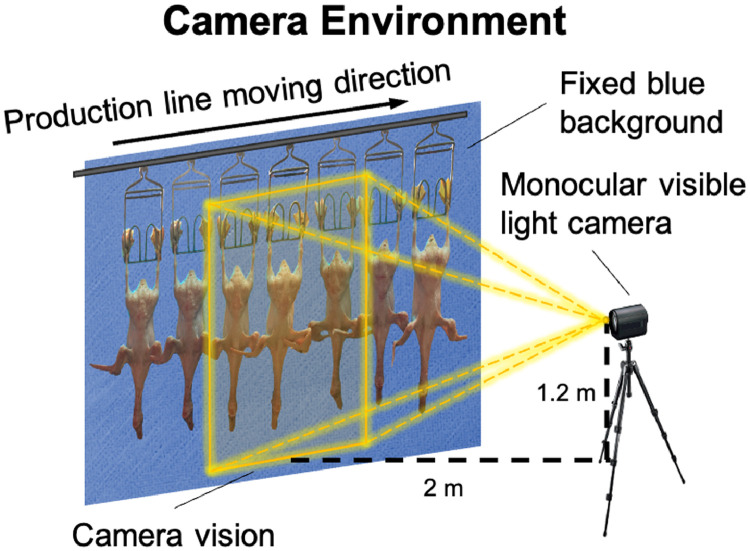
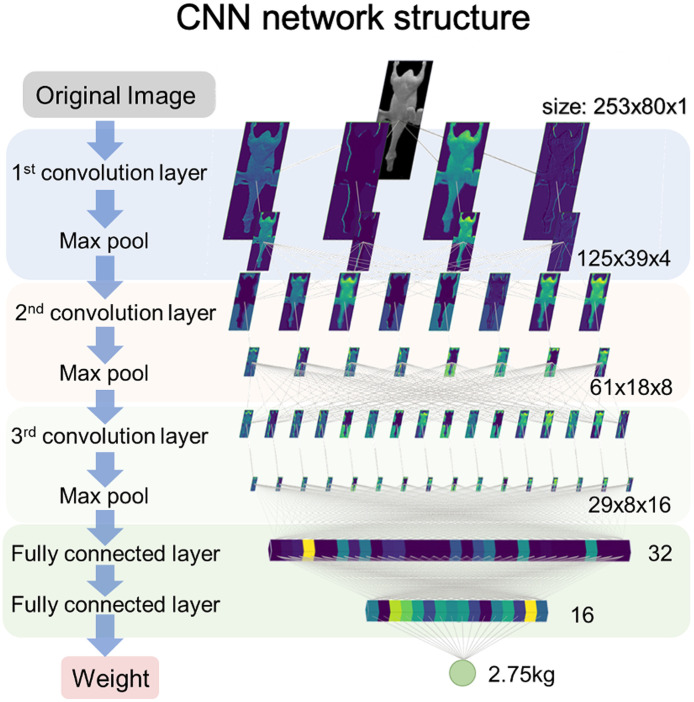
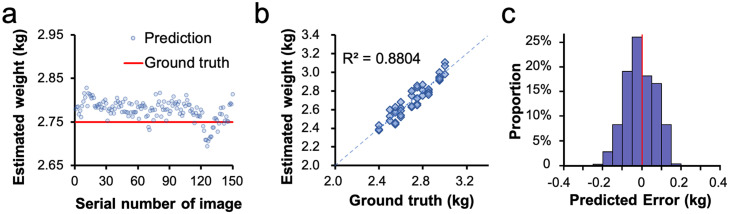
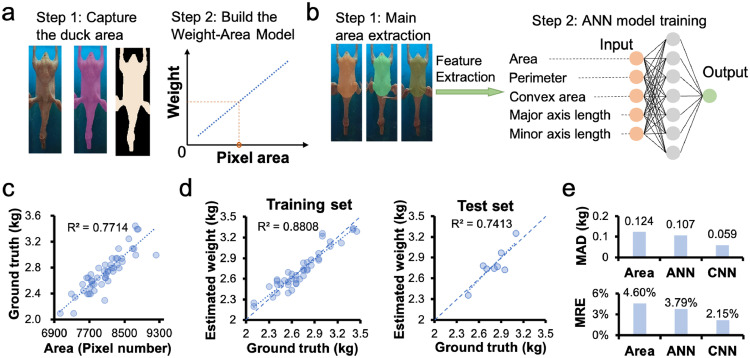
The increasing consumption of ducks and chickens in China demands characterizing carcasses of domestic birds efficiently. Most existing methods, however, were developed for characterizing carcasses of pigs or cattle. Here, we developed a noncontact and automated weighing method for duck carcasses hanging on a production line. A 2D camera with its facilitating parts recorded the moving duck carcasses on the production line. To estimate the weight of carcasses, the images in the acquired dataset were modeled by a convolution neuron network (CNN). This model was trained and evaluated using 10-fold cross-validation. The model estimated the weight of duck carcasses precisely with a mean abstract deviation (MAD) of 58.8 grams and a mean relative error (MRE) of 2.15% in the testing dataset. Compared with 2 widely used methods, pixel area linear regression and the artificial neural network (ANN) model, our model decreases the estimation error MAD by 64.7 grams (52.4%) and 48.2 grams (45.0%). We release the dataset and code at https://github.com/RuoyuChen10/Image_weighing.
中国对鸭和鸡的消费需求不断增加,这就要求高效地对家禽胴体进行分类。然而,现有的大多数方法都是为了对猪或牛的胴体进行分类而开发的。在这里,我们开发了一种用于悬挂在生产线上的鸭胴体的非接触式自动称重方法。带有辅助部件的 2D 相机记录了生产线上移动的鸭胴体。为了估计胴体的重量,通过卷积神经元网络(CNN)对采集到的数据集的图像进行建模。该模型通过 10 折交叉验证进行训练和评估。该模型在测试数据集上的平均绝对偏差(MAD)为 58.8 克,平均相对误差(MRE)为 2.15%,能够精确地估计鸭胴体的重量。与 2 种广泛使用的方法,即像素面积线性回归和人工神经网络(ANN)模型相比,我们的模型将估计误差 MAD 分别降低了 64.7 克(52.4%)和 48.2 克(45.0%)。我们在 https://github.com/RuoyuChen10/Image_weighing 上发布了数据集和代码。