Otsuka-Kamakura Narumi, Sugiura Yoshiya, Yamazaki Toshiki, Shimizu Naomi, Hiruta Nobuyuki
Department of Pathology, Sakura Hospital, Toho University Medical Center, Sakura, Japan.
Department of Surgical Pathology, Sakura Hospital, Toho University Medical Center, Sakura, Japan.
Front Oncol. 2022 Nov 29;12:1023785. doi: 10.3389/fonc.2022.1023785. eCollection 2022.
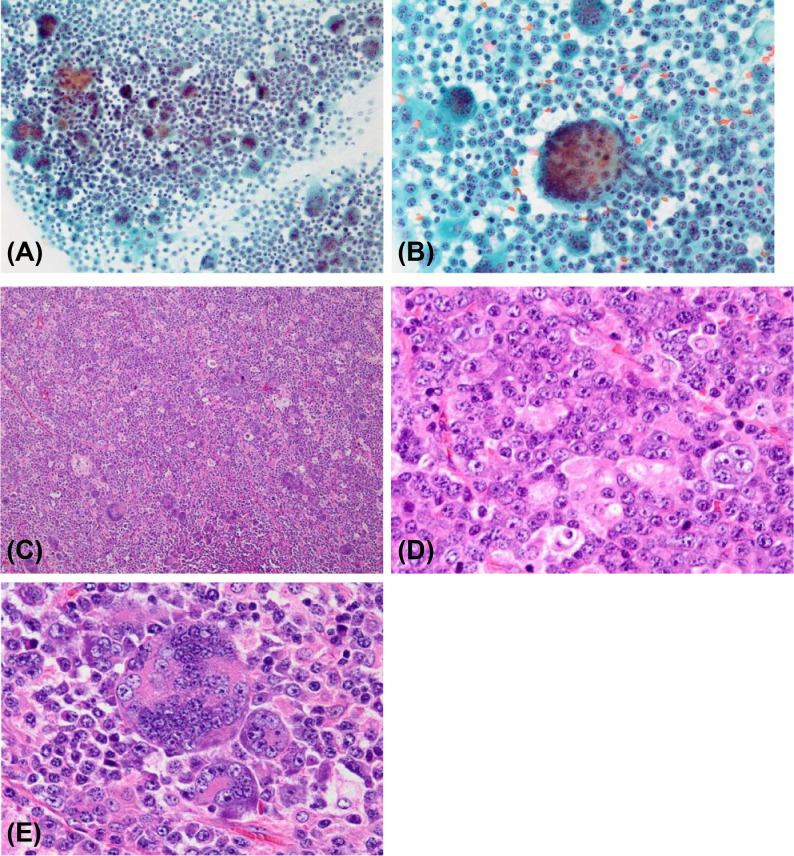
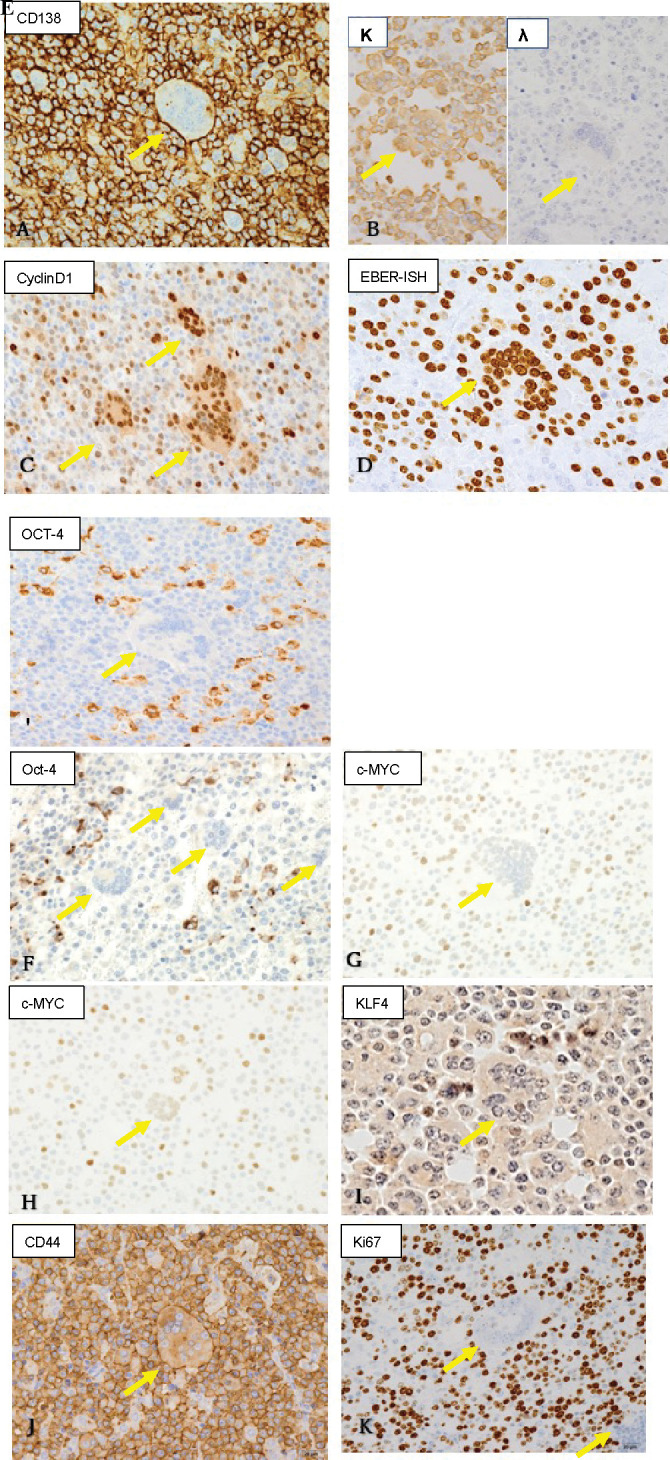
Cancer stem cells have the capability of self-renewal and multipotency and are, therefore, associated with tumor heterogeneity, resistance to chemoradiation therapy, and metastasis. The hypothesis that multinucleated giant cells, which often emerge following chemo- and/or radiotherapy, serve as cancer stem cells has not been fully evaluated. Although a previous study demonstrated that these cells functioned as stem cells, only low levels of Yamanaka factors were expressed, contrasting with the high expression seen from their gestated first-generation mononuclear cells. Herein, we report a case of a plasmablastic neoplasm with multinucleated giant cells that were analyzed for stemness to test the above hypothesis. The patient was a male in his 80s who had a plasmablastic neoplasm that was not easily distinguishable as plasmablastic lymphoma versus plasma cell myeloma of plasmablastic type. Lymph node biopsy showed predominant mononuclear cell proliferation with admixed multinucleated giant cells. Immunohistochemistry and hybridization showed that both multinucleated and mononuclear cells had the same profile: CD138(+), light chain restriction of κ>λ, cyclin D1(+), CD68(-), EBER-ISH (+). These results suggested that both cell types were neoplastic. In accordance with the previous study, the multinucleated giant cells showed low expression of Yamanaka factors, which were highly expressed in some of the mononuclear cells. Furthermore, the multinucleated giant cells showed a much lower proliferative activity (Mib1/Ki67 index) than the mononuclear cells. Based on these results, the multinucleated giant cells were compatible with cancer stem cells. This case is expected to expand the knowledge base regarding biology of cancer stem cells.
癌症干细胞具有自我更新和多能性的能力,因此与肿瘤异质性、放化疗耐药性及转移相关。化疗和/或放疗后常出现的多核巨细胞作为癌症干细胞的假说尚未得到充分评估。尽管先前的一项研究表明这些细胞具有干细胞功能,但与它们发育而来的第一代单核细胞中观察到的高表达情况相比,这些细胞中仅低水平表达山中因子。在此,我们报告一例伴有多核巨细胞的浆母细胞性肿瘤病例,对其干性进行分析以验证上述假说。患者为一名80多岁男性,患有浆母细胞性肿瘤,难以明确诊断为浆母细胞性淋巴瘤还是浆母细胞型浆细胞骨髓瘤。淋巴结活检显示以单核细胞增殖为主,伴有多核巨细胞。免疫组织化学和杂交显示,多核细胞和单核细胞具有相同的特征:CD138(+),κ轻链限制>λ,细胞周期蛋白D1(+),CD68(-),EBER原位杂交(+)。这些结果提示两种细胞类型均为肿瘤性。与先前的研究一致,多核巨细胞显示山中因子低表达,而部分单核细胞中高表达。此外,多核巨细胞的增殖活性(Mib1/Ki67指数)比单核细胞低得多。基于这些结果,多核巨细胞符合癌症干细胞的特征。该病例有望扩展关于癌症干细胞生物学的知识库。