
轻度新型冠状病毒肺炎会导致老年男性肌钙蛋白I早期、可量化且持续升高。
Mild COVID-19 induces early, quantifiable, persistent troponin I elevations in elder men.
作者信息
Bürgi Justus J, Rösslein Matthias, Nolte Oliver, Wick Peter, Garcia Boy Regine, Stranders Siegfried, Dollenmaier Günter, Peier Karen, Nohynek Brigitte, Fischer Aldo, Stolz Raphael, Cettuzzi Michele, Graf Lukas, Korte Wolfgang
机构信息
Center for Laboratory Medicine, St. Gallen, Switzerland.
Swiss Federal Laboratories for Materials Science and Technology, St. Gallen, Switzerland.
出版信息
Front Cardiovasc Med. 2022 Dec 1;9:1053790. doi: 10.3389/fcvm.2022.1053790. eCollection 2022.
IMPORTANCE
Elderly patients, especially men, are at risk of increased morbidity from coronavirus disease 2019 (COVID-19). Long-term data on troponin I levels in longitudinal observational studies of outpatients with mild to moderate COVID-19 are scarce.
OBJECTIVE
This controlled cohort study aimed to evaluate the course of troponin I concentrations over a long period in convalescent COVID-19 outpatients with mild to moderate symptoms.
SETTING AND PARTICIPANTS
In this cohort study, individuals with PCR-confirmed, mild to moderate SARS-CoV-2 infection as well as control individuals with confirmed negative PCR and negative SARS-CoV-2 serology were included. Study visits were performed from April 2020 through July 2021 (initialized during the first wave of the corona pandemic in Switzerland). A study visit in patients comprised blood draws every week in the first month and additionally after 8 weeks. This course was repeated in patients observed long-term.
RESULTS
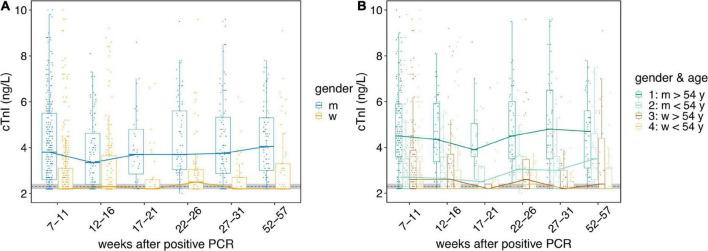
This study enrolled 278 individuals from the Canton of St. Gallen, Switzerland, aged 12-92 years (59.5% women), who had mild to moderate COVID-19 symptoms (outpatients only) and a diagnosis confirmed by positive RT-PCR. Fifty-four of the participants with confirmed SARS-CoV-2 infection were followed for 14 months with repeat cycles of the testing protocol. In addition, 115 symptomatic patients that were PCR and serology negative were enrolled in the same time period as a control group. In COVID-19 patients, low-level troponin I concentrations (cTnI) were significantly increased from baseline until week 9 after positive RT-PCR diagnosis in men older than 54 years [ΔcTnI = 5.0 ng/L (median); 95% CI 4.1-6.0; = 0.02]. The troponin I concentration remained elevated throughout 14 months in men older than 54 years within the cohort with a prolonged observation period. This statistically significant change in troponin I concentration was not dependent on co-morbidities in this group. ALT, Creatinine, BNP, and D-Dimer values after convalescence did not differ in comparison to the control cohort.
CONCLUSION
In this analysis of individuals with confirmed SARS-CoV-2 infection, hs troponin I levels of men aged 54 or older significantly increased after infection. They remained elevated for at least 14 months after diagnosis. This suggests the possibility of an ongoing, long-term, low-grade myocardial injury. Further studies with focus on elderly patients and a prolonged observational period are necessary to elucidate whether the phenomenon observed is associated with detectable structural changes to the heart muscle or is without further clinical consequences.
重要性
老年患者,尤其是男性,感染2019冠状病毒病(COVID-19)后发病风险增加。关于轻度至中度COVID-19门诊患者肌钙蛋白I水平的长期纵向观察研究数据稀缺。
目的
这项对照队列研究旨在评估轻度至中度症状的COVID-19康复门诊患者肌钙蛋白I浓度的长期变化过程。
背景与参与者
在这项队列研究中,纳入了PCR确诊的轻度至中度SARS-CoV-2感染个体以及PCR确诊为阴性且SARS-CoV-2血清学检测为阴性的对照个体。研究访视于2020年4月至2021年7月进行(在瑞士新冠疫情第一波期间启动)。患者的研究访视包括在第一个月每周采血,8周后额外采血。对于长期观察的患者,重复此过程。
结果
本研究招募了瑞士圣加仑州的278名个体,年龄在12 - 92岁之间(59.5%为女性),他们有轻度至中度COVID-19症状(仅门诊患者)且RT-PCR检测呈阳性确诊。54名确诊SARS-CoV-2感染的参与者按照检测方案的重复周期进行了14个月的随访。此外,115名PCR和血清学检测均为阴性的有症状患者在同一时期作为对照组纳入。在COVID-19患者中,年龄大于54岁的男性从基线到RT-PCR阳性诊断后第9周,低水平肌钙蛋白I浓度(cTnI)显著升高[ΔcTnI = 5.0 ng/L(中位数);95%CI 4.1 - 6.0;P = 0.02]。在观察期延长的队列中,年龄大于54岁的男性在整个14个月内肌钙蛋白I浓度一直升高。该组中肌钙蛋白I浓度的这种统计学显著变化不依赖于合并症。康复后谷丙转氨酶、肌酐、脑钠肽和D-二聚体的值与对照队列相比无差异。
结论
在这项对确诊SARS-CoV-2感染个体的分析中,54岁及以上男性感染后hs肌钙蛋白I水平显著升高。诊断后至少14个月一直保持升高。这提示存在持续的、长期的、轻度心肌损伤的可能性。有必要针对老年患者开展进一步研究并延长观察期,以阐明所观察到的现象是否与可检测到的心肌结构变化相关,或者是否没有进一步的临床后果。


 Zotero 插件