Madhok Raahil, Gulati Sumeet
Food and Resource Economics Group, Faculty of Land and Food Systems, University of British Columbia, 2357 Main Mall, Vancouver, BC V6T 1Z4, Canada.
The Wildlife and Conservation Economics Lab, University of British Columbia, 2357 Main Mall, Vancouver, BC V6T 1Z4, Canada.
Biol Conserv. 2022 Jul;271:109597. doi: 10.1016/j.biocon.2022.109597. Epub 2022 May 19.
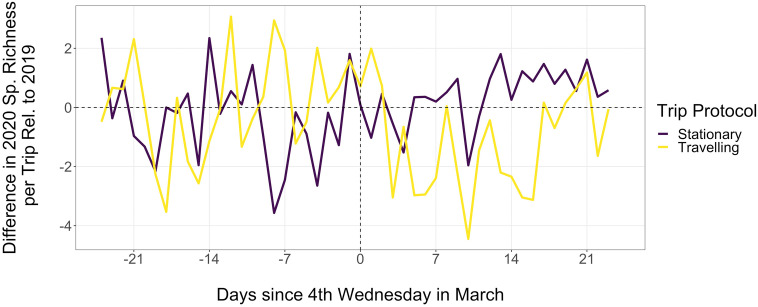
As we retreated to our dwellings in the "anthropause" of spring 2020, were the wildlife sightings in previously crowded spaces a reclamation of habitat, or a mere increase in detection? We leverage an increase in balcony birdwatching, a million eBird entries, and difference-in-difference techniques to test if urban avian species richness rose during India's COVID-19 lockdown. Controlling for effort, birdwatchers in the 20 most populous cities observed a 16% increase in the number of species during lockdown. While human activity stopped overnight, and noise and visual pollution decreased soon after, increased species diversity was observed 1-2 weeks later; evidence that gradual population recovery, not better detection, underlay our results. We find at-risk, and rare, species among those reclaiming cities, implying that reducing human disturbance in urban areas can protect threatened species. Increased species diversity likely derives from a reduction in noise and air pollution associated with the lockdown, implying that urban planners should consider conservation co-benefits of urban policies when designing sustainable cities.
2020年春季“封城”期间,当我们回到住所时,在以往拥挤的空间里看到野生动物,这是栖息地的恢复,还是仅仅是监测发现的增加呢?我们利用阳台观鸟活动的增加、eBird上的一百万条记录以及双重差分法,来测试印度新冠疫情封锁期间城市鸟类物种丰富度是否上升。在控制了观测力度后,20个人口最多城市的观鸟者发现封锁期间物种数量增加了16%。虽然人类活动一夜之间停止,噪音和视觉污染也在之后很快减少,但物种多样性增加是在1至2周后才观察到的;这证明我们的结果背后是种群的逐渐恢复,而非更好的监测发现。我们在重新回到城市的物种中发现了濒危和珍稀物种,这意味着减少城市地区的人类干扰可以保护受威胁物种。物种多样性增加可能源于与封锁相关的噪音和空气污染减少,这意味着城市规划者在设计可持续城市时应考虑城市政策的保护协同效益。