Miami Cancer Institute, 1228 S Pine Island Road, Plantation, Miami, FL, 33324, USA.
Pfizer Inc, 235 42nd St, New York, NY, 10017, USA.
BMC Cancer. 2022 Dec 22;22(1):1343. doi: 10.1186/s12885-022-10325-9.
In clinical trials, poly (ADP-ribose) polymerase inhibitors (PARPi) versus chemotherapy resulted in significantly improved progression-free survival, manageable adverse event profiles, and favorable patient-reported outcomes (PROs) in patients with human epidermal growth factor receptor 2-negative (HER2-) advanced breast cancer (ABC) and germline BRCA1/2 mutations (gBRCA1/2mut). The objective of this study was to evaluate PROs and physician satisfaction with treatment in patients with gBRCA1/2mut HER2- ABC receiving PARPi or physician's choice of chemotherapy in a multi-country, real-world setting.
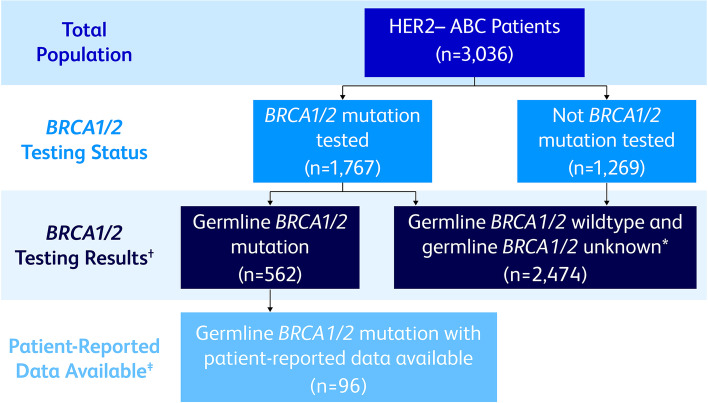
This retrospective analysis used data from the Adelphi Real World ABC Disease Specific Programmes in the United States, European Union, and Israel. PROs were assessed at a single timepoint using the EuroQol 5-Dimensions 5-Level (EQ-5D-5L) scale, Cancer Therapy Satisfaction Questionnaire (CTSQ), and European Organization for Research and Treatment of Cancer Quality-of-Life Questionnaire Core 30 (EORTC QLQ-C30) and the breast cancer-specific module (QLQ-BR23). Baseline PROs were not assessed. Physician satisfaction with treatment scores was dichotomized to a 0/1 variable (0 = very dissatisfied/dissatisfied/moderately satisfied; 1 = satisfied/very satisfied). Scores were compared using inverse-probability-weighted regression adjustment, controlling for multiple confounding factors.
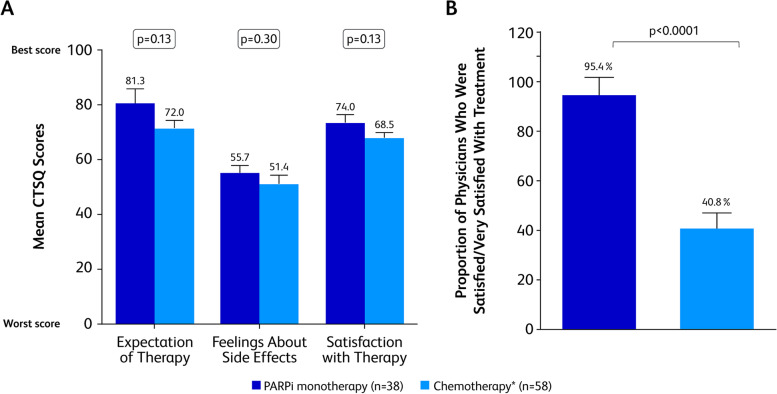
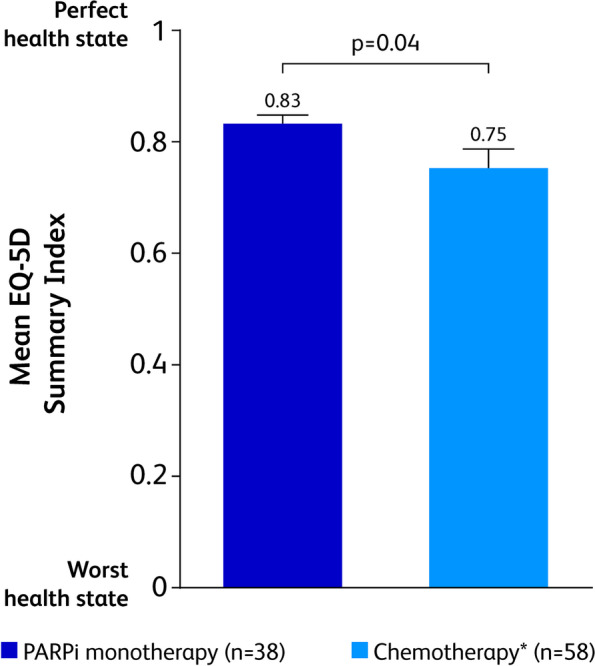
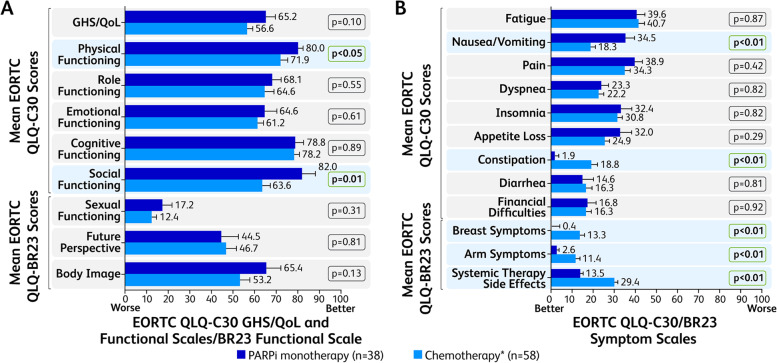
The study included 96 patients (PARPi, n = 38; platinum/non-platinum-based chemotherapy, n = 58). Patients receiving PARPi versus chemotherapy reported significantly better scores on the EQ-5D-5L Health Utility Index. On the EORTC QLQ-C30 functional scales, patients receiving PARPi reported significantly better scores (mean ± SE) for physical functioning (80.0 ± 2.4 vs 71.9 ± 3.4; p < 0.05) and social functioning (82.0 ± 6.2 vs 63.6 ± 3.7; p < 0.05) and, on the symptom scales, reported significantly better scores for constipation (1.9 ± 1.8 vs 18.7 ± 3.2; p < 0.001), breast symptoms (0.4 ± 3.9 vs 13.3 ± 2.6; p < 0.01), arm symptoms (2.6 ± 1.3 vs 11.4 ± 2.4; p = 0.001), and systemic therapy side effects (13.5 ± 1.8 vs 29.4 ± 2.3; p < 0.001). In contrast, patients receiving chemotherapy scored significantly better on the nausea/vomiting scale (18.3 ± 2.8 vs 34.5 ± 5.1; p < 0.01). Patients receiving PARPi reported numerically better satisfaction scores on the CTSQ scales. Physicians were more likely to be satisfied/very satisfied with PARPi versus chemotherapy (95.4% ± 7.3% vs 40.8% ± 6.2%; p < 0.001).
The PRO findings in this real-world population of patients with gBRCA1/2mut HER2- ABC complement those from the pivotal clinical trials, providing further support for treatment with PARPi in these patients.
在临床试验中,聚(ADP-核糖)聚合酶抑制剂(PARPi)与化疗相比,可显著改善无进展生存期,具有可管理的不良事件谱,并改善人表皮生长因子受体 2 阴性(HER2-)晚期乳腺癌(ABC)和种系 BRCA1/2 突变(gBRCA1/2mut)患者的患者报告结局(PROs)。本研究的目的是评估 gBRCA1/2mut HER2-ABC 患者在多国家真实世界环境中接受 PARPi 或医生选择的化疗时的 PROs 和医生对治疗的满意度。
本回顾性分析使用了美国、欧盟和以色列 Adelphi Real World ABC 疾病特定项目的数据。PROs 采用 EuroQol 5-维度 5 水平(EQ-5D-5L)量表、癌症治疗满意度问卷(CTSQ)以及欧洲癌症研究与治疗组织生活质量问卷核心 30 项(EORTC QLQ-C30)和乳腺癌特定模块(QLQ-BR23)在单个时间点进行评估。未评估基线 PROs。医生对治疗满意度评分分为 0/1 变量(0=非常不满意/不满意/中度满意;1=满意/非常满意)。使用逆概率加权回归调整进行评分比较,控制了多个混杂因素。
本研究纳入了 96 例患者(PARPi 组,n=38;铂类/非铂类化疗组,n=58)。与化疗相比,接受 PARPi 治疗的患者在 EQ-5D-5L 健康效用指数上报告了显著更好的评分。在 EORTC QLQ-C30 功能量表上,接受 PARPi 治疗的患者报告了在身体功能(80.0±2.4 与 71.9±3.4;p<0.05)和社会功能(82.0±6.2 与 63.6±3.7;p<0.05)方面的显著更好评分,并且在症状量表上,报告了在便秘(1.9±1.8 与 18.7±3.2;p<0.001)、乳房症状(0.4±3.9 与 13.3±2.6;p<0.01)、手臂症状(2.6±1.3 与 11.4±2.4;p=0.001)和全身治疗副作用(13.5±1.8 与 29.4±2.3;p<0.001)方面的显著更好评分。相反,接受化疗的患者在恶心/呕吐量表上的评分(18.3±2.8 与 34.5±5.1;p<0.01)显著更好。接受 PARPi 治疗的患者在 CTSQ 量表上的满意度评分呈数值上的优势。与化疗相比,医生更有可能对 PARPi 感到满意/非常满意(95.4%±7.3%与 40.8%±6.2%;p<0.001)。
本真实世界人群中 gBRCA1/2mut HER2-ABC 患者的 PRO 研究结果与关键性临床试验结果一致,为这些患者接受 PARPi 治疗提供了进一步的支持。