Department of Cardiology, Nanjing First Hospital, Nanjing Medical University, No. 68 Changle Road, Nanjing 210006, China.
Department of Cardiology, Nanjing Heart Centre, No. 68 Changle Road, Nanjing 210006, China.
Cells. 2022 Dec 15;11(24):4060. doi: 10.3390/cells11244060.
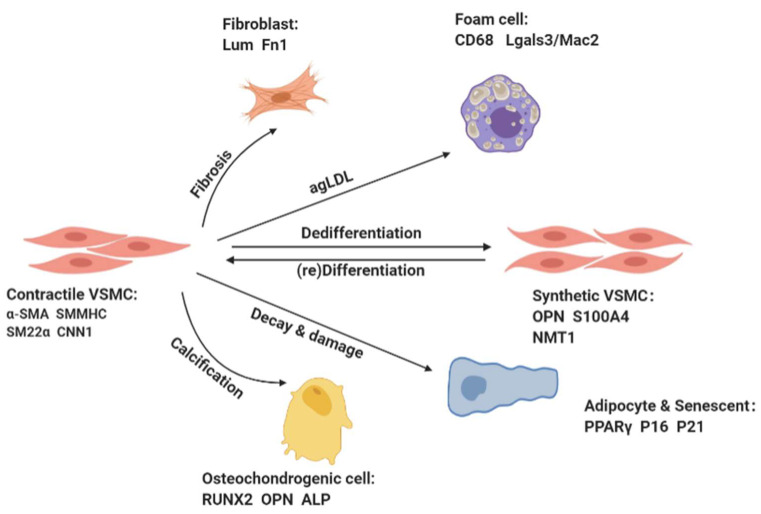
Vascular smooth muscle cells (VSMCs), the major cell type in the arterial vessel wall, have a contractile phenotype that maintains the normal vessel structure and function under physiological conditions. In response to stress or vascular injury, contractile VSMCs can switch to a less differentiated state (synthetic phenotype) to acquire the proliferative, migratory, and synthetic capabilities for tissue reparation. Imbalances in VSMCs phenotypic switching can result in a variety of cardiovascular diseases, including atherosclerosis, in-stent restenosis, aortic aneurysms, and vascular calcification. It is very important to identify the molecular mechanisms regulating VSMCs phenotypic switching to prevent and treat cardiovascular diseases with high morbidity and mortality. However, the key molecular mechanisms and signaling pathways participating in VSMCs phenotypic switching have still not been fully elucidated despite long-term efforts by cardiovascular researchers. In this review, we provide an updated summary of the recent studies and systematic knowledge of VSMCs phenotypic switching in atherosclerosis, in-stent restenosis, aortic aneurysms, and vascular calcification, which may help guide future research and provide novel insights into the prevention and treatment of related diseases.
血管平滑肌细胞(VSMCs)是动脉血管壁的主要细胞类型,在生理条件下具有收缩表型,维持正常的血管结构和功能。在应激或血管损伤时,收缩型 VSMCs 可以向分化程度较低的状态(合成表型)转变,获得增殖、迁移和合成能力,以进行组织修复。VSMCs 表型转换的失衡可导致多种心血管疾病,包括动脉粥样硬化、支架内再狭窄、主动脉瘤和血管钙化。识别调节 VSMCs 表型转换的分子机制对于预防和治疗具有高发病率和死亡率的心血管疾病非常重要。然而,尽管心血管研究人员进行了长期努力,但参与 VSMCs 表型转换的关键分子机制和信号通路仍未完全阐明。在本文中,我们对动脉粥样硬化、支架内再狭窄、主动脉瘤和血管钙化中 VSMCs 表型转换的最新研究和系统知识进行了更新总结,这可能有助于指导未来的研究,并为相关疾病的预防和治疗提供新的见解。