Chen Huixian, Wang Fan, Yang Ye, Hua Bingzhu, Wang Hong, Chen Jie, Feng Xuebing
Department of Rheumatology and Immunology, Nanjing Drum Tower Hospital, Medical School of Southeast University, Nanjing 210008, China.
Department of Otolaryngology, Nanjing Drum Tower Hospital, Medical School of Southeast University, Nanjing 210008, China.
J Clin Med. 2022 Dec 19;11(24):7527. doi: 10.3390/jcm11247527.
To investigate the clinical characteristics of hearing loss (HL) in patients with systemic lupus erythematosus (SLE) and its related factors.
Ninety-one hospitalized SLE patients and thirty healthy controls were enrolled. All subjects completed pure tone audiometry (PTA), extended high frequency audiometry (EHFA) and distortion product otoacoustic emission (DPOAE) to assess hearing function. SLE patients were divided into two groups according to the presence or absence of HL, and the risk factors of HL were determined by multivariate logistic regression.
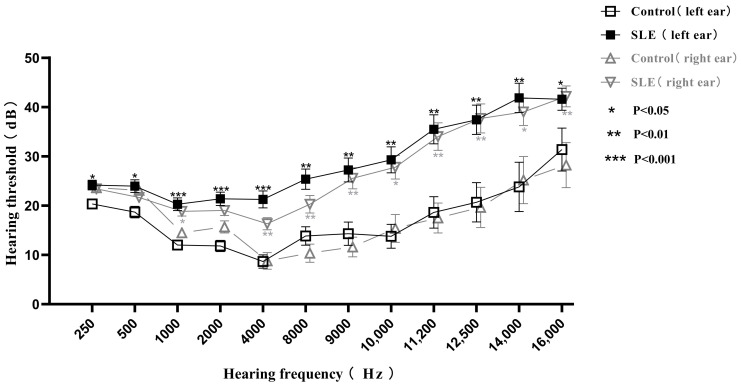
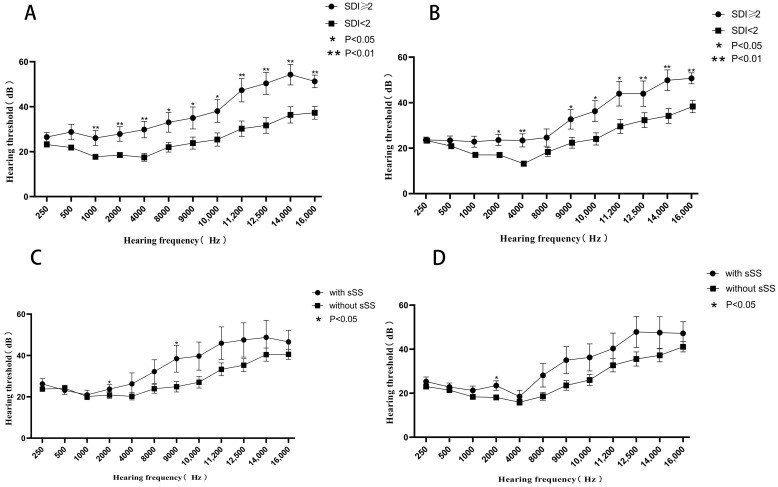
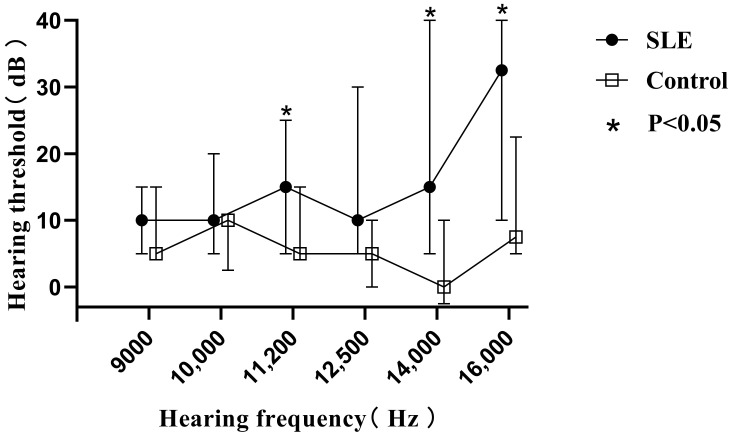
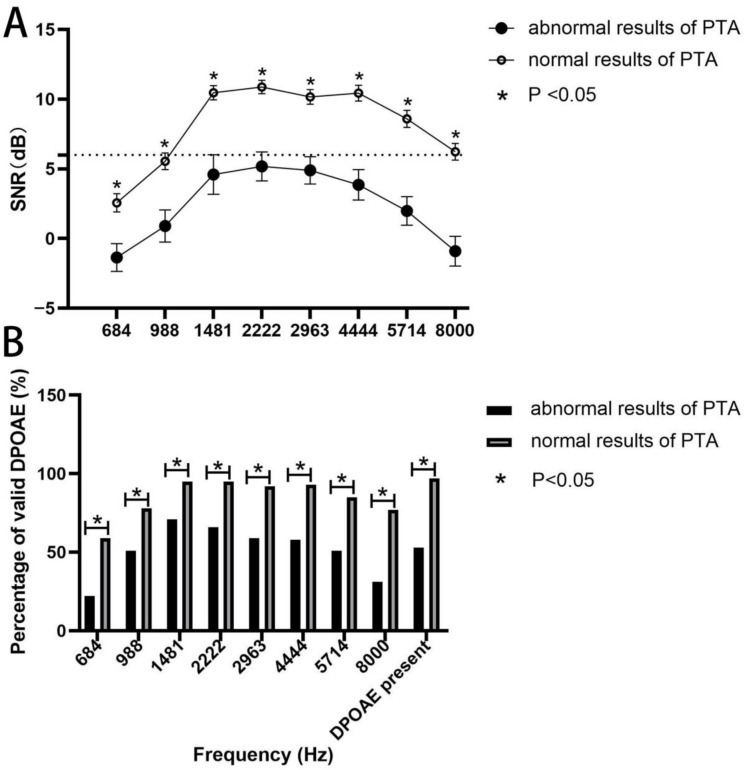
The incidence of HL was 27.47% in SLE patients, significantly higher than in the control group (3.3%) and most cases were mild-to-moderate, bilateral and predominantly sensorineural. Compared with the control group, the hearing thresholds of SLE patients increased significantly in the middle and high frequencies starting from 2000 Hz. Even though the PTA test results were normal, the EHFA test results showed significant differences in hearing impairment between SLE patients and normal controls. For patients with abnormal PTA results, the signal-to-noise ratio (SNR) in DPOAE was markedly reduced, and the pass rate was also decreased. The Systemic Lupus International Collaborating Clinics Damage Index (SDI, OR 9.13) and secondary Sjögren's syndrome (sSS, OR 8.20) were identified as independent associated factors for HL, and there was no difference in PTA and EHFA at all frequencies between hydroxychloroquine users and non-users.
HL is not rare in SLE patients, and EHFA can help identify early hearing impairment. Having a high SDI score and secondary Sjögren's syndrome may predict the presence of HL in SLE.
探讨系统性红斑狼疮(SLE)患者听力损失(HL)的临床特征及其相关因素。
纳入91例住院SLE患者和30例健康对照。所有受试者均完成纯音听力测试(PTA)、扩展高频听力测试(EHFA)和畸变产物耳声发射(DPOAE)以评估听力功能。SLE患者根据是否存在HL分为两组,并通过多因素逻辑回归确定HL的危险因素。
SLE患者中HL的发生率为27.47%,显著高于对照组(3.3%),且大多数病例为轻至中度、双侧性且以感音神经性为主。与对照组相比,SLE患者从2000Hz开始在中高频的听力阈值显著升高。即使PTA测试结果正常,EHFA测试结果也显示SLE患者与正常对照在听力损害方面存在显著差异。对于PTA结果异常的患者,DPOAE中的信噪比(SNR)明显降低,通过率也降低。系统性红斑狼疮国际协作临床损伤指数(SDI,OR 9.13)和继发性干燥综合征(sSS,OR 8.20)被确定为HL的独立相关因素,使用羟氯喹和未使用羟氯喹的患者在所有频率的PTA和EHFA方面均无差异。
HL在SLE患者中并不罕见,EHFA有助于识别早期听力损害。高SDI评分和继发性干燥综合征可能预示SLE患者存在HL。