
咬合板治疗联合颅颞下颌运动疗法治疗颞下颌关节紊乱病患者的CBCT研究
Occlusal Splint Therapy Combined with Cranio-Temporomandibular Kinesiotherapy in Patients with Temporomandibular Disorders-A CBCT Study.
作者信息
Tăut Manuela, Buduru Smaranda Dana, Tălmăceanu Daniel, Ban Alina, Roman Raluca, Leucuța Daniel, Barbur Ioan, Ilea Aranka
机构信息
Department of Oral Rehabilitation, "Iuliu Hațieganu" University of Medicine and Pharmacy, 400029 Cluj-Napoca, Romania.
Department of Prosthetic Dentistry and Dental Materials, Prosthetic Dentistry, "Iuliu Hațieganu" University of Medicine and Pharmacy, 400029 Cluj-Napoca, Romania.
出版信息
Life (Basel). 2022 Dec 19;12(12):2143. doi: 10.3390/life12122143.
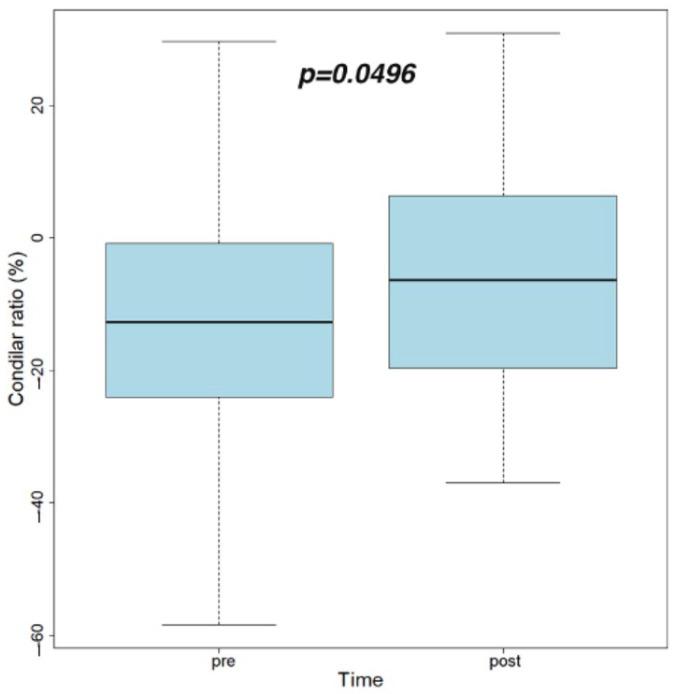
Occlusal splints are used as a non-invasive treatment for patients diagnosed with temporomandibular disorders (TMD). Another non-invasive treatment option for TMD patients is kinesiotherapy, which may be used alone or in conjunction with occlusal splint therapy. The aim of this study was to evaluate the changes in the intra-articular spaces of the temporomandibular joint (TMJ) after occlusal splint therapy combined with cranio-temporomandibular kinesiotherapy in TMD patients. Twenty-four patients ( = 24) diagnosed with TMD according to Research Diagnostic Criteria for Temporomandibular Disorders (RDC/TMD) were included. Cone beam computed tomography (CBCT) images were taken before and after treatment. The anterior, superior, posterior, and medial joint spaces were measured on the CBCT images, and the condylar ratio was calculated using Pullinger and Hollender's formula. Additionally, the thickness of the glenoid fossa (GFT), condylar medio-lateral widths (MLW), and condylar height (HCo) were measured. The condylar ratio was significantly higher after treatment ( = 0.049). The changes in dimensions of the anterior, superior, posterior and medial joint spaces were not statistically significant after treatment. No statistically significant differences were found in the dimensions of the GFT, MLW, and HCo post treatment. The condylar position did not shift anteriorly in a statistically significant way after occlusal splint therapy combined with cranio-temporomandibular kinesiotherapy in TMD patients.
牙合垫被用作诊断为颞下颌关节紊乱病(TMD)患者的一种非侵入性治疗方法。TMD患者的另一种非侵入性治疗选择是运动疗法,其可单独使用或与牙合垫治疗联合使用。本研究的目的是评估牙合垫治疗联合颅颞下颌运动疗法后TMD患者颞下颌关节(TMJ)关节内间隙的变化。纳入了24例根据颞下颌关节紊乱病研究诊断标准(RDC/TMD)诊断为TMD的患者。在治疗前后拍摄锥形束计算机断层扫描(CBCT)图像。在CBCT图像上测量关节前、上、后和内侧间隙,并使用Pullinger和Hollender公式计算髁突比率。此外,测量关节窝厚度(GFT)、髁突内外侧宽度(MLW)和髁突高度(HCo)。治疗后髁突比率显著更高(P = 0.049)。治疗后关节前、上、后和内侧间隙尺寸的变化无统计学意义。治疗后GFT、MLW和HCo的尺寸未发现有统计学意义的差异。在TMD患者中,牙合垫治疗联合颅颞下颌运动疗法后髁突位置未出现具有统计学意义的向前移位。


 Zotero 插件