Department of Orthopaedic Surgery, Chosun University Hospital, Gwangju 61453, Republic of Korea.
School of Medicine, Chosun University, Gwangju 61452, Republic of Korea.
Medicina (Kaunas). 2022 Nov 22;58(12):1699. doi: 10.3390/medicina58121699.
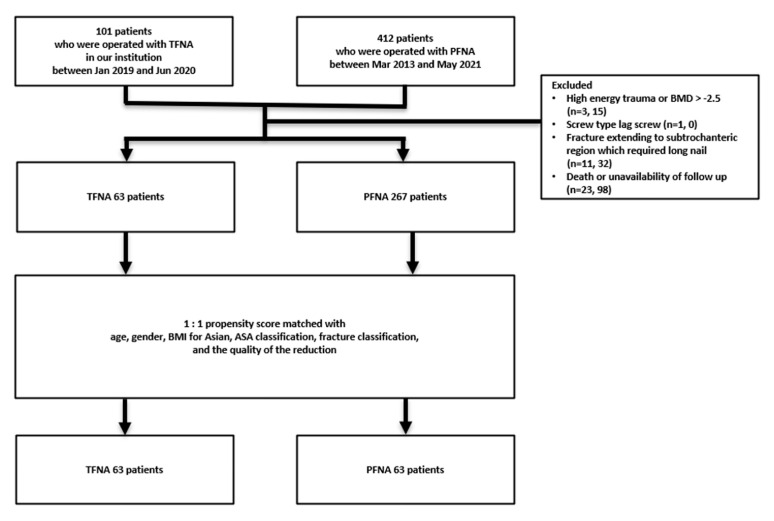
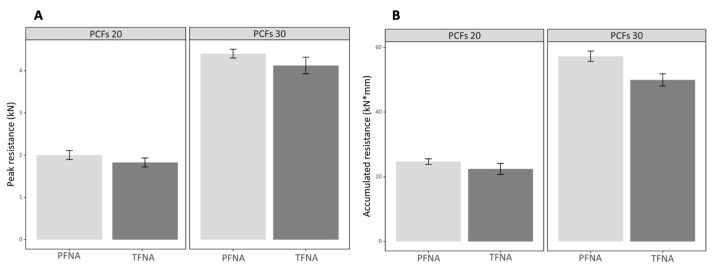
: This study aimed to compare the biomechanical properties and outcomes of osteoporotic intertrochanteric fractures treated with two different helical blade systems, the trochanteric fixation nail-advanced (TFNA) and proximal femoral nail antirotation II (PFNA), to evaluate the efficacy and safety of the newly introduced TFNA system. : A biomechanical comparison of the two helical blades was performed using uniaxial compression tests on polyurethane foam blocks of different densities. The peak resistance (PR) and accumulated resistance (AR) were measured during the 20 mm advancement through the test block. For clinical comparison, 63 osteoporotic intertrochanteric fractures treated with TFNA were identified and compared with the same number of fractures treated with PFNA using propensity score matching. Ambulatory status, medial migration, lateral sliding, fixation failure, and patient-reported outcomes were compared between the two groups over a minimum of 1 year's follow up. : The uniaxial compression test showed that a slightly, but significantly lower resistance was required to advance the TFNA through the test block compared with the PFNA (20 PCF, = 0.017 and = 0.026; 30 PCF, = 0.007 and = 0.001 for PR and AR, respectively). Clinically, the two groups showed no significant differences in post-operative ambulatory status and patient-reported outcomes. However, in TFNA groups, significantly more medial migration (TFNA, 0.75 mm; PFNA, 0.40 mm; = 0.0028) and also, lateral sliding was noted (TFNA, 3.99 mm; PFNA, 1.80 mm; = 0.004). Surgical failure occurred in four and two fractures treated with the TFNA and PFNA, respectively. The results of our study suggest that the newly introduced TFNA provides clinical outcomes comparable with those of the PFNA. However, inferior resistance to medial migration in the TFNA raises concerns regarding potential fixation failures.
本研究旨在比较两种不同螺旋刀片系统(股骨近端抗旋髓内钉 II 型[PFNA]和股骨近端髓内钉-先进型[TFNA])治疗骨质疏松性股骨转子间骨折的生物力学特性和结果,以评估新引入的 TFNA 系统的疗效和安全性。
通过对不同密度的聚氨酯泡沫块进行单轴压缩试验,对两种螺旋刀片进行生物力学比较。在通过测试块推进 20mm 的过程中,测量峰值阻力(PR)和累积阻力(AR)。为了进行临床比较,我们确定了 63 例采用 TFNA 治疗的骨质疏松性股骨转子间骨折,并采用倾向评分匹配的方法与相同数量的采用 PFNA 治疗的骨折进行比较。在至少 1 年的随访中,比较两组患者的活动状态、内侧迁移、外侧滑动、固定失败和患者报告的结果。
单轴压缩试验表明,与 PFNA 相比,TFNA 通过测试块推进所需的阻力略低,但具有统计学意义(PR:20PCF, = 0.017 和 = 0.026;AR:30PCF, = 0.007 和 = 0.001)。临床结果显示,两组患者术后活动状态和患者报告的结果无显著差异。然而,在 TFNA 组中,明显更多的内侧迁移(TFNA:0.75mm;PFNA:0.40mm; = 0.0028)和外侧滑动(TFNA:3.99mm;PFNA:1.80mm; = 0.004)。采用 TFNA 和 PFNA 治疗的骨折中,分别有 4 例和 2 例发生手术失败。
我们的研究结果表明,新引入的 TFNA 提供的临床结果与 PFNA 相当。然而,TFNA 对内侧迁移的阻力较低,这引发了对潜在固定失败的担忧。