Lu Jianlin, Gullett Jessica M, Kanneganti Thirumala-Devi
Department of Immunology, St. Jude Children's Research Hospital, Memphis, TN 38105, USA.
Pathogens. 2022 Nov 23;11(12):1400. doi: 10.3390/pathogens11121400.
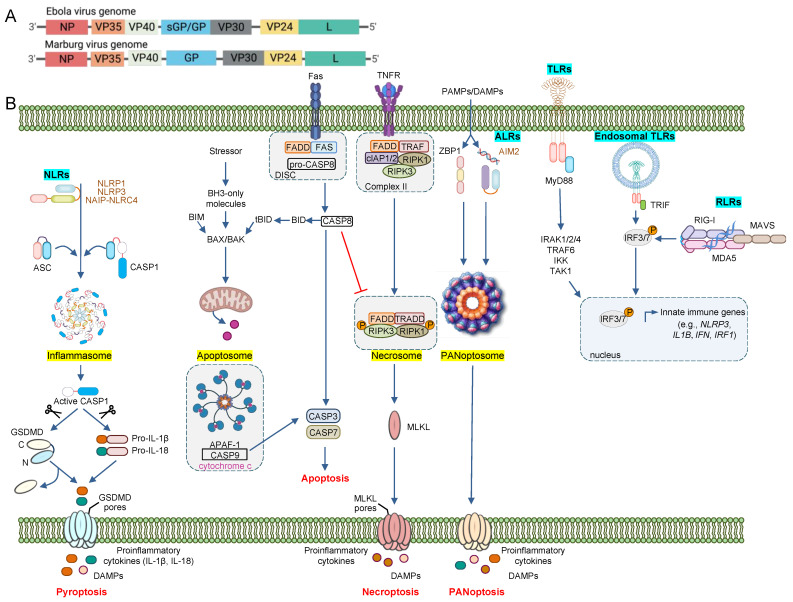
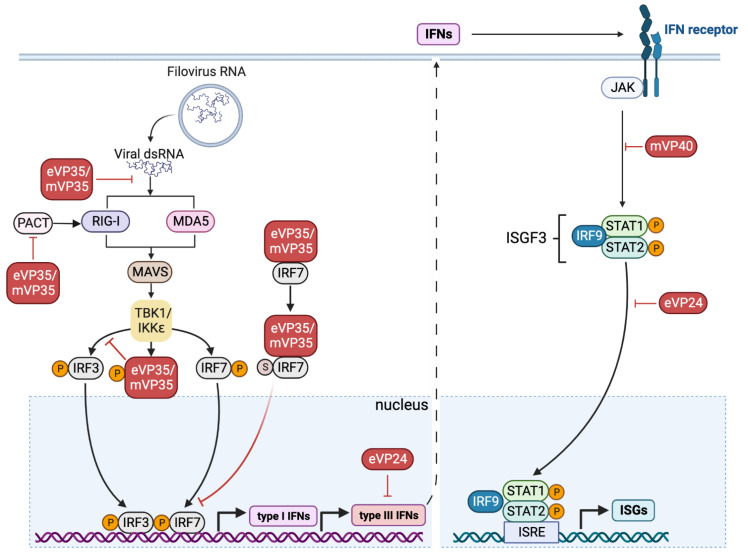
Filoviruses are a group of single-stranded negative sense RNA viruses. The most well-known filoviruses that affect humans are ebolaviruses and marburgviruses. During infection, they can cause life-threatening symptoms such as inflammation, tissue damage, and hemorrhagic fever, with case fatality rates as high as 90%. The innate immune system is the first line of defense against pathogenic insults such as filoviruses. Pattern recognition receptors (PRRs), including toll-like receptors, retinoic acid-inducible gene-I-like receptors, C-type lectin receptors, AIM2-like receptors, and NOD-like receptors, detect pathogens and activate downstream signaling to induce the production of proinflammatory cytokines and interferons, alert the surrounding cells to the threat, and clear infected and damaged cells through innate immune cell death. However, filoviruses can modulate the host inflammatory response and innate immune cell death, causing an aberrant immune reaction. Here, we discuss how the innate immune system senses invading filoviruses and how these deadly pathogens interfere with the immune response. Furthermore, we highlight the experimental difficulties of studying filoviruses as well as the current state of filovirus-targeting therapeutics.
丝状病毒是一类单链负义RNA病毒。影响人类的最著名的丝状病毒是埃博拉病毒和马尔堡病毒。在感染期间,它们可引发危及生命的症状,如炎症、组织损伤和出血热,病死率高达90%。先天免疫系统是抵御丝状病毒等病原体侵袭的第一道防线。模式识别受体(PRR),包括 Toll 样受体、视黄酸诱导基因 I 样受体、C 型凝集素受体、AIM2 样受体和 NOD 样受体,可检测病原体并激活下游信号传导,以诱导促炎细胞因子和干扰素的产生,向周围细胞警示威胁,并通过先天免疫细胞死亡清除受感染和受损的细胞。然而,丝状病毒可调节宿主炎症反应和先天免疫细胞死亡,导致异常免疫反应。在此,我们讨论先天免疫系统如何感知入侵的丝状病毒,以及这些致命病原体如何干扰免疫反应。此外,我们强调了研究丝状病毒的实验困难以及靶向丝状病毒疗法的当前状况。