
使用功能化介孔二氧化硅纳米颗粒的姜黄素和秋水仙碱共递送系统促进抗癌和凋亡作用。
Co-Delivery System of Curcumin and Colchicine Using Functionalized Mesoporous Silica Nanoparticles Promotes Anticancer and Apoptosis Effects.
作者信息
AbouAitah Khaled, Soliman Ahmed A F, Swiderska-Sroda Anna, Nassrallah Amr, Smalc-Koziorowska Julita, Gierlotka Stanislaw, Lojkowski Witold
机构信息
Medicinal and Aromatic Plants Research Department, Pharmaceutical and Drug Industries Research Institute, National Research Centre (NRC), 33 El-Behouth Street, Dokki, Giza 12622, Egypt.
Drug Bioassay-Cell Culture Laboratory, Pharmacognosy Department, Pharmaceutical and Drug Industries Research Institute, National Research Centre (NRC), 33 El-Behouth St, Dokki, Giza 12622, Egypt.
出版信息
Pharmaceutics. 2022 Dec 11;14(12):2770. doi: 10.3390/pharmaceutics14122770.
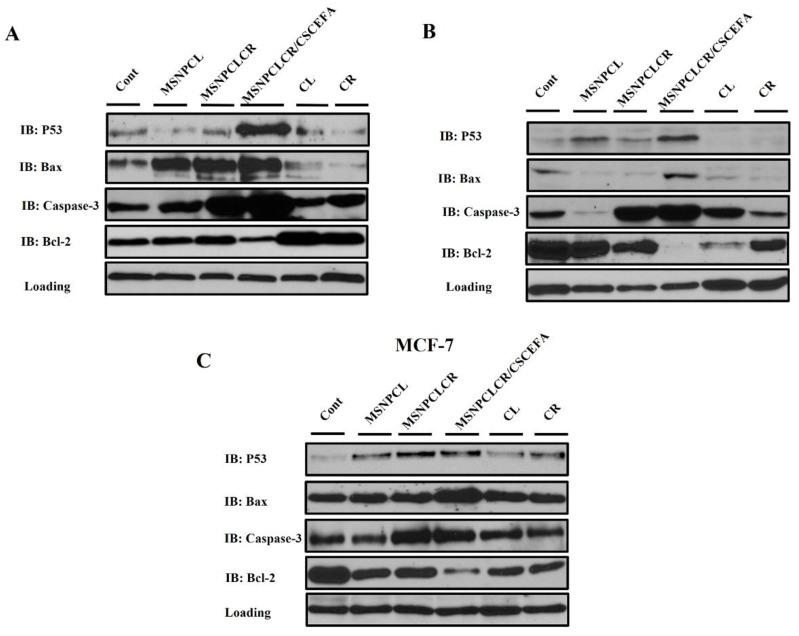
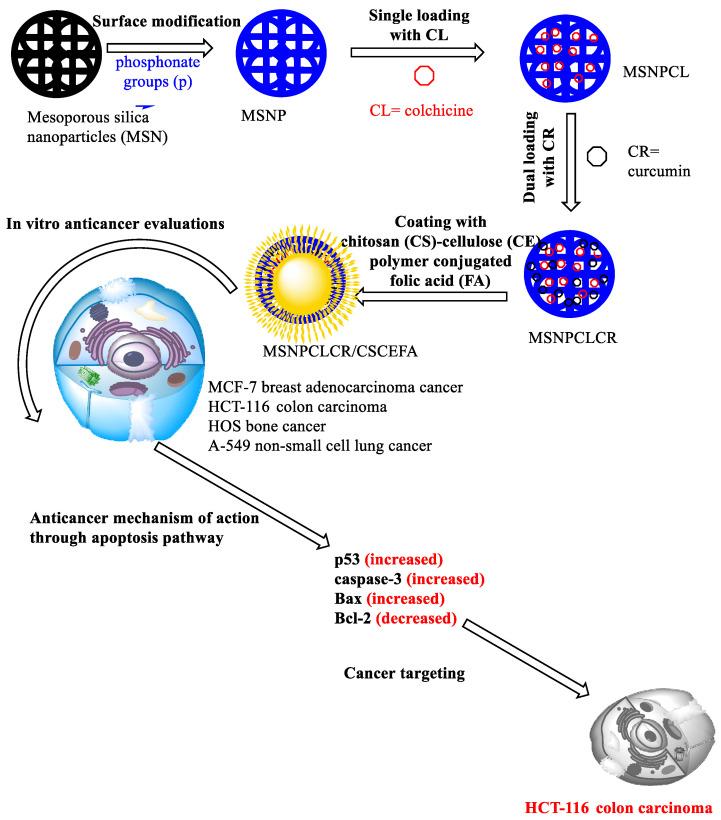
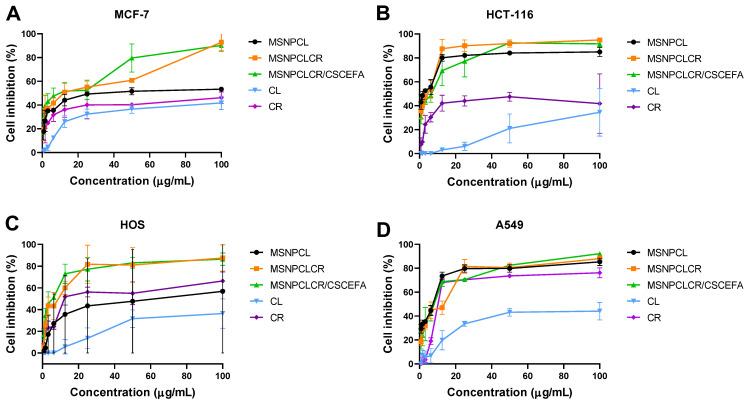
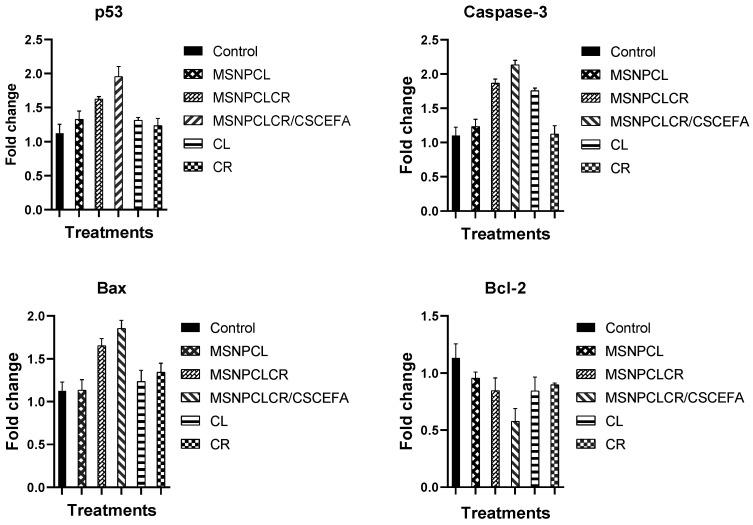
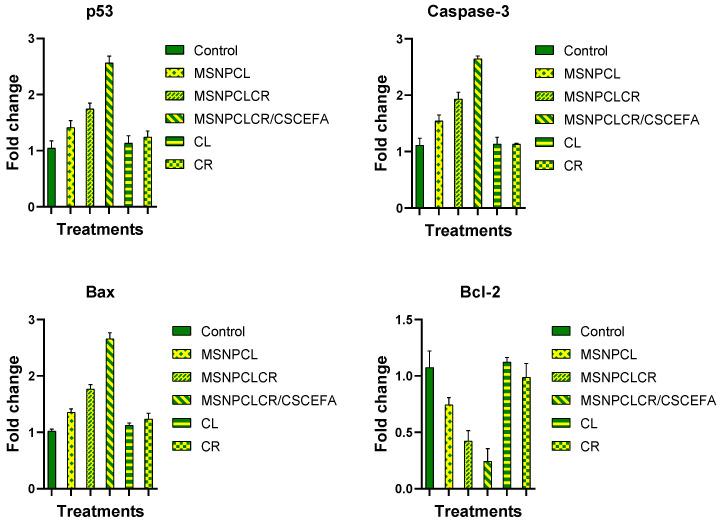
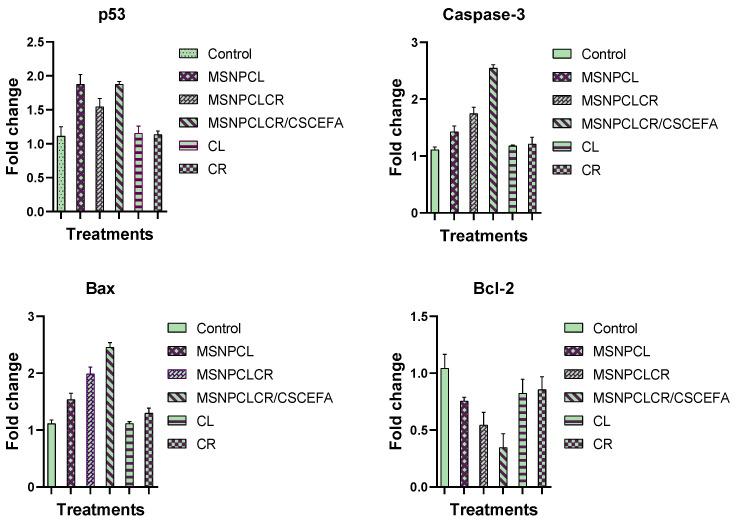
Purpose: Many natural agents have a high anticancer potential, and their combination may be advantageous for improved anticancer effects. Such agents, however, often are not water soluble and do not efficiently target cancer cells, and the kinetics of their action is poorly controlled. One way to overcome these barriers is to combine natural agents with nanoparticles. Our aim in the current study was to fabricate an anticancer nanoformulation for co-delivery of two natural agents, curcumin (CR) and colchicine (CL), with a core-shell structure. Using cancer cell lines, we compared the anticancer efficacy between the combination and a nanoformulation with CL alone. Methods: For the single-drug nanoformulation, we used phosphonate groups to functionalize mesoporous silica nanoparticles (MSNs) and loaded the MSNs with CL. Additional loading of this nanoformulation with CR achieved the co-delivery format. To create the structure with a core shell, we selected a chitosan−cellulose mixture conjugated with targeting ligands of folic acid for the coating. For evaluating anticancer and apoptosis effects, we assessed changes in important genes and proteins in apoptosis (p53, caspase-3, Bax, Bcl-2) in several cell lines (MCF-7, breast adenocarcinoma; HCT-116, colon carcinoma; HOS, human osteosarcoma; and A-549, non−small cell lung cancer). Results: Nanoformulations were successfully synthesized and contained 10.9 wt.% for the CL single-delivery version and 18.1 wt.% for the CL+CR co-delivery nanoformulation. Anticancer effects depended on treatment, cell line, and concentration. Co-delivery nanoformulations exerted anticancer effects that were significantly superior to those of single delivery or free CL or CR. Anticancer effects by cell line were in the order of HCT-116 > A549 > HOS > MCF-7. The lowest IC50 value was obtained for the nanoformulation consisting of CL and CR coated with a polymeric shell conjugated with FA (equivalent to 4.1 ± 0.05 µg/mL). With dual delivery compared with the free agents, we detected strongly increased p53, caspase-3, and Bax expression, but inhibition of Bcl-2, suggesting promotion of apoptosis. Conclusions: Our findings, although preliminary, indicate that the proposed dual delivery nanoformulation consisting of nanocore: MSNs loaded with CL and CR and coated with a shell of chitosan−cellulose conjugated folic acid exerted strong anticancer and apoptotic effects with potent antitumor activity against HCT-116 colon cells. The effect bested CL alone. Evaluating and confirming the efficacy of co-delivery nanoformulations will require in vivo studies.
目的
许多天然药物具有很高的抗癌潜力,它们的联合使用可能有利于提高抗癌效果。然而,这类药物往往不溶于水,不能有效地靶向癌细胞,且其作用动力学难以精确控制。克服这些障碍的一种方法是将天然药物与纳米颗粒相结合。我们在本研究中的目的是制备一种具有核壳结构的抗癌纳米制剂,用于共递送两种天然药物姜黄素(CR)和秋水仙碱(CL)。我们使用癌细胞系比较了联合用药与单独使用CL的纳米制剂之间的抗癌效果。方法:对于单药纳米制剂,我们使用膦酸基团对介孔二氧化硅纳米颗粒(MSN)进行功能化,并将CL负载到MSN中。通过向该纳米制剂中额外负载CR实现共递送形式。为了创建核壳结构,我们选择了与叶酸靶向配体共轭的壳聚糖 - 纤维素混合物作为涂层。为了评估抗癌和凋亡作用,我们评估了几种细胞系(MCF - 7,乳腺腺癌;HCT - 116,结肠癌;HOS,人骨肉瘤;以及A - 549,非小细胞肺癌)中凋亡相关重要基因和蛋白质(p53、半胱天冬酶 - 3、Bax、Bcl - 2)的变化。结果:成功合成了纳米制剂,CL单递送版本含10.9 wt.%,CL + CR共递送纳米制剂含18.1 wt.%。抗癌效果取决于治疗方式、细胞系和浓度。共递送纳米制剂的抗癌效果明显优于单递送或游离的CL或CR。各细胞系的抗癌效果顺序为HCT - 116 > A549 > HOS > MCF - 7。由与FA共轭的聚合物壳包裹的CL和CR组成的纳米制剂获得了最低的IC50值(相当于4.1±0.05 µg/mL)。与游离药物相比,联合递送时,我们检测到p53、半胱天冬酶 - 3和Bax表达大幅增加,但Bcl - 2受到抑制,表明促进了细胞凋亡。结论:我们的研究结果虽然是初步的,但表明所提出的由负载CL和CR的纳米核MSN以及包裹壳聚糖 - 纤维素共轭叶酸的纳米制剂具有很强的抗癌和凋亡作用,对HCT - 116结肠细胞具有强大的抗肿瘤活性。该效果优于单独使用CL。评估和确认共递送纳米制剂的疗效将需要进行体内研究。
 Zotero 插件