Beijing National Laboratory for Molecular Sciences, CAS Key Laboratory of Organic Solids, Institute of Chemistry, Chinese Academy of Sciences, Beijing 100190, China.
University of Chinese Academy of Sciences, Beijing 100049, China.
Sci Adv. 2022 Dec 23;8(51):eade4692. doi: 10.1126/sciadv.ade4692.
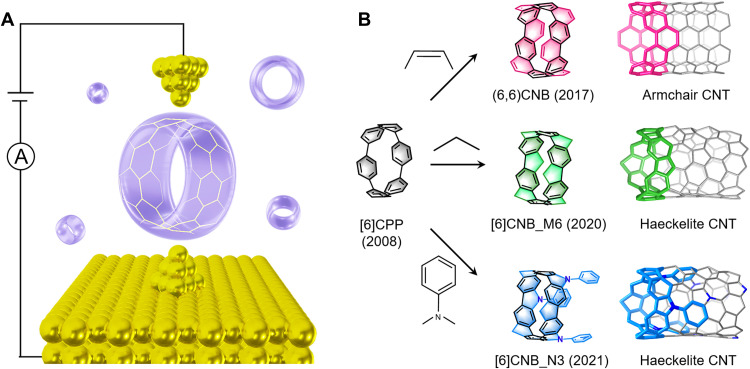
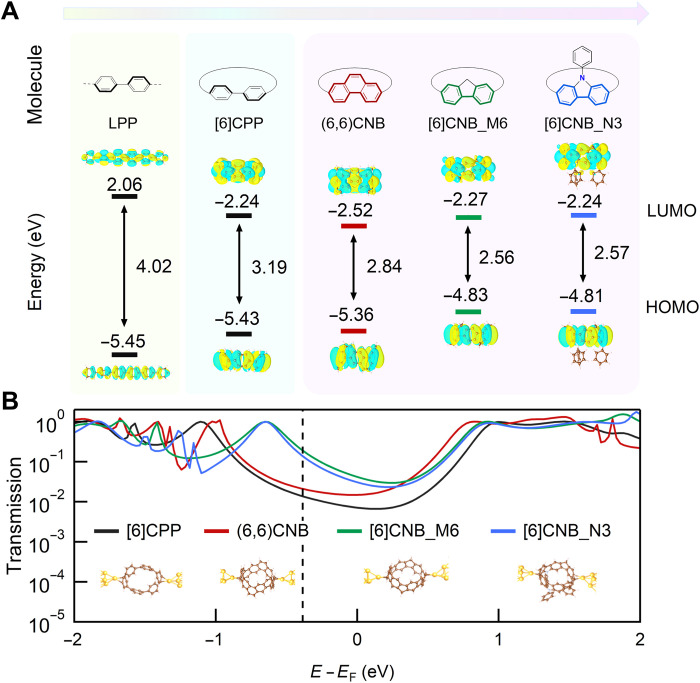
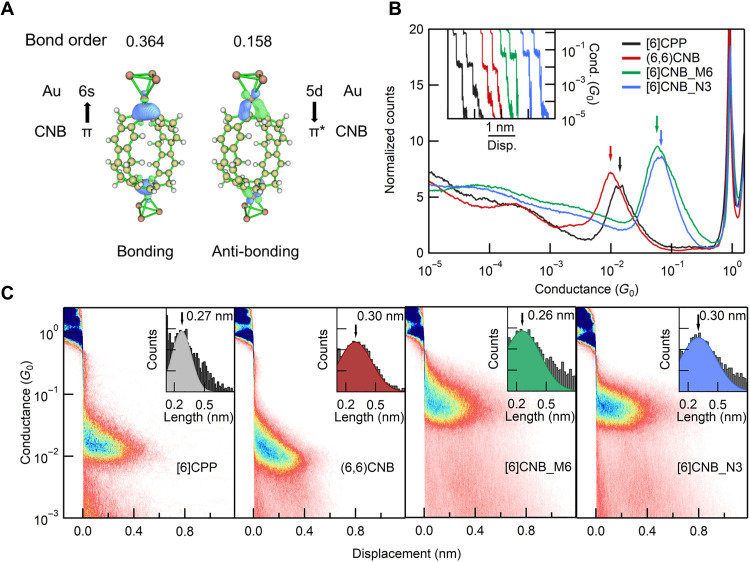
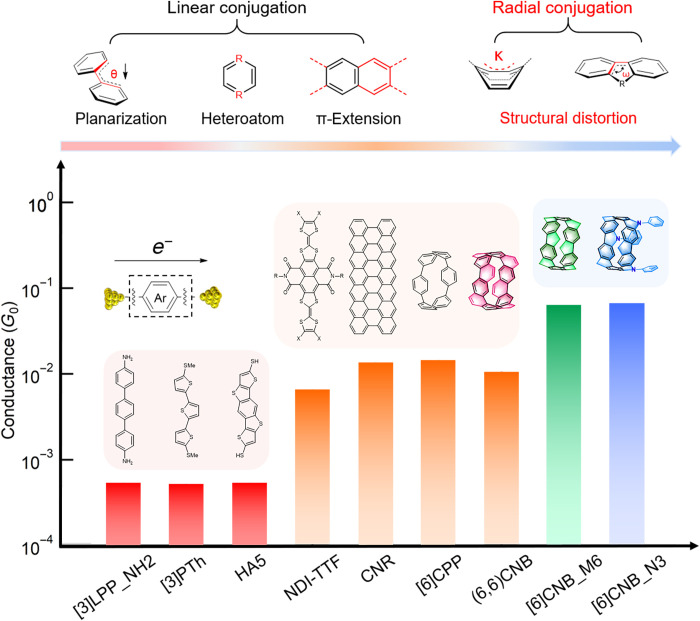
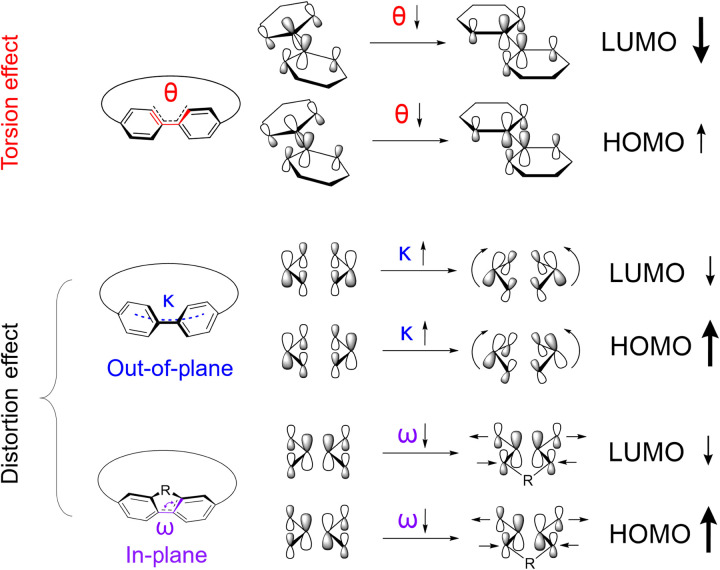
Carbon nanobelts (CNBs) are a new form of nanocarbon that has promising applications in optoelectronics due to their unique belt-shaped π-conjugated systems. Recent synthetic breakthrough has led to the access to various CNBs, but their optoelectronic properties have not been explored yet. In this work, we study the electronic transport performance of a series of CNBs by incorporating them into molecular devices using the scanning tunneling microscope break junction technique. We show that, by tuning the bridging groups between the adjacent benzenes in the CNBs, we can achieve remarkably high conductance close to 0.1 , nearly one order of magnitude higher than their nanoring counterpart cycloparaphenylene. Density functional theory-based calculations further elucidate the crucial role of the structural distortion played in facilitating the unique radial π-electron delocalization and charge transport across the belt-shaped carbon skeletons. These results develop a basic understanding of electronic transport properties of CNBs and lay the foundation for further exploration of CNB-based optoelectronic applications.
碳纳米带(CNBs)是一种新型纳米碳,由于其独特的带状π共轭体系,在光电子学领域具有广阔的应用前景。最近的合成突破使人们能够获得各种 CNB,但它们的光电性能尚未得到探索。在这项工作中,我们通过将 CNB 结合到分子器件中,使用扫描隧道显微镜断结技术研究了一系列 CNB 的电子输运性能。我们表明,通过调节 CNB 中相邻苯环之间的桥接基团,可以实现接近 0.1 的高电导,比它们的纳米环对应物环对苯撑高出近一个数量级。基于密度泛函理论的计算进一步阐明了结构变形在促进独特的径向π电子离域和沿带状碳骨架传输电荷方面所起的关键作用。这些结果为理解 CNB 的电子输运性质奠定了基础,并为进一步探索基于 CNB 的光电子应用奠定了基础。