College of Health Professions, Pace University, 163 William Street, New York, NY, 10038, USA.
School of Nursing, Thompson Rivers University, 805 TRU Way, Kamloops, BC, V2C 0C8, Canada.
Trials. 2022 Dec 23;23(1):1043. doi: 10.1186/s13063-022-06643-9.
HIV-related stigma negatively impacts HIV prevention, treatment, and care, particularly among children and adolescents in sub-Saharan Africa. Interventions that are culturally grounded and relevant for addressing root causes may reduce the stigma experienced by HIV-positive and HIV-affected young people. This study, to be conducted in a post-conflict, rural setting in Omoro District, Uganda, will develop and evaluate a transformative arts-based HIV-related stigma intervention rooted in local cultural knowledge to reduce stigma and improve HIV prevention and care for young people living with HIV. The intervention will be delivered to young people attending school by community Elders, with the support of teachers, through the transfer of local cultural knowledge and practices with the aim of re-establishing the important cultural and social role of Elders within a community that has suffered the loss of intergenerational transfer of cultural knowledge throughout a 25-year civil war.
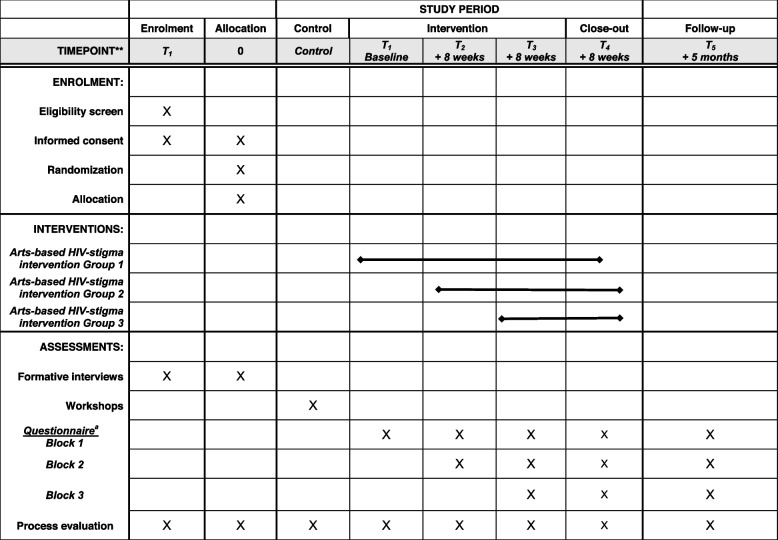
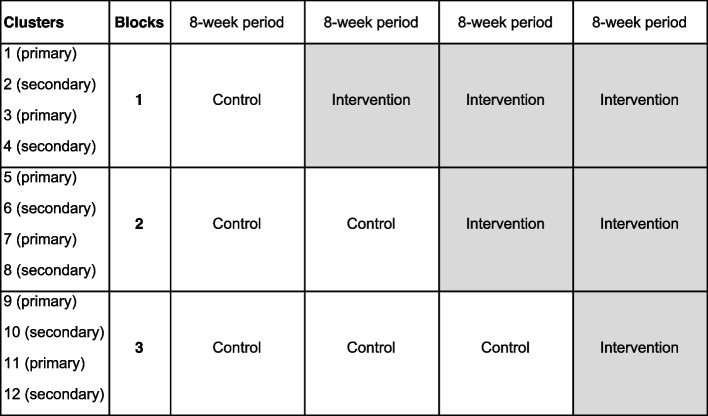
A formative research phase consisting of interviews with students, teachers, and Elders will inform the intervention and provide data for study objectives. Workshops will be delivered to Elders and teachers in participating schools to build capacity for arts-based, educational workshops to be conducted with students in the classroom. The intervention will be evaluated using a stepped-wedge cluster-randomized trial. Government-funded schools in Omoro District will be randomized into three blocks, each comprised of two primary and two secondary schools (n=1800 students). Schools will be randomly assigned to a crossover sequence from control to intervention condition in 8-week intervals. A process evaluation will be implemented throughout the study to evaluate pathways between intervention development, implementation, and effects.
This study will generate comprehensive, in-depth participatory research and evaluation data to inform an effective and sustainable protocol for implementing arts-based HIV stigma interventions for young people in school settings. Findings will have widespread implications in post-conflict settings for HIV prevention, treatment, and care.
ClinicalTrials.gov NCT04946071 . Registered on 30 June 2021.
与艾滋病相关的耻辱感对艾滋病的预防、治疗和护理产生负面影响,尤其是在撒哈拉以南非洲的儿童和青少年中。以文化为基础、针对根本原因的干预措施可能会减少艾滋病毒阳性和受艾滋病影响的年轻人所经历的耻辱感。这项研究将在乌干达奥莫罗区的一个冲突后农村地区进行,旨在开发和评估一种基于转化艺术的艾滋病相关耻辱感干预措施,该干预措施根植于当地文化知识,以减少耻辱感,并改善艾滋病毒感染者青少年的预防和护理。该干预措施将由社区长者通过学校教师向在校的年轻人提供,通过传授当地文化知识和习俗,旨在恢复在经历了 25 年内战期间代际文化知识传递中断的社区中,长者的重要文化和社会角色。
一个由学生、教师和长者访谈组成的形成性研究阶段将为干预措施提供信息,并为研究目标提供数据。将在参与学校为长者和教师举办研讨会,以建立开展课堂学生艺术教育工作坊的能力。该干预措施将使用逐步楔形集群随机试验进行评估。奥莫罗区的政府资助学校将被随机分为三组,每组包括两所小学和两所中学(n=1800 名学生)。学校将以 8 周的间隔随机分配到从对照到干预条件的交叉序列中。整个研究将实施一个过程评估,以评估干预措施的发展、实施和效果之间的途径。
这项研究将生成全面、深入的参与式研究和评估数据,为在学校环境中为年轻人实施基于艺术的艾滋病耻辱感干预措施提供有效的和可持续的方案。研究结果将对冲突后环境中的艾滋病预防、治疗和护理产生广泛影响。
ClinicalTrials.gov NCT04946071。注册于 2021 年 6 月 30 日。