Department of Geriatric Neurology, Xiangya Hospital, Central South University, Changsha, Hunan, China.
National Clinical Research Center for Geriatric Disorders, Xiangya Hospital, Central South University, Changsha, Hunan, China.
Front Immunol. 2022 Dec 8;13:1056944. doi: 10.3389/fimmu.2022.1056944. eCollection 2022.
Neuromyelitis optica spectrum disorder (NMOSD) is an inflammatory disease preferentially affects the optic nerve and the spinal cord. The first attack usually occurs in the third or fourth decade, though patients with disease onset in the fifties or later are not uncommon. This study aimed to investigate the clinical characteristics and prognosis in patients with different age of onset and to explore the correlations between age of onset and clinical characteristics and prognostic outcomes.
We retrospectively reviewed the medical records of 298 NMOSD patients diagnosed according to the 2015 updated version of diagnostic criteria. Patients were divided into early-onset NMOSD (EO-NMOSD) (<50 years at disease onset) and late-onset NMOSD (LO-NMOSD) (≥50 years at disease onset) based on the age of disease onset. LO-NMOSD patients were divided into two subgroups: relative-late-onset NMOSD (RLO-NMOSD) (50~70 years at disease onset) and very-late-onset NMOSD (≥70 years at disease onset). Clinical characteristics, laboratory findings, neuroimaging features, and prognostic outcomes were investigated.
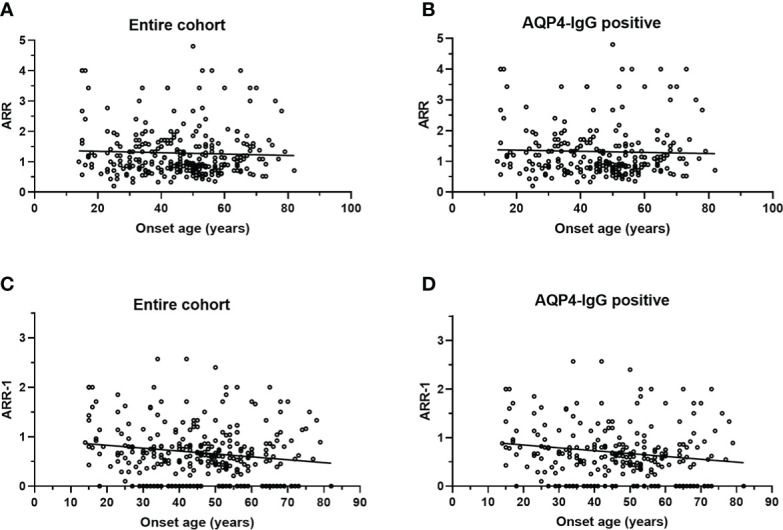
Compared to EO-NMOSD patients, patients with LO-NMOSD showed more frequent transverse myelitis (TM) (58.20% vs. 36.00%, = 0.007) while less frequent optic neuritis (ON) (23.10% vs. 34.80%, = 0.031) and brainstem/cerebral attacks (7.50% vs. 18.30%, = 0.006) as the first attack. Patients with LO-NMOSD showed less frequent relapses, higher Expanded Disability Status Scale (EDSS) score at the last follow-up, fewer NMOSD-typical brain lesions, and longer segments of spinal cord lesions. Patients with older onset age showed a higher proportion of increased protein levels in cerebrospinal fluid during the acute phase of attacks. Age at disease onset positively correlated with length of spinal cord lesions at first attack and at last follow-up, negatively correlated with ARR-1 (ARR excluding the first attack, calculated from disease onset to final follow-up), irrespective of AQP4-IgG serostatus. Patients with older age at disease onset progressed to severe motor disability sooner, and age of onset positively correlated with EDSS score at the last follow-up, irrespective of AQP4-IgG serostatus.
Age of disease onset affects clinical characteristics and prognosis outcomes of patients with NMOSD.
视神经脊髓炎谱系疾病(NMOSD)是一种炎症性疾病,主要影响视神经和脊髓。首次发作通常发生在第三或第四个十年,但五十岁以后发病的患者并不少见。本研究旨在探讨不同发病年龄的患者的临床特征和预后,并探讨发病年龄与临床特征和预后结果之间的关系。
我们回顾性分析了根据 2015 年修订的诊断标准诊断的 298 例 NMOSD 患者的病历。根据发病年龄,将患者分为早发性 NMOSD(EO-NMOSD)(发病时<50 岁)和晚发性 NMOSD(LO-NMOSD)(发病时≥50 岁)。将 LO-NMOSD 患者分为两个亚组:相对晚发性 NMOSD(RLO-NMOSD)(发病时 50~70 岁)和极晚发性 NMOSD(≥70 岁)。研究了临床特征、实验室检查结果、神经影像学特征和预后结果。
与 EO-NMOSD 患者相比,LO-NMOSD 患者更常见横惯性脊髓炎(TM)(58.20%比 36.00%,=0.007),而更少发生视神经炎(ON)(23.10%比 34.80%,=0.031)和脑干/脑攻击(7.50%比 18.30%,=0.006)作为首发症状。LO-NMOSD 患者的复发频率较低,最后一次随访时扩展残疾状态量表(EDSS)评分较高,NMOSD 典型脑病变较少,脊髓病变节段较长。发病年龄较大的患者在发病急性期脑脊液中蛋白水平升高的比例较高。发病年龄与首次发病和最后一次随访时的脊髓病变长度呈正相关,与 ARR-1(ARR 排除首发,从发病到最终随访计算)呈负相关,与 AQP4-IgG 血清学状态无关。发病年龄较大的患者较早进展为严重运动残疾,发病年龄与最后一次随访时的 EDSS 评分呈正相关,与 AQP4-IgG 血清学状态无关。
发病年龄影响 NMOSD 患者的临床特征和预后结果。