Department of Molecular Immunology, Groningen Biomolecular Sciences and Biotechnology, University of Groningen, Groningen, the Netherlands.
Department of Molecular Cell Biology and Immunology, Amsterdam Cardiovascular Sciences, Amsterdam Gastroenterology Endocrinology Metabolism, Amsterdam Institute for Infection and Immunity, Cancer Centre Amsterdam, Amsterdam UMC, Vrije Universiteit Amsterdam, Amsterdam, the Netherlands.
Redox Biol. 2023 Feb;59:102591. doi: 10.1016/j.redox.2022.102591. Epub 2022 Dec 24.
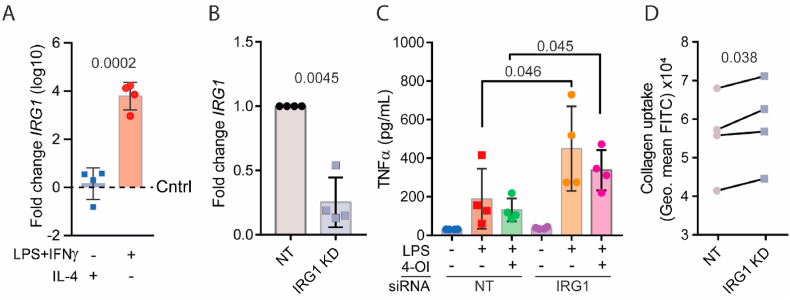
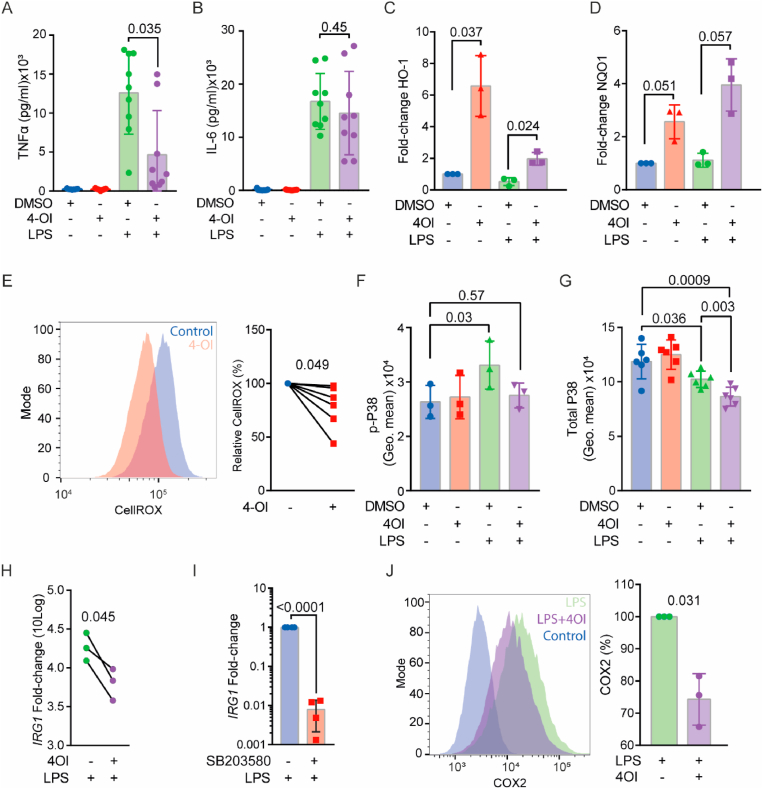
Pathological conditions associated with dysfunctional wound healing are characterized by impaired remodelling of extracellular matrix (ECM), increased macrophage infiltration, and chronic inflammation. Macrophages also play an important role in wound healing as they drive wound closure by secretion of molecules like transforming growth factor beta-1 (TGF-β). As the functions of macrophages are regulated by their metabolism, local administration of small molecules that alter this might be a novel approach for treatment of wound-healing disorders. Itaconate is a tricarboxylic acid (TCA) cycle-derived metabolite that has been associated with resolution of macrophage-mediated inflammation. However, its effects on macrophage wound healing functions are unknown. In this study, we investigated the effects of the membrane-permeable 4-octyl itaconate (4-OI) derivative on ECM scavenging by cultured human blood monocyte-derived macrophages (hMDM). We found that 4-OI reduced signalling of p38 mitogen-activated protein kinase (MAPK) induced by the canonical immune stimulus lipopolysaccharide (LPS). Likely as a consequence of this, the production of the inflammatory mediators like tumor necrosis factor (TNF)-α and cyclooxygenase (COX)-2 were also reduced. On the transcriptional level, 4-OI increased expression of the gene coding for TGF-β (TGFB1), whereas expression of the collagenase matrix metalloprotease-8 (MMP8) was reduced. Furthermore, surface levels of the anti-inflammatory marker CD36, but not CD206 and CD11c, were increased in these cells. To directly investigate the effect of 4-OI on scavenging of ECM by macrophages, we developed an assay to measure uptake of fibrous collagen. We observed that LPS promoted collagen uptake and that this was reversed by 4-OI-induced signaling of nuclear factor erythroid 2-related factor 2 (NRF2), a regulator of cellular resistance to oxidative stress and the reduced glycolytic capacity of the macrophage. These results indicate that 4-OI lowers macrophage inflammation, likely promoting a more wound-resolving phenotype.
与功能失调性伤口愈合相关的病理状况的特征是细胞外基质 (ECM) 的重塑受损、巨噬细胞浸润增加和慢性炎症。巨噬细胞在伤口愈合中也起着重要作用,因为它们通过分泌转化生长因子-β1 (TGF-β) 等分子来驱动伤口闭合。由于巨噬细胞的功能受其代谢调节,局部给予改变这种代谢的小分子可能是治疗伤口愈合障碍的一种新方法。衣康酸是一种三羧酸 (TCA) 循环衍生的代谢物,与巨噬细胞介导的炎症消退有关。然而,它对巨噬细胞伤口愈合功能的影响尚不清楚。在这项研究中,我们研究了膜透性 4-辛基衣康酸 (4-OI) 衍生物对培养的人血单核细胞衍生的巨噬细胞 (hMDM) 清除 ECM 的影响。我们发现,4-OI 降低了经典免疫刺激物脂多糖 (LPS) 诱导的 p38 丝裂原活化蛋白激酶 (MAPK) 的信号转导。可能因此,炎症介质如肿瘤坏死因子 (TNF)-α 和环氧化酶 (COX)-2 的产生也减少了。在转录水平上,4-OI 增加了编码 TGF-β (TGFB1) 的基因的表达,而胶原酶基质金属蛋白酶-8 (MMP8) 的表达则减少了。此外,这些细胞表面的抗炎标志物 CD36 水平增加,但 CD206 和 CD11c 水平没有增加。为了直接研究 4-OI 对巨噬细胞清除 ECM 的影响,我们开发了一种测量纤维胶原摄取的测定法。我们观察到 LPS 促进了胶原的摄取,而 4-OI 诱导的核因子红细胞 2 相关因子 2 (NRF2) 的信号转导则逆转了这种摄取,NRF2 是细胞对氧化应激和巨噬细胞糖酵解能力降低的抵抗力的调节剂。这些结果表明,4-OI 降低了巨噬细胞炎症,可能促进了更有利于伤口愈合的表型。