Kumar Shine, Memon Danish, Raj Manu, Sen Amitabh C, Jayasankar Jessin P, Leeladharan Sreelakshmi P, Sudhakar Abish, Kumar Raman K
Department of Pediatric Cardiology, Pulmonary Hypertension Clinic, Amrita Institute of Medical Sciences Amrita Vishwa Vidyapeetham University Kochi Kerala India.
Department of Pediatrics and Health Sciences Research, Amrita Institute of Medical Sciences Amrita Vishwa Vidyapeetham University Kochi Kerala India.
Pulm Circ. 2022 Oct 1;12(4):e12180. doi: 10.1002/pul2.12180. eCollection 2022 Oct.
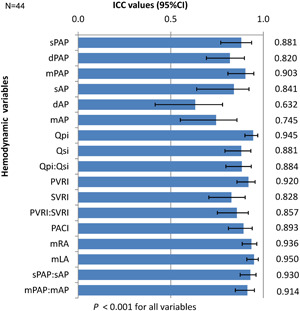
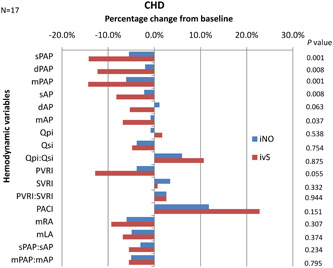
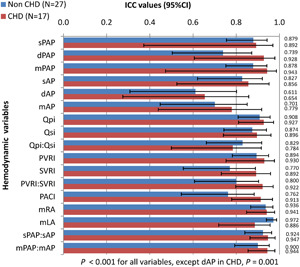
Acute vasodilator testing (AVT) identifies acute responders for initiation of calcium channel blockers in pulmonary arterial hypertension (PAH) and operability in congenital heart disease (CHD). We sought to determine the feasibility of intravenous sildenafil (ivS) as an alternative to inhaled nitric oxide (iNO) in AVT. All patients with PAH undergoing cardiac catheterization for AVT (November 2015 to December 2020) were prospectively enrolled. Hemodynamic data were obtained at baseline, with iNO 20 ppm and ivS (0.25 mg/kg for children and 10 mg for adults). We studied 44 patients with a mean age of 20.5 ± 14.4 years (27 [61%] females and 20 [45%] children). There were 17 (38.6%) patients in the CHD group for operability assessment and 27 patients in non-CHD group (idiopathic pulmonary arterial hypertension-16 [36.3%], residual PAH after shunt closure-7 [15.9%], and 2 cases [4.5%] each of familial PAH and portopulmonary hypertension). There was an excellent intraclass correlation for mean pulmonary artery pressures (0.903, 95% confidence interval, CI: 0.809-0.949, < 0.001), mean aortic pressures (0.745, 95% CI: 0.552-0.858, < 0.001), pulmonary vascular resistance index (0.920, 95% CI: 0.858-0.956, < 0.001), systemic vascular resistance (SVR) index (0.828, 95% CI: 0.706-0.902, < 0.001), and the ratio of pulmonary and SVR indices (0.857, 95% CI: 0.752-0.919, < 0.001) between the two agents. There were two responders, both in non-CHD group, and were identified by iNO and ivS. The hemodynamic effects of ivS show excellent correlation with iNO and could be a potential alternative agent for identifying acute responders during AVT.
急性血管扩张剂试验(AVT)可识别出肺动脉高压(PAH)患者中适合起始使用钙通道阻滞剂的急性反应者以及先天性心脏病(CHD)患者的可手术性。我们旨在确定静脉注射西地那非(ivS)在AVT中替代吸入一氧化氮(iNO)的可行性。前瞻性纳入了所有因AVT接受心脏导管检查的PAH患者(2015年11月至2020年12月)。在基线、吸入20 ppm iNO以及静脉注射ivS(儿童为0.25 mg/kg,成人为10 mg)时获取血流动力学数据。我们研究了44例患者,平均年龄为20.5±14.4岁(女性27例[61%],儿童20例[45%])。CHD组中有17例(38.6%)患者用于可手术性评估,非CHD组有27例患者(特发性肺动脉高压16例[36.3%],分流关闭后残余PAH 7例[15.9%],家族性PAH和 portopulmonary高血压各2例[4.5%])。两种药物之间的平均肺动脉压(组内相关系数为0.903,95%置信区间[CI]:0.809 - 0.949,P < 0.001)、平均主动脉压(0.745,95% CI:0.552 - 0.858,P < 0.001)、肺血管阻力指数(0.920,95% CI:0.858 - 0.956,P < 0.001)、体循环血管阻力(SVR)指数(0.828,95% CI:0.706 - 0.902,P < 0.001)以及肺和SVR指数之比(0.857,95% CI:0.752 - 0.919,P < 0.001)具有良好的组内相关性。有两名反应者,均在非CHD组,通过iNO和ivS识别出。ivS的血流动力学效应与iNO显示出良好的相关性,可能是AVT期间识别急性反应者的一种潜在替代药物。