Uni Shigehiko, Mat Udin Ahmad Syihan, Tan Poai Ean, Rodrigues Jules, Martin Coralie, Junker Kerstin, Agatsuma Takeshi, Low Van Lun, Lim Yvonne Ai-Lian, Saijuntha Weerachai, Omar Hasmahzaiti, Zainuri Nur Afiquah, Fukuda Masako, Kimura Daisuke, Matsubayashi Makoto, Uga Shoji, Takaoka Hiroyuki, Azirun Mohd Sofian, Ramli Rosli
Institute of Biological Sciences, Faculty of Science, Universiti Malaya, Kuala Lumpur 50603, Malaysia.
Department of Public Health, Faculty of Nursing, Kobe Women's University, Kobe 650-0046, Japan.
Curr Res Parasitol Vector Borne Dis. 2022 Jan 30;2:100078. doi: 10.1016/j.crpvbd.2022.100078. eCollection 2022.
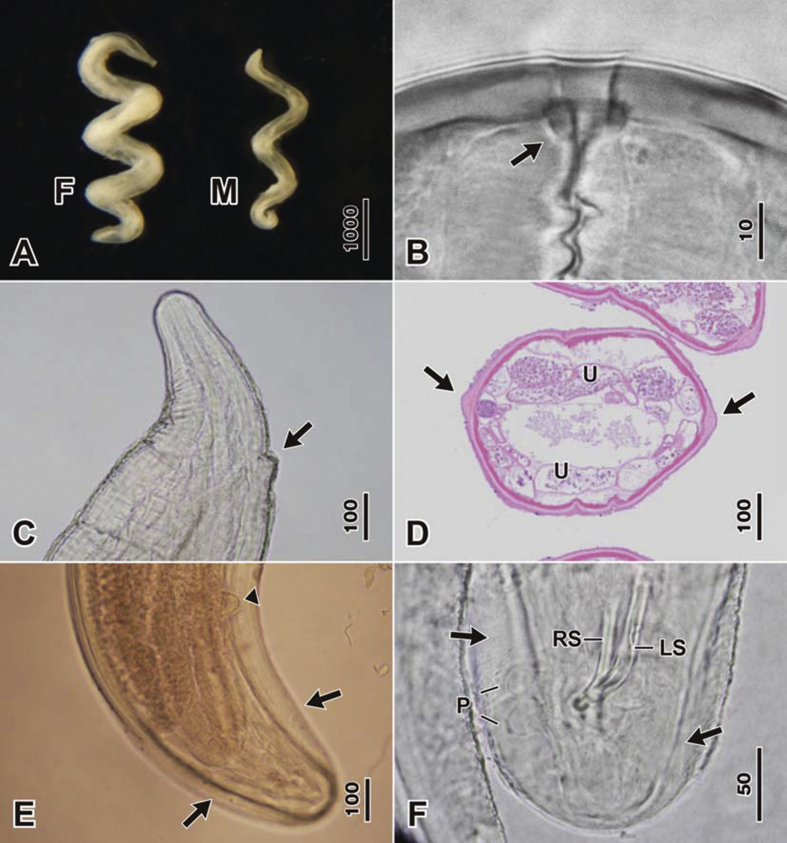
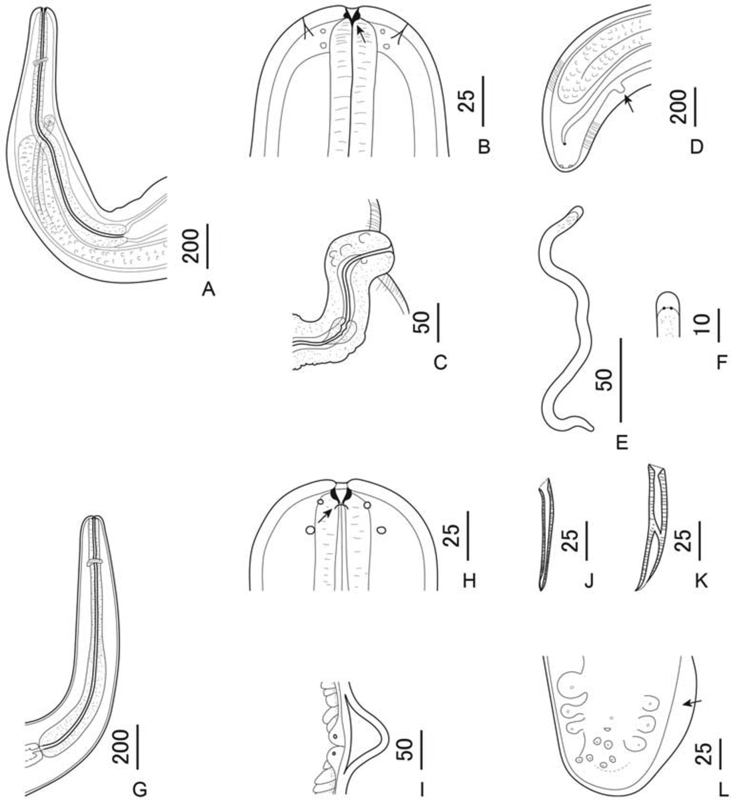
Species of the genus Railliet & Henry, 1910 the most widely distributed avian filariae in Africa and South America. Zoonotic cases in humans were reported in South America. While investigating the filarial fauna of wild animals in Malaysia, we discovered an undescribed filaria from the swollen footpad of the left leg of (Scopoli) in Pahang, Peninsular Malaysia. Adults of both sexes have a corkscrew-shaped body. Based on comparison of their morphological characteristics (i.e. pre-oesophageal cuticular ring distinct, oesophagus divided, vulva protuberant and situated at the level of anterior half of oesophagus, spicules strongly sclerotized and left spicule with broad blade) with other species, they are here described as Uni, Mat Udin & Martin n. sp. Multi-locus sequence analyses based on seven genes ( rDNA, 1, rDNA, rDNA, , and ) were performed to determine the phylogenetic position of the new species. The calculated p-distance between the 1 gene sequences for n. sp. and (Diesing, 1861) was 14.1%. Intraspecific genetic variation between two individuals of the new species was 0.4%. In both the Bayesian inference and maximum-likelihood trees, n. sp. was positioned in the second clade of ONC5, containing three genera of the subfamily Dirofilariinae ( Seurat, 1917, and Stiles, 1905). Immunostaining and molecular analyses remained negative for the presence of endosymbionts. Our findings corroborate the division of the subfamily Dirofilariinae into ONC3 with Railliet & Henry, 1911 and ONC5 with .
雷耶(Railliet)和亨利(Henry)属的物种,于1910年在非洲和南美洲分布最为广泛的鸟类丝虫。在南美洲报告了人类的人畜共患病病例。在对马来西亚野生动物的丝虫动物群进行调查时,我们在马来西亚半岛彭亨州的(斯科普利)左腿肿胀的脚垫中发现了一种未描述的丝虫。雌雄成虫均有螺旋形身体。根据其形态特征(即食管前角质环明显、食管分开、阴门突出且位于食管前半部分水平、交合刺强烈硬化且左交合刺有宽叶片)与其他物种的比较,它们在此被描述为Uni,Mat Udin和Martin新种。基于七个基因(rDNA、1、rDNA、rDNA、、和)进行多位点序列分析,以确定新物种的系统发育位置。新种和(迪辛,1861年)的1基因序列之间计算的p距离为14.1%。新物种两个个体之间的种内遗传变异为0.4%。在贝叶斯推断树和最大似然树中,新种都位于ONC5的第二个分支中,该分支包含恶丝虫亚科的三个属(瑟拉特,1917年,和斯蒂尔斯,1905年)。免疫染色和分子分析均未检测到内共生体的存在。我们的研究结果证实了恶丝虫亚科分为1911年的雷耶(Railliet)和亨利(Henry)属的ONC3以及属的ONC5。