Institute of General Practice, Universitätsklinikum Erlangen, Friedrich-Alexander-Universität Erlangen-Nürnberg, Erlangen, Germany
GWQ ServicePlus AG, Düsseldorf, Germany.
BMJ Open. 2023 Jan 2;13(1):e063490. doi: 10.1136/bmjopen-2022-063490.
Direct oral anticoagulants (DOACs) were introduced based on randomised controlled trials (RCTs) comparing them to vitamin-K-antagonist (VKA) warfarin. In Germany, almost exclusively phenprocoumon is used as VKA. RCTs with phenprocoumon being absent we analysed the benefits and harms of DOACs and phenprocoumon for patients with atrial fibrillation (AF) in a real-world setting.
In a retrospective observational cohort study, claims data covering inpatient and outpatient care from 2015 to 2019 were analysed by Cox regression and propensity score matching (PSM).
Data from a group of small-sized to medium-sized health insurance companies in Germany.
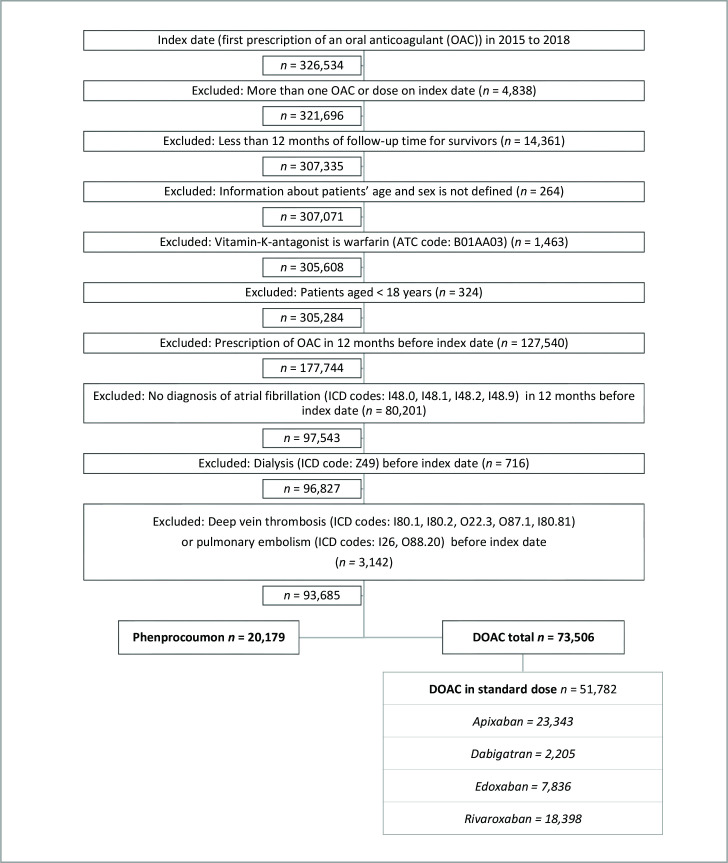
We analysed datasets of 71 961 patients with AF and first prescription of phenprocoumon (n=20 179) or DOAC in standard dose (n=51 782). Patients with reduced dose of DOACs were excluded (n=21 724).
Outcomes were thromboembolic events, major bleeding and death during a 12-month follow-up period.
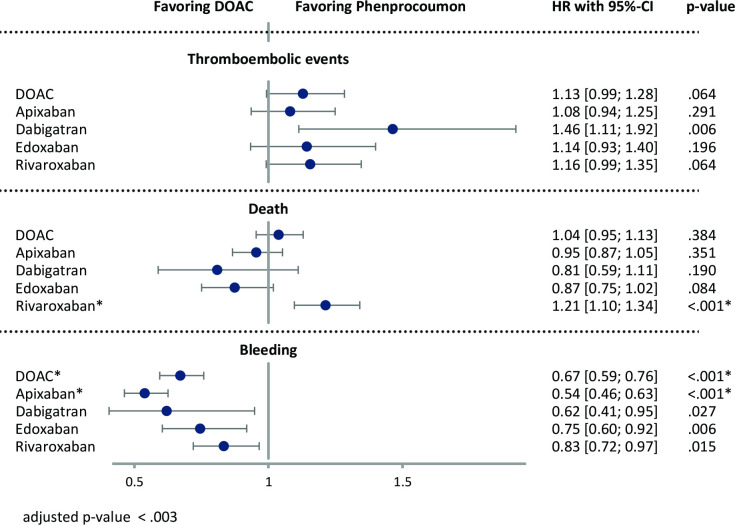
The regression analysis widely showed similarity between phenprocoumon and standard dose DOACs regarding effectiveness and safety. There were only three statistically significant differences: a lower bleeding risk with composite DOACs and apixaban (HR (95% CI) = 0.67 (0.59 to 0.76) and 0.54 (0.46 to 0.63), respectively) and a higher risk of death with rivaroxaban (1.21 (1.10 to 2.34)). The analysis after PSM was consistent with the first two results regarding composite DOACs and apixaban (number needed to treat, NNT 101 and 78) and showed a lower bleeding risk with rivaroxaban (NNT 156). Absolute differences were small.
The small superiority or non-inferiority of DOACs over warfarin seen in the RCTs might not translate into relevant advantages of DOACs over phenprocoumon. To confirm the hypothesis, an RCT with phenprocoumon is needed. Next to the safety and effectiveness assessments other factors might also play a substantial role in the decision on the right OAC for stroke prevention.
直接口服抗凝剂(DOACs)是基于与维生素 K 拮抗剂(VKA)华法林进行随机对照试验(RCTs)比较而引入的。在德国,几乎仅使用苯丙香豆素作为 VKA。我们分析了 RCTs 中没有苯丙香豆素的数据,以评估 DOACs 和苯丙香豆素在真实世界环境中对房颤(AF)患者的获益和危害。
在一项回顾性观察队列研究中,通过 Cox 回归和倾向评分匹配(PSM)分析了 2015 年至 2019 年的住院和门诊护理索赔数据。
来自德国一组中小型健康保险公司的数据。
我们分析了 71961 名患有 AF 并首次服用苯丙香豆素(n=20179)或标准剂量 DOAC(n=51782)的患者数据集。排除了 DOAC 低剂量组患者(n=21724)。
在 12 个月的随访期间,结局为血栓栓塞事件、大出血和死亡。
回归分析广泛表明,苯丙香豆素与标准剂量 DOACs 在有效性和安全性方面具有相似性。只有三个统计学上的显著差异:与复合 DOACs 和阿哌沙班相比,出血风险较低(HR(95%CI)分别为 0.67(0.59 至 0.76)和 0.54(0.46 至 0.63)),与利伐沙班相比,死亡风险较高(1.21(1.10 至 2.34))。PSM 后的分析与前两个结果关于复合 DOACs 和阿哌沙班一致(需要治疗的人数,NNT 为 101 和 78),并显示利伐沙班出血风险较低(NNT 为 156)。绝对差异很小。
RCT 中观察到 DOACs 优于华法林的微小优势或非劣效性可能无法转化为 DOACs 相对于苯丙香豆素的相关优势。为了证实这一假设,需要进行苯丙香豆素的 RCT。除了安全性和有效性评估外,其他因素也可能在预防中风的 OAC 选择方面发挥重要作用。