Department of Epidemiology, Harvard T. H. Chan School of Public Health, Boston, Massachusetts.
Department of Cardiac Surgery, S. Croce Hospital, Cuneo, Italy.
JAMA Netw Open. 2023 Jan 3;6(1):e2249321. doi: 10.1001/jamanetworkopen.2022.49321.
Recent European Society of Cardiology/European Association for Cardio-Thoracic Surgery (ESC/EACTS) guidelines highlighted some concerns about the randomized clinical trials (RCTs) comparing transcatheter aortic valve implantation (TAVI) and surgical aortic valve replacement (SAVR) for aortic stenosis. Quantification of these biases has not been previously performed.
To assess whether randomization protects RCTs comparing TAVI and SAVR from biases other than nonrandom allocation.
A systematic review of the literature between January 1, 2007, and June 6, 2022, on MEDLINE, Embase, and Cochrane Central Register of Controlled Trials was performed. Specialist websites were also checked for unpublished data.
The study included RCTs with random allocation to TAVI or SAVR with a maximum 5-year follow-up.
Data extraction was performed by 2 independent investigators following the PRISMA guidelines. A random-effects meta-analysis was used for quantifying pooled rates and differential rates between treatments of deviation from random assigned treatment (DAT), loss to follow-up, and receipt of additional treatments.
The primary outcomes were the proportion of DAT, loss to follow-up, and patients who were provided additional treatments and myocardial revascularization, together with their ratio between treatments. The measures were the pooled overall proportion of the primary outcomes and the risk ratio (RR) in the TAVI vs SAVR groups.
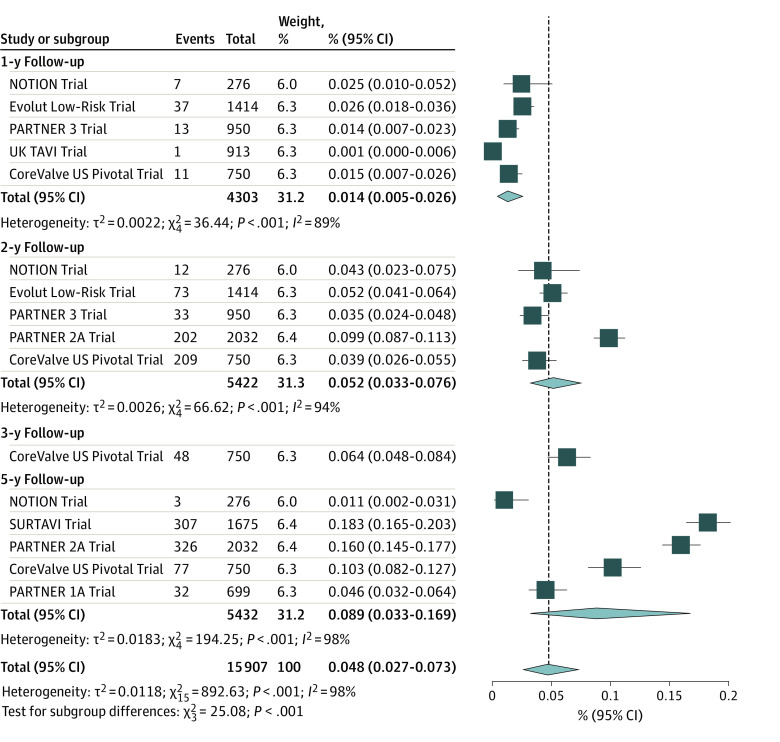
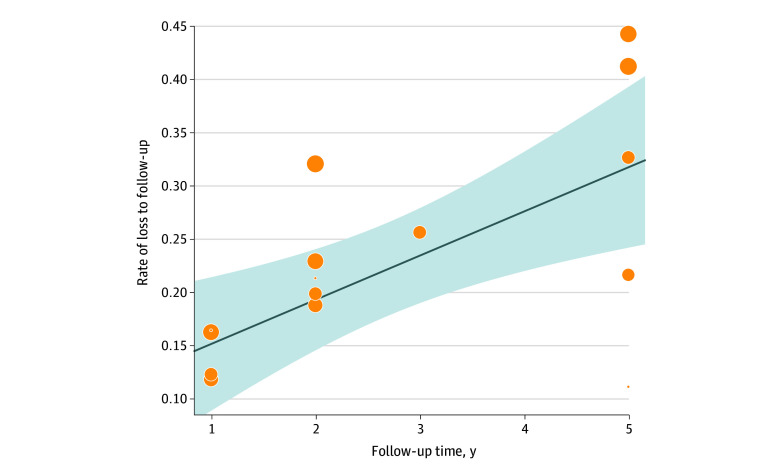
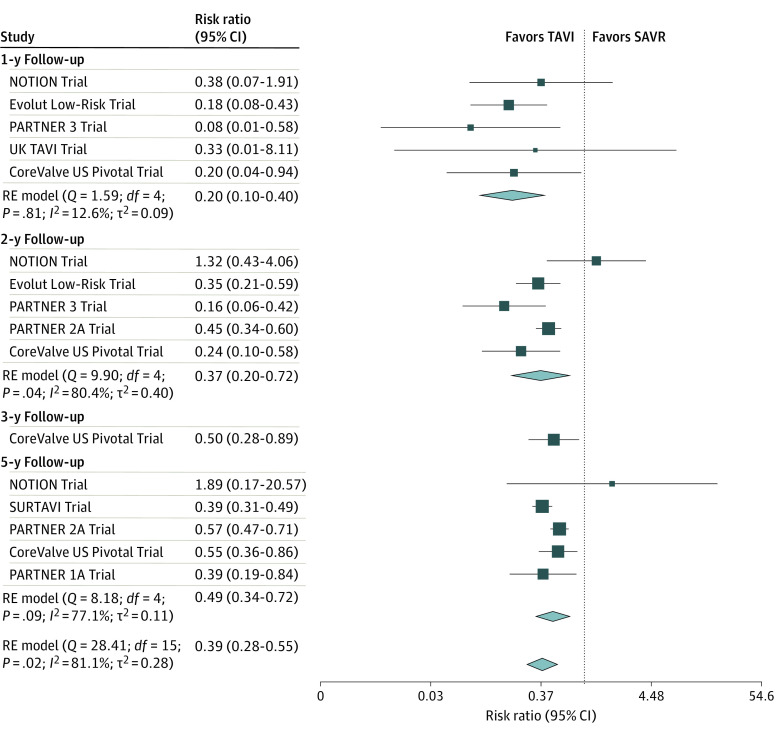
The search identified 8 eligible trials including 8849 participants randomly assigned to undergo TAVI (n = 4458) or SAVR (n = 4391). The pooled proportion of DAT among the sample was 4.2% (95% CI, 3.0%-5.6%), favoring TAVI (pooled RR vs SAVR, 0.16; 95% CI, 0.08-0.36; P < .001). The pooled proportion of loss to follow-up was 4.8% (95% CI, 2.7%-7.3%). Meta-regression showed a significant association between the proportion of participants lost to follow-up and follow-up time (slope, 0.042; 95% CI, 0.017-0.066; P < .001). There was an imbalance of loss to follow-up favoring TAVI (RR, 0.39; 95% CI, 0.28-0.55; P < .001). The pooled proportion of patients who had additional procedures was 10.4% (95% CI, 4.4%-18.5%): 4.6% (95% CI, 1.5%-9.3%) in the TAVI group and 16.5% (95% CI, 7.5%-28.1%) in the SAVR group (RR, 0.27; 95% CI, 0.15-0.50; P < .001). The imbalance between groups also favored TAVI for additional myocardial revascularization (RR, 0.40; 95% CI, 0.24-0.68; P < .001).
This study suggests that, in RCTs comparing TAVI vs SAVR, there are substantial proportions of DAT, loss to follow-up, and additional procedures together with systematic selective imbalance in the same direction characterized by significantly lower proportions of patients undergoing TAVI that might affect internal validity.
最近欧洲心脏病学会/欧洲心胸外科学会(ESC/EACTS)指南强调了一些对经导管主动脉瓣置换术(TAVI)和主动脉瓣置换术(SAVR)比较治疗主动脉瓣狭窄的随机临床试验(RCT)的担忧。以前没有对这些偏差进行量化。
评估随机分配是否能保护 TAVI 和 SAVR 比较 RCT 免受非随机分配以外的偏差。
对 2007 年 1 月 1 日至 2022 年 6 月 6 日 MEDLINE、Embase 和 Cochrane 对照试验中心注册数据库进行了系统的文献综述。还检查了专门网站以获取未发表的数据。
该研究纳入了随机分配至 TAVI 或 SAVR 且随访时间最长为 5 年的 RCT。
数据提取由 2 名独立研究人员按照 PRISMA 指南进行。采用随机效应荟萃分析量化处理组之间偏离随机分配治疗(DAT)、失访和接受额外治疗的差异率和 pooled 率。
主要结局是 DAT、失访和接受额外治疗的比例,以及心肌血运重建的比例及其治疗组之间的比值。测量指标是主要结局的 pooled 总体比例和 TAVI 与 SAVR 组的风险比(RR)。
搜索共确定了 8 项符合条件的试验,包括 8849 名随机分配接受 TAVI(n=4458)或 SAVR(n=4391)的参与者。样本中 DAT 的 pooled 比例为 4.2%(95%CI,3.0%-5.6%),有利于 TAVI(pooled RR 与 SAVR,0.16;95%CI,0.08-0.36;P<.001)。失访的 pooled 比例为 4.8%(95%CI,2.7%-7.3%)。元回归显示,失访参与者的比例与随访时间呈显著相关(斜率,0.042;95%CI,0.017-0.066;P<.001)。失访存在有利于 TAVI 的不平衡(RR,0.39;95%CI,0.28-0.55;P<.001)。接受额外治疗的患者的 pooled 比例为 10.4%(95%CI,4.4%-18.5%):TAVI 组为 4.6%(95%CI,1.5%-9.3%),SAVR 组为 16.5%(95%CI,7.5%-28.1%)(RR,0.27;95%CI,0.15-0.50;P<.001)。两组之间的不平衡也有利于 TAVI 进行额外的心肌血运重建(RR,0.40;95%CI,0.24-0.68;P<.001)。
本研究表明,在 TAVI 与 SAVR 比较的 RCT 中,存在相当比例的 DAT、失访和额外治疗,以及以显著较低比例接受 TAVI 治疗的系统选择性不平衡,这可能影响内部有效性。