
COVID-19 结局的预测因素:衰弱、合并症和年龄在 COVID-19 预后中的相互作用。
Predictors of COVID-19 outcomes: Interplay of frailty, comorbidity, and age in COVID-19 prognosis.
机构信息
UCLA David Geffen School of Medicine, Los Angeles, CA.
UCLA Division of General Internal Medicine and Health Services Research, Los Angeles, CA.
出版信息
Medicine (Baltimore). 2022 Dec 23;101(51):e32343. doi: 10.1097/MD.0000000000032343.
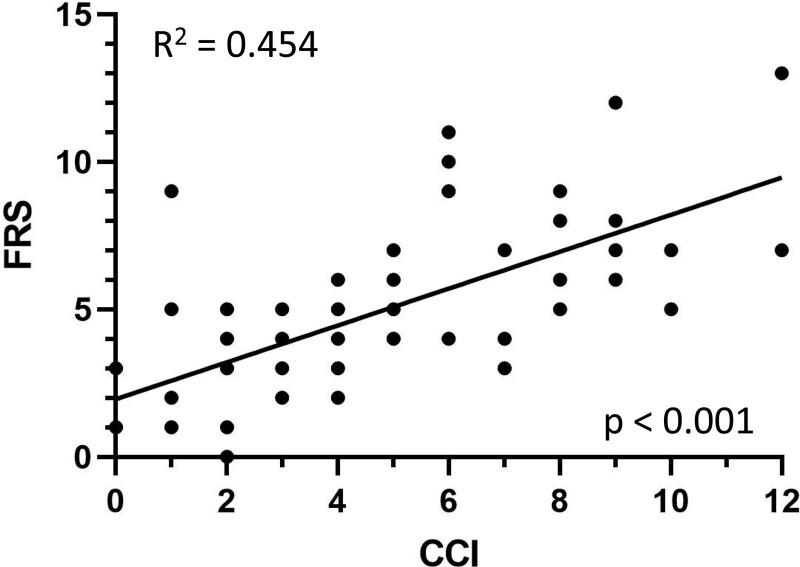
Prior research has identified frailty, comorbidity, and age as predictors of outcomes for patients with coronavirus disease 2019 (COVID-19), including mortality. However, it remains unclear how these factors play different roles in COVID-19 prognosis. This study focused on correlations between frailty, comorbidity and age, and their correlations to discharge outcome and length-of-stay in hospitalized patients with COVID-19. Clinical data was collected from 56 patients who were ≥50 years old and admitted from March 2020 to June 2020 primarily for COVID-19. Frailty Risk Score (FRS) and the Charlson Comorbidity Index (CCI) were used for assessment of frailty and comorbidity burden, respectively. Age had significant positive correlation with FRS and CCI (P < .001, P < .001, respectively). There was also significant positive correlation between FRS and CCI (P < .001). For mortality, patients who died during their hospitalization had significantly higher FRS and CCI (P = .01 and P < .001, respectively) but were not significantly older than patients who did not. FRS, CCI, and age were all significantly associated when looking at overall adverse discharge outcome (transfer to other facility or death) (P < .001, P = .005, and P = .009, respectively). However, none of the 3 variables were significantly correlated with length-of-stay. Multivariate analysis showed FRS (P = .007) but not patient age (P = .967) was significantly associated with death. We find that frailty is associated with adverse outcomes from COVID-19 and supplants age in multivariable analysis. Frailty should be part of risk assessment of older adults with COVID-19.
先前的研究已经确定了衰弱、合并症和年龄是 2019 冠状病毒病(COVID-19)患者结局的预测因素,包括死亡率。然而,这些因素在 COVID-19 预后中扮演的不同角色仍不清楚。本研究重点关注衰弱、合并症和年龄之间的相关性,以及它们与 COVID-19 住院患者出院结局和住院时间的相关性。临床数据来自 56 名年龄≥50 岁的患者,他们于 2020 年 3 月至 6 月因 COVID-19 主要入院。使用衰弱风险评分(FRS)和 Charlson 合并症指数(CCI)分别评估衰弱和合并症负担。年龄与 FRS 和 CCI 呈显著正相关(P<0.001,P<0.001)。FRS 与 CCI 之间也存在显著正相关(P<0.001)。在死亡率方面,住院期间死亡的患者的 FRS 和 CCI 显著更高(P=0.01 和 P<0.001),但与未死亡的患者相比年龄没有显著更大。FRS、CCI 和年龄在总体不良出院结局(转至其他医疗机构或死亡)方面均显著相关(P<0.001,P=0.005 和 P=0.009)。然而,在住院时间方面,这 3 个变量均无显著相关性。多变量分析显示 FRS(P=0.007)而不是患者年龄(P=0.967)与死亡显著相关。我们发现,衰弱与 COVID-19 的不良结局相关,并在多变量分析中取代了年龄。衰弱应该成为评估 COVID-19 老年患者风险的一部分。



 Zotero 插件