
体内克隆追踪显示证据表明血岛细胞和造血中胚层细胞对卵黄囊造血有贡献。
In vivo clonal tracking reveals evidence of haemangioblast and haematomesoblast contribution to yolk sac haematopoiesis.
机构信息
The Walter and Eliza Hall Institute of Medical Research, Melbourne, VIC, Australia.
Department of Medical Biology, The University of Melbourne, Melbourne, VIC, Australia.
出版信息
Nat Commun. 2023 Jan 3;14(1):41. doi: 10.1038/s41467-022-35744-x.
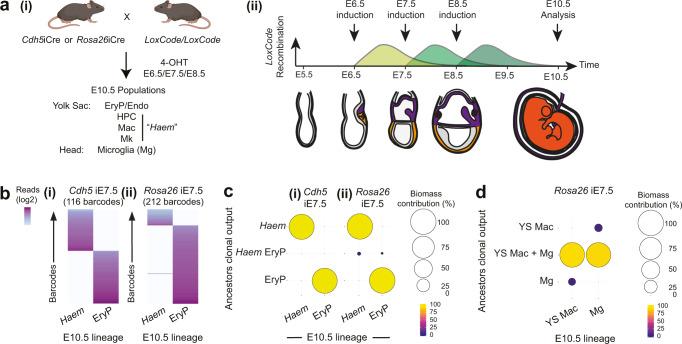
During embryogenesis, haematopoietic and endothelial lineages emerge closely in time and space. It is thought that the first blood and endothelium derive from a common clonal ancestor, the haemangioblast. However, investigation of candidate haemangioblasts in vitro revealed the capacity for mesenchymal differentiation, a feature more compatible with an earlier mesodermal precursor. To date, no evidence for an in vivo haemangioblast has been discovered. Using single cell RNA-Sequencing and in vivo cellular barcoding, we have unravelled the ancestral relationships that give rise to the haematopoietic lineages of the yolk sac, the endothelium, and the mesenchyme. We show that the mesodermal derivatives of the yolk sac are produced by three distinct precursors with dual-lineage outcomes: the haemangioblast, the mesenchymoangioblast, and a previously undescribed cell type: the haematomesoblast. Between E5.5 and E7.5, this trio of precursors seeds haematopoietic, endothelial, and mesenchymal trajectories.
在胚胎发生过程中,造血和内皮谱系在时间和空间上紧密出现。人们认为第一个血液和内皮来源于一个共同的克隆祖先,即血岛细胞。然而,对体外候选血岛细胞的研究揭示了它们具有间充质分化的能力,这一特征更符合早期中胚层前体。迄今为止,尚未发现体内血岛细胞的证据。使用单细胞 RNA 测序和体内细胞条形码技术,我们揭示了导致卵黄囊造血谱系、内皮和间充质的祖细胞的祖先关系。我们表明,卵黄囊的中胚层衍生物是由三种具有双系命运的不同前体细胞产生的:血岛细胞、间充质血岛细胞和以前未描述的细胞类型:造血间充质细胞。在 E5.5 和 E7.5 之间,这三个前体细胞种子造血、内皮和间充质轨迹。




 Zotero 插件