School of Public Health, Xi'an Jiaotong University Health Science Center, Xi'an, China.
Nutritional Epidemiology, Department of Clinical Sciences Malmö, Lund University, Jan Waldenströms Gata 35, 21428, Malmö, Sweden.
Eur J Epidemiol. 2023 Feb;38(2):211-224. doi: 10.1007/s10654-022-00937-7. Epub 2023 Jan 6.
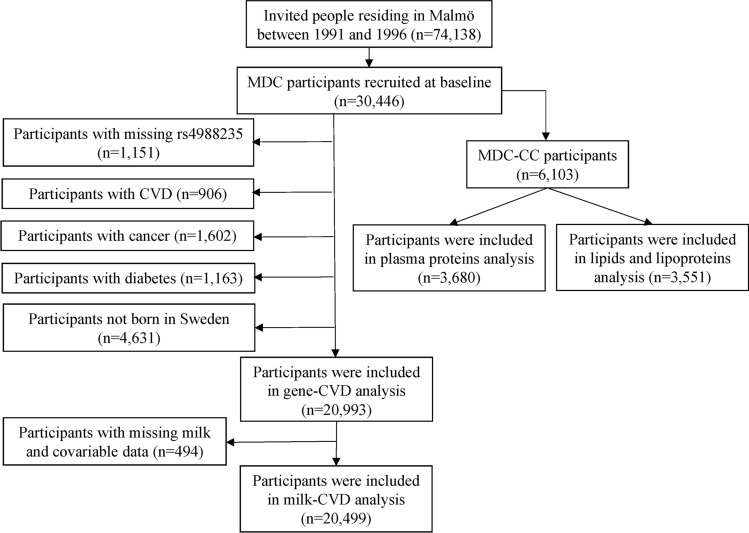
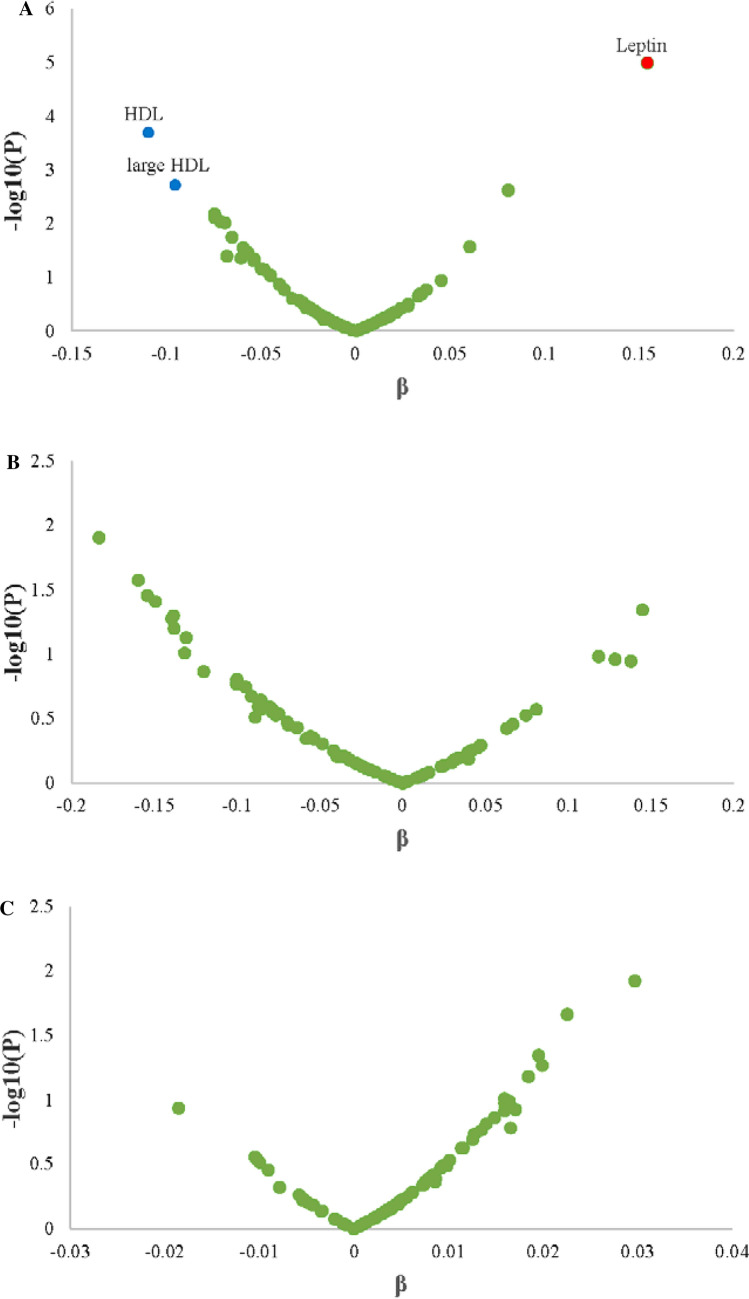
To investigate the associations of milk intake (non-fermented and fermented milk), lactase persistence (LCT-13910 C/T) genotype (a proxy for long-term non-fermented milk intake), and gene-milk interaction with risks of cardiovascular disease (CVD) and CVD mortality. Also, to identify the CVD-related plasma proteins and lipoprotein subfractions associated with milk intake and LCT-13910 C/T genotype. The prospective cohort study included 20,499 participants who were followed up for a mean of 21 years. Dietary intake was assessed using a modified diet history method. Cox proportional hazards regression models were used to calculate hazard ratios (HRs) and 95% confidence intervals (CIs). After adjusting for sociodemographic and lifestyle factors, higher non-fermented milk intake was significantly associated with higher risks of coronary heart disease (CHD) and CVD mortality, whereas higher fermented milk intake was significantly associated with lower risks of CVD and CVD mortality. The genotype associated with higher milk (mainly non-fermented) intake was positively associated with CHD (CT/TT vs. CC HR = 1.27; 95% CI: 1.03, 1.55) and CVD (HR = 1.22; 95% CI: 1.05, 1.42). The association between rs4988235 genotype and CVD mortality was stronger in participants with higher milk intake than among participants with lower intake (P for interaction < 0.05). Furthermore, leptin, HDL, and large HDL were associated with non-fermented milk intake, while no plasma proteins or lipoprotein subfractions associated with fermented milk intake and LCT-13910 C/T genotype were identified. In conclusion, non-fermented milk intake was associated with higher risks of CHD and CVD mortality, as well as leptin and HDL, whereas fermented milk intake was associated with lower risks of CVD and CVD mortality.
研究牛奶摄入(非发酵和发酵牛奶)、乳糖酶持续性(LCT-13910 C/T)基因型(长期非发酵牛奶摄入的替代指标)和基因-牛奶相互作用与心血管疾病(CVD)风险和 CVD 死亡率的关联。此外,还确定与牛奶摄入和 LCT-13910 C/T 基因型相关的与 CVD 相关的血浆蛋白和脂蛋白亚组分。这项前瞻性队列研究纳入了 20499 名参与者,平均随访 21 年。采用改良饮食史法评估饮食摄入。使用 Cox 比例风险回归模型计算风险比(HR)和 95%置信区间(CI)。在调整了社会人口统计学和生活方式因素后,较高的非发酵牛奶摄入与较高的冠心病(CHD)和 CVD 死亡率风险显著相关,而较高的发酵牛奶摄入与较低的 CVD 和 CVD 死亡率风险显著相关。与较高牛奶(主要是非发酵牛奶)摄入相关的基因型与 CHD(CT/TT 与 CC HR=1.27;95%CI:1.03,1.55)和 CVD(HR=1.22;95%CI:1.05,1.42)风险显著相关。与 rs4988235 基因型和 CVD 死亡率之间的关联在摄入较高牛奶的参与者中比在摄入较低牛奶的参与者中更强(交互作用 P<0.05)。此外,瘦素、HDL 和大 HDL 与非发酵牛奶摄入相关,而未发现与发酵牛奶摄入和 LCT-13910 C/T 基因型相关的血浆蛋白或脂蛋白亚组分。结论:非发酵牛奶摄入与 CHD 和 CVD 死亡率的风险增加以及瘦素和 HDL 相关,而发酵牛奶摄入与 CVD 和 CVD 死亡率的风险降低相关。