Wenzhou Medical University, Wenzhou, 325035, Zhejiang, China.
Department of Medical Oncology, The Cancer Hospital of the University of Chinese Academy of Sciences (Zhejiang Cancer hospital), Hangzhou, 310022, Zhejiang, China.
BMC Cancer. 2023 Jan 5;23(1):16. doi: 10.1186/s12885-022-10448-z.
Antiangiogenic drugs have shown initial efficacy in the treatment of advanced thymic carcinomas (TCs); however, data are limited. In this study, we provide real-world data relating to the efficacy of antiangiogenic drugs for the treatment of patients with TCs.
We retrospectively collected data on clinical progress after first-line chemotherapy in TCs patients who were treated with small molecule antiangiogenic drugs at our institution between January 2010 and December 2021. Tumor response was evaluated according to version 1.1 of the Response Evaluation Criteria in Solid Tumors. Progression free survival and overall survival were calculated using the Kaplan-Meier method.
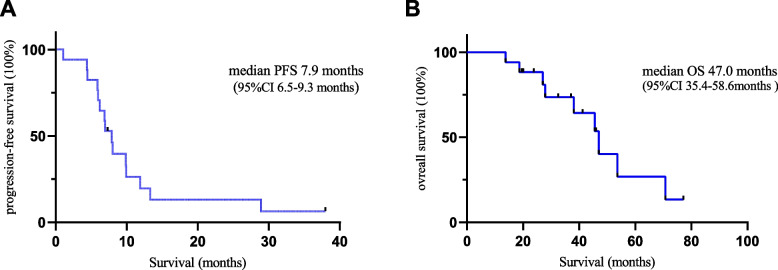
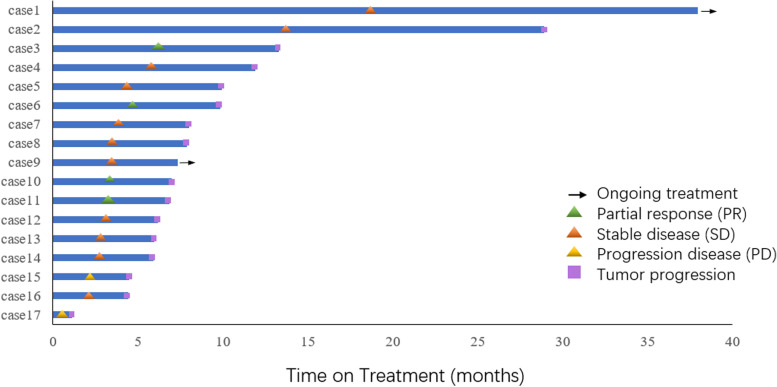
Of the 17 patients enrolled, 13 (76.5%) received apatinib and four (23.5%) anlotinib monotherapy with an objective response rate of 23.5%. Eleven (64.7%) patients had stable disease. The median follow-up period was 46.0 months (95% confidence interval [CI], 33.0-59.0 months). The median progression survival and overall survival were 7.9 months (95% CI, 6.5-9.3) and 47.0 months (95% CI, 35.4-58.6), respectively. In the 13 patients receiving apatinib, the median PFS was 7.0 months (95% CI, 5.0-9.0), compared with 8.0 months (95% CI, 2.7-13.3 months) for patients in the anlotinib group (P = 0.945). The most common grade 3 adverse events (AEs) were hypertension (n = 3, 23.1%), followed by proteinuria and hand-foot syndrome (HFS, n = 2, 15.4%). There were no grade 4 AEs although eight patients (47.1%) required mid-course discontinuation.
For refractory TCs, small molecule antiangiogenic drugs are efficacious as second- or post-line treatments. The toxicity of antiangiogenic therapy is manageable.
抗血管生成药物在治疗晚期胸腺癌(TC)方面显示出初步疗效;然而,相关数据有限。在本研究中,我们提供了与抗血管生成药物治疗 TC 患者疗效相关的真实世界数据。
我们回顾性地收集了 2010 年 1 月至 2021 年 12 月期间在我们机构接受小分子抗血管生成药物治疗的 TC 患者一线化疗后临床进展的数据。根据实体瘤反应评价标准 1.1 版评估肿瘤反应。使用 Kaplan-Meier 法计算无进展生存期和总生存期。
在纳入的 17 名患者中,13 名(76.5%)接受阿帕替尼单药治疗,4 名(23.5%)接受安罗替尼单药治疗,客观缓解率为 23.5%。11 名(64.7%)患者疾病稳定。中位随访时间为 46.0 个月(95%置信区间 [CI],33.0-59.0 个月)。中位无进展生存期和总生存期分别为 7.9 个月(95% CI,6.5-9.3)和 47.0 个月(95% CI,35.4-58.6)。在接受阿帕替尼治疗的 13 名患者中,中位 PFS 为 7.0 个月(95% CI,5.0-9.0),而接受安罗替尼治疗的患者中位 PFS 为 8.0 个月(95% CI,2.7-13.3 个月)(P=0.945)。最常见的 3 级不良事件(AE)是高血压(n=3,23.1%),其次是蛋白尿和手足综合征(HFS,n=2,15.4%)。无 4 级 AE,但 8 名患者(47.1%)需要中途停药。
对于难治性 TC,小分子抗血管生成药物作为二线或后线治疗是有效的。抗血管生成治疗的毒性是可控的。