Department of Rheumatology, University Medical Centre Ljubljana, 1000 Ljubljana, Slovenia.
Faculty of Mathematics, Natural Sciences and Information Technologies, University of Primorska, 6000 Koper, Slovenia.
Int J Mol Sci. 2022 Dec 22;24(1):211. doi: 10.3390/ijms24010211.
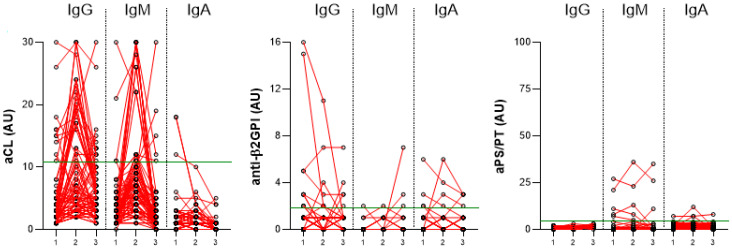
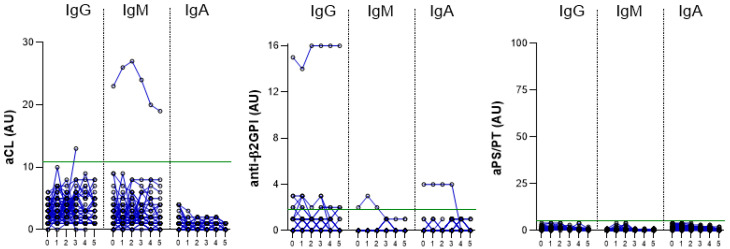
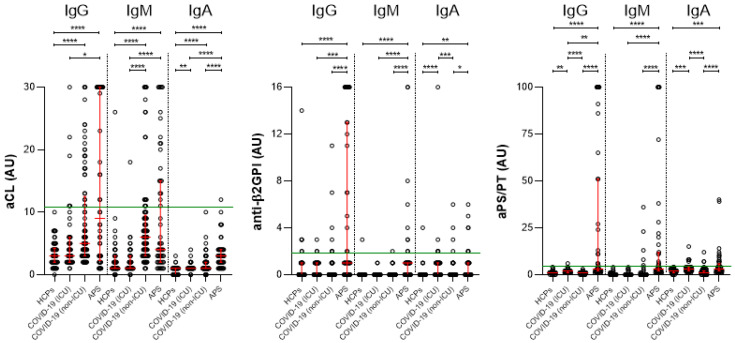
Antiphospholipid antibodies (aPL) comprise a group of autoantibodies that reflect prothrombotic risk in antiphospholipid syndrome (APS) but may also be present in a small proportion of healthy individuals. They are often transiently elevated in infections, including SARS-CoV-2, and may also be associated with vaccine-induced autoimmunity. Therefore, we aimed to investigate the dynamics of aPL in COVID-19 patients and in individuals (healthcare professionals-HCPs) after receiving BNT162b2 vaccine and to compare aPL levels and positivity with those found in APS patients. We measured solid-phase identifiable aPL, including anticardiolipin (aCL), anti-β2 glycoprotein I (anti-β2GPI), and anti-prothrombin/phosphatidylserine (aPS/PT) antibodies in 58 HCPs before and after vaccination (at 3 weeks, 3, 6, and 9 months after the second dose, and 3 weeks after the third booster dose), in 45 COVID-19 patients hospitalized in the ICU, in 89 COVID-19 patients hospitalized in the non-ICU (at admission, at hospital discharge, and at follow-up), and in 52 patients with APS. The most frequently induced aPL in COVID-19 patients (hospitalized in non-ICU) were aCL (50.6% of patients had positive levels at at least one time point), followed by anti-β2GPI (21.3% of patients had positive levels at at least one time point). In 9/89 COVID-19 patients, positive aPL levels persisted for three months. One HCP developed aCL IgG after vaccination but the persistence could not be confirmed, and two HCPs developed persistent anti-β2GPI IgG after vaccination with no increase during a 1-year follow-up period. Solid-phase aPL were detected in 84.6% of APS patients, in 49.4% of COVID-19 patients hospitalized in the non-ICU, in 33.3% of COVID-19 patients hospitalized in the ICU, and in only 17.2% of vaccinated HCPs. aPL levels and multiple positivity were significantly lower in both infected groups and in vaccinated individuals compared with APS patients. In conclusion, BNT162b2 mRNA vaccine may have induced aPL in a few individuals, whereas SARS-CoV-2 infection itself results in a higher percentage of aPL induction, but the levels, persistence, and multiple positivity of aPL do not follow the pattern observed in APS.
抗磷脂抗体 (aPL) 是一组自身抗体,反映抗磷脂综合征 (APS) 中的血栓形成风险,但也可能存在于一小部分健康个体中。它们在感染,包括 SARS-CoV-2 时通常会短暂升高,也可能与疫苗诱导的自身免疫有关。因此,我们旨在研究 COVID-19 患者和接受 BNT162b2 疫苗后的个体(医护人员-HCP)中 aPL 的动态,并将 aPL 水平和阳性率与 APS 患者进行比较。我们在 58 名接种疫苗前和接种后(第二次剂量后 3 周、3、6 和 9 个月,以及第三次加强剂量后 3 周)的 58 名 HCP、45 名 ICU 住院 COVID-19 患者、89 名非 ICU 住院 COVID-19 患者(入院时、出院时和随访时)和 52 名 APS 患者中测量了固相可识别的 aPL,包括抗心磷脂 (aCL)、抗-β2 糖蛋白 I (anti-β2GPI) 和抗凝血酶原/磷脂酰丝氨酸 (aPS/PT) 抗体。在非 ICU 住院的 COVID-19 患者中,最常诱导产生的 aPL 是 aCL(至少在一个时间点上有阳性水平的患者占 50.6%),其次是抗-β2GPI(至少在一个时间点上有阳性水平的患者占 21.3%)。在 89 名 COVID-19 患者中,有 9 名患者的 aPL 水平持续阳性达三个月。1 名 HCP 在接种疫苗后出现 aCL IgG,但无法确认其持续存在,2 名 HCP 在接种疫苗后出现持续的抗-β2GPI IgG,在 1 年的随访期间没有增加。APS 患者中有 84.6%、非 ICU 住院 COVID-19 患者中有 49.4%、ICU 住院 COVID-19 患者中有 33.3%、接种疫苗的 HCP 中仅有 17.2%检测到固相 aPL。与 APS 患者相比,感染组和接种疫苗的个体的 aPL 水平和多重阳性率均显著降低。总之,BNT162b2 mRNA 疫苗可能在少数个体中诱导产生了 aPL,而 SARS-CoV-2 感染本身会导致更高比例的 aPL 诱导,但 aPL 的水平、持续时间和多重阳性率并不遵循 APS 中观察到的模式。