Division of Food, Nutrition and Dietetics, School of Biosciences, Sutton Bonington Campus, University of Nottingham, Loughborough LE12 5RD, Leicestershire, UK.
Fund for the Replacement of Animals in Medical Experiments (FRAME) Laboratory, School of Life Sciences, University of Nottingham, Nottingham NG7 2UH, Nottinghamshire, UK.
Nutrients. 2022 Dec 21;15(1):40. doi: 10.3390/nu15010040.
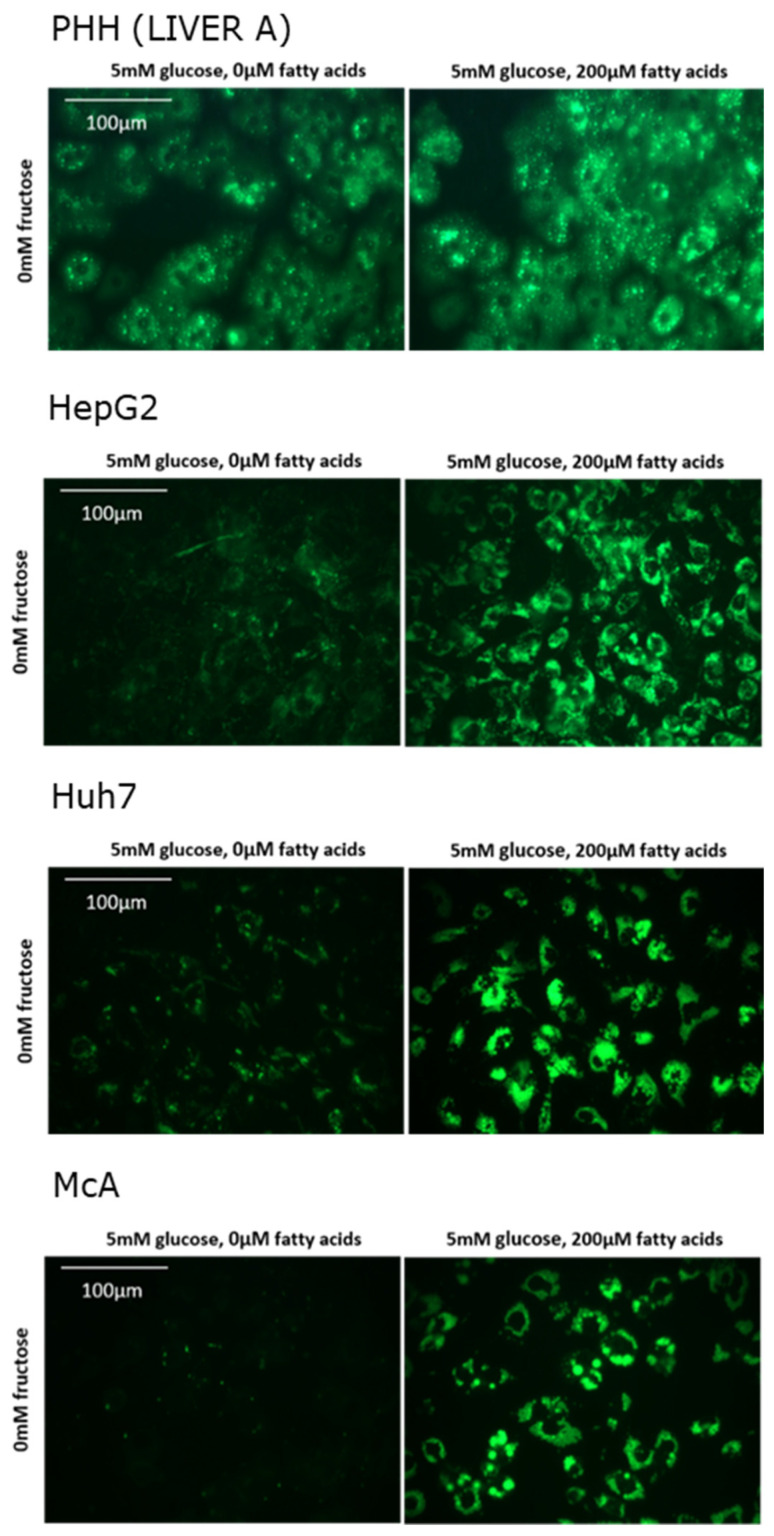
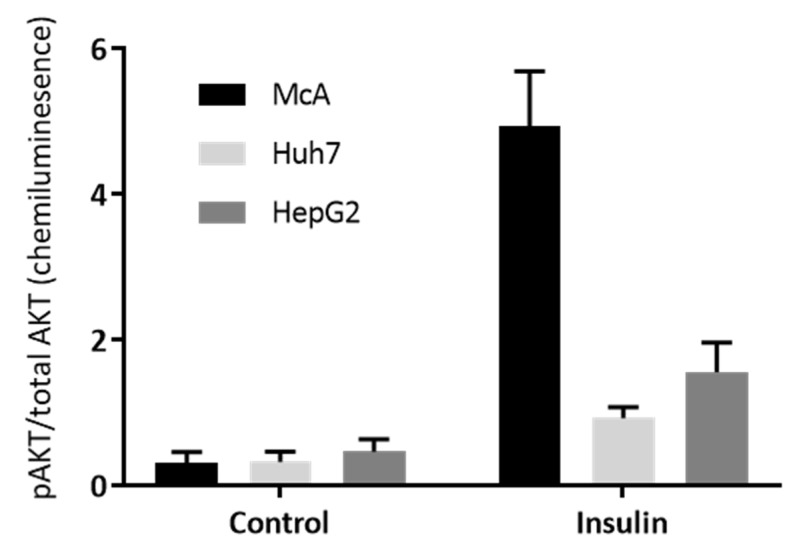
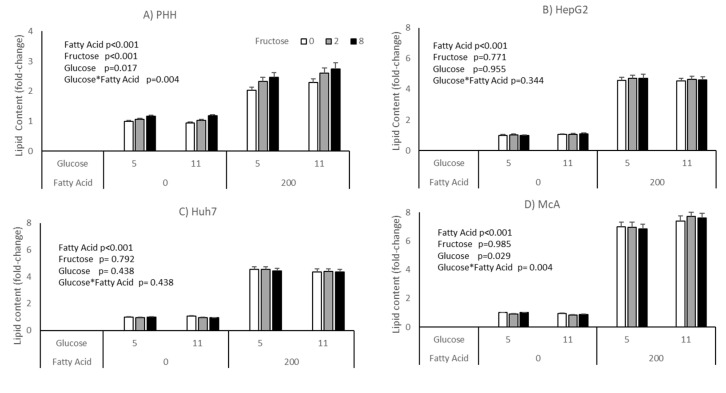
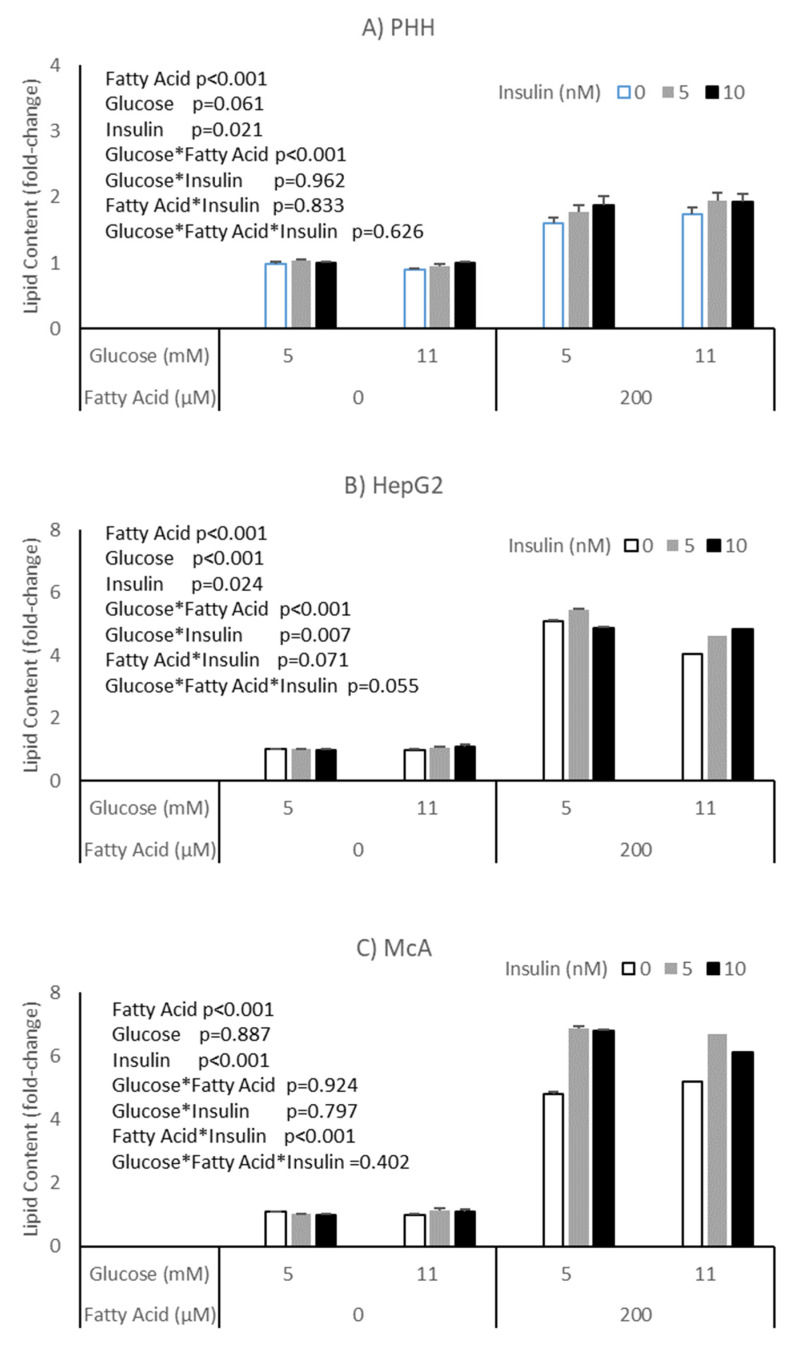
Non-alcoholic fatty liver disease (NAFLD) begins with lipid accumulation within hepatocytes, but the relative contributions of different macronutrients is still unclear. We investigated the impact of fatty acids, glucose and fructose on lipid accumulation in primary human hepatocytes (PHH) and three different cell lines: HepG2 (human hepatoblastoma−derived cell line), Huh7 (human hepatocellular carcinoma cell line) and McA-RH7777 (McA, rat hepatocellular carcinoma cell line). Cells were treated for 48 h with fatty acids (0 or 200 μM), glucose (5 mM or 11 mM) and fructose (0 mM, 2 mM or 8 mM). Lipid accumulation was measured via Nile Red staining. All cell types accumulated lipid in response to fatty acids (p < 0.001). PHH and McA, but not HepG2 or Huh7 cells, accumulated more lipid with 11 mM glucose plus fatty acids (p = 0.004, fatty acid × glucose interaction, for both), but only PHH increased lipid accumulation in response to fructose (p < 0.001). Considerable variation was observed between PHH cells from different individuals. Lipid accumulation in PHH was increased by insulin (p = 0.003) with inter-individual variability. Similarly, insulin increased lipid accumulation in both HepG2 and McA cells, with a bigger response in McA in the presence of fatty acids (p < 0.001 for fatty acid × insulin). McA were more insulin sensitive than either HepG2 or Huh7 cells in terms of AKT phosphorylation (p < 0.001 insulin × cell type interaction). Hence, glucose and fructose can contribute to the accumulation of lipid in PHH with considerable inter-individual variation, but hepatoma cell lines are not good models of PHH.
非酒精性脂肪性肝病 (NAFLD) 始于肝细胞内脂质堆积,但不同宏量营养素的相对贡献仍不清楚。我们研究了脂肪酸、葡萄糖和果糖对原代人肝细胞 (PHH) 和三种不同细胞系(HepG2 [人肝癌衍生细胞系]、Huh7 [人肝癌细胞系]和 McA-RH7777 [McA,大鼠肝癌细胞系])中脂质堆积的影响。细胞用脂肪酸(0 或 200 μM)、葡萄糖(5 mM 或 11 mM)和果糖(0 mM、2 mM 或 8 mM)处理 48 h。通过尼罗红染色测量脂质堆积。所有细胞类型在脂肪酸作用下都堆积了脂质(p < 0.001)。PHH 和 McA,但不是 HepG2 或 Huh7 细胞,在用 11 mM 葡萄糖加脂肪酸处理时堆积了更多的脂质(p = 0.004,脂肪酸×葡萄糖相互作用,两者均),但只有 PHH 对果糖有反应增加了脂质堆积(p < 0.001)。不同个体的 PHH 细胞之间存在相当大的差异。胰岛素(p = 0.003)增加了 PHH 中的脂质堆积,个体间存在差异。同样,胰岛素增加了 HepG2 和 McA 细胞中的脂质堆积,在存在脂肪酸时,McA 的反应更大(脂肪酸×胰岛素,p < 0.001)。在 AKT 磷酸化方面,McA 比 HepG2 或 Huh7 细胞更敏感胰岛素(p < 0.001 胰岛素×细胞类型相互作用)。因此,葡萄糖和果糖可以导致 PHH 中脂质堆积,个体间差异较大,但肝癌细胞系不是 PHH 的良好模型。